

Turin was a haunted city in September. Thousands of people crowded the streets for Terra Madre, Slow Food’s biennial celebration of taste and culture. The organisation itself was created by Carlo Petrini, an appreciation of whom I posted here after his death in May. This was the first major Slow Food event without Carlo, and he was everywhere.
(For those outside the foodie world, Slow Food does what it says on the tin: it’s an attempt to push back on the homogenisation of taste driven by Fast Food.)
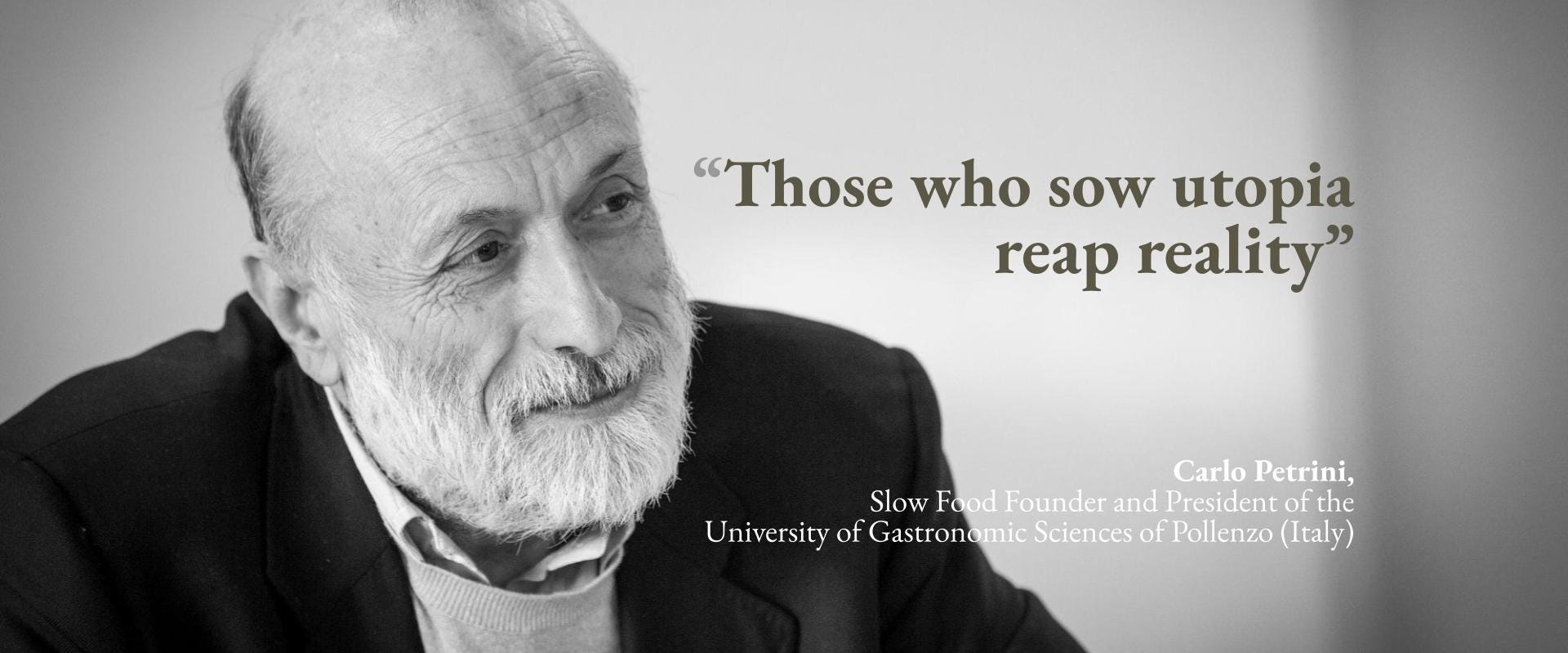
You had to work hard not to see this picture and this slogan. It was on flags, posters, and on rotation on almost every screen. Indeed, it became so much a part of the background that I didn’t really hear anyone talk about it. So, in my session with Jessica Duncan and Edie Mukiibi, I thought I’d have a crack at it.
Chi semina utopia raccoglie realtà / those who sow utopia reap reality. It derives from a proverb that offers a threat: Chi semina vento raccoglie tempesta / whoever sows the wind will reap the whirlwind. Carlo Petrini’s inversion turned it into a promise, and a theory of change. It’s an old and venerable theory.
Oscar Wilde shared it in 1891 in The Soul of Man Under Socialism, when he wrote that a map of the world without Utopia on it was not worth looking at,
“for it leaves out the one country at which Humanity is always landing.And when Humanity lands there, it looks out, and, seeing a better country, sets sail. Progress is the realisation of Utopias.”
The students of 1968 had it on the walls as “Be realistic, demand the impossible.”
This is Carlo’s terrain. He never recanted his critiques of capitalism - at least, I’ve not found evidence that he did. Slow Food keeps those critiques close to heart. It distinguishes itself from basic snobbery around olive oil and red wine by wanting food to be good, clean and fair. Food must be delicious, sustainable, and made with dignified labour. This last stipulation, which depends on workers’ dignity, is where the radicalism is smuggled in.
A world in which workers are able to enjoy the fruits of their labour, in which those who do the work that makes food possible get to enjoy it, that world is not this one. It’s the world to come, the one after capitalism. So when celebrating Carlo, I asked folk whether, like him, they’d call themselves anti-capitalist.
Julian Baggini, the writer whose How the World Eats came out in 2024, was in the room. When I asked everyone to yell out, as praxis, “I’m anti-capitalist”, Baggini remained silent, as he wrote afterwards. The next evening, from the same stage, alongside Eric Schlosser and Elisabetta Recine, he made the case for the other way of changing things. In the argument that followed, we came up against utopia.
Baggini welcomes dreams of a better world. His objection is to abolishing existing arrangements without a viable alternative, “lest what rises from the ruins is worse than the edifice torn down.” Drawing on Amartya Sen, he argues that we can tackle identifiable injustices without first agreeing on a perfectly just society. The failures of attempts to overthrow capitalism reinforce his caution, and he leaned heavily on the Soviet Union (though not, tellingly, China).
We agree that improvements cannot wait for a complete blueprint. We cannot know in advance everything a better world will require: that’s hubris pure and simple. People must be free to disagree, experiment and change their minds. But humility about what we can know needn’t mean shrinking our ambitions or imaginations to whatever the present order will accommodate.
One reform we discussed was Eric Schlosser’s proposal that the industry should pay the costs it now passes to everyone else. I’m for it. The scale of those costs is staggering: a Rockefeller Foundation study published in 2021 estimated that the US food system’s total cost in 2019 was at least $3.2 trillion, roughly three times the $1.1 trillion spent on food.
The disagreement hinges on why those externalities exist. I’ve got a story about how capitalism generates those externalities not as an oversight but as a necessary outcome. Here’s that argument presented as Jason W Moore and I offered it in A History of the World in Seven Cheap Things.
A short introduction to the food system through A History of the World In Seven Cheap Things
It’s not an accident, especially in the food system, that the industry’s revenue is so much smaller than the damage it causes. Capitalism as we recognise it today had its first factories in the fields, its modern territorial characteristics honed in the sugar industry.
If you don’t think that externalities are an intrinsic feature of capitalism — if you think that capitalism can work better and that it’s just a bit of an accident that a range of reports have found that the revenues from the food industry are dwarfed by their social costs — then you’re not required to imagine a radically different future.
If your theory of change doesn’t need the organising infrastructure that leads to a radical future then, like Amartya Sen, your theory of change relies on the goodwill of governments and their capacity to be shamed by the free press to achieve change. The liberal mechanism for social transformation is bourgeois embarrassment.
Social and environmental costs can be tamed with just a marginally better tomorrow, and a couple of restraints on the power of food companies, won politely and patiently. And all it costs to be free from responsibly imagining the future is not having a sound analysis of the present.
Carlo’s anti-capitalism ran deeper. He understood that ownership gives some people the power to decide how other people work, what gets produced and where the proceeds go. I want democracy to reach those decisions too. I just don’t think that letters to the editor are enough. I’m not sure if you’ve met the governments of the United States, India, or any other major democracy which nominally meets Sen’s criteria for a place without famine, but I’m fairly certain that shame isn’t a part of the ruling lexicon. That’s why the organisational infrastructure for change is so vital.
Compromise will come. Our visions will encounter other people’s desires, organised opposition, material limits, shocks, and discoveries that oblige us to think again. But to begin with our aspirations already pruned to what seems immediately negotiable, we make the first concession before being asked.
Once a compromise becomes ordinary, it is easy to forget how unreasonable its demands once sounded, or how much organising made it possible. We risk treating the settlement as the limit of what could ever have been won, and forgetting the dream and the material hustle that helped people win it.
In 1975, Carlo was elected to Bra’s town council for the Partito di Unità Proletaria per il Comunismo, a party to the left of the Communists. As he recalled in an unfinished interview, he found himself the only councillor in opposition: the Communists were supporting the administration under the historic compromise in which they allied themselves with the Christian Democrats.
His political tradition carried its own critique of the Soviet Union. In 1982, the PdUP’s Lucio Magri argued against treating the Soviet crisis as a reason to abandon systemic change in the West. You could give up on Moscow without giving up on the dream.
And you could build things. Carlo and his comrades organised through a cooperative and Radio Bra Onde Rosse, whose broadcasts were repeatedly shut down by the authorities. The station invited unions, neighbourhood groups, feminists, and students to use its microphones. Listeners could call in. Carlo was always about prefiguring the future, even on a radio show. A phone-in was a commitment to popular participation, taking practical shape on the airwaves. People could exercise a little of the power they wanted, and could get used to wielding it, in preparation for greater things.
Carlo carried that ambition into the everyday pleasures of food. He built organisations through which people could give those commitments practical form. In 2017 he told the movement that it could not win on its own, urging alliances with others who shared its fundamental objectives. The scale of the ambition made room for many different kinds of participation.
Indeed, it’s here that I ended up disagreeing with Carlo. Behind a couple of the counters serving artisanal food in Turin were the jagged edges of tattoos I've seen before in unsavoury contexts. When I mentioned this, I was told that I might want to be a a bit more generous to those from other political persuasions who also wanted clean food, food free of glyphosate, or good food that’s traditional even if they steep those demands in the language of blood and soil.
In other words, I ought to embrace all comers, even the fascists who would have me deported. I’m always struck both by those in Europe who encourage me to be open to this sort of big-tent politics are white. The people who saw the fascist turn in food politics coming long ago, aren’t. Don’t get me wrong. You don’t have to be white to be a fascist foodie — there are plenty in India. But some of Carlo’s generosity towards all comers had me wincing, because the fascists would have betrayed the goals for which he fought so hard, for all workers regardless of nation.
Those objectives matter. Enthusiasm for good food tells us little about someone’s commitment to equality. A politics that includes fair treatment for everyone gives us grounds for deciding whom to work with, and where to draw a line. We can make those judgements without possessing a comprehensive design for the future.
We will have compromises enough. To win even the small things, we need people willing to imagine the large ones.
Carlo’s face was everywhere in Turin. The harder task is to keep his ambition alive in what we build, who gets to participate, and how much power we are prepared to share.
Thank you. You clearly explain the different arguments about how we should demand change. Now, as a food scientist, I just need to get my colleagues to recognize that current food systems aren't working.
Especially thank you for your comments about the challenges with welcoming everyone to this tent, even those who would happily shut up and exclude others.