

Carlo Petrini died on the evening of 21 May, at home in Bra, the small Piedmontese town at the heart of Slow Food. He was 76, and he was the reason I joined Slow Food’s advisory board.
(Since I’m on record as observing that Slow Food can look like a “circle jerk of olive oil fanciers and red wine fetishists” you’d be right to wonder whether I’ve decided to fuck it all and join the bourgeoisie, or whether it’s just that I’ve overcome my kink-shaming and decided to oil up. Truth is, it’s too late: I’m already a middle-class university professor, and already deep into obscure alcohol and unguents.)
The reason I serve Slow Food is because it has at its heart a radical maxim: that there’s nothing too good for the working class. Carlo Petrini understood that this included food too, and that the route to democratise pleasure is politics. Always politics. The Italian press celebrated his communist past. The various English language obituaries seem to have obscured that history — looking at you, New York Times *— so here’s a reclamation of the man and the politics which made his life.
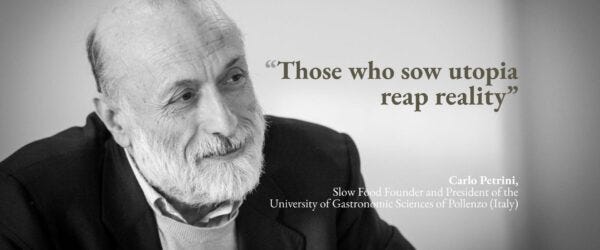
Petrini’s mum was a greengrocer. In Italian, she was an ortolana: a word that I was delighted to discover was connected to ortolans through the same root that gives the English word horticultural. His dad was a communist railwayman. He carried both inheritances. He studied sociology at Trento, a hotbed of the Italian extra-parliamentary left, where he started to be a Maoist. It’s not entirely clear if he ever really stopped.
The group of which he was initially part was called “Avanguardia proletaria maoista” - the proletarian maoist vanguard and, he recalled, it was in this space that urban kids like him came to understand that peasants were not sacks of potatoes but agents of history. I can’t imagine what it was like to have one’s mind changed in the 1970s in febrile discussions with the likes of Primo Levi, but I’m certainly grateful for those transformations. It set him on a road to politics via food and media.
In 1975 he was elected to Bra’s town council as the sole representative of the Partito di Unità Proletaria — a party that, as he himself later put it, sat to the left of the PCI - the Italian Communist Party. That same year, he and a few friends bought a CB set at a market in Livorno and founded Radio Bra Onde Rosse. The pirate radio station opened its broadcasts with the Internationale. He ran a members-only food cooperative, the Spaccio di Unità Popolare, at deliberately political prices. The radio station was seized, again and again, by magistrates enforcing the state broadcasting monopoly, until Dario Fo and Franca Rame arrived in solidarity. (Dario Fo was, of course, a friend of Petrini’s and had designed a poster for the radio station.)
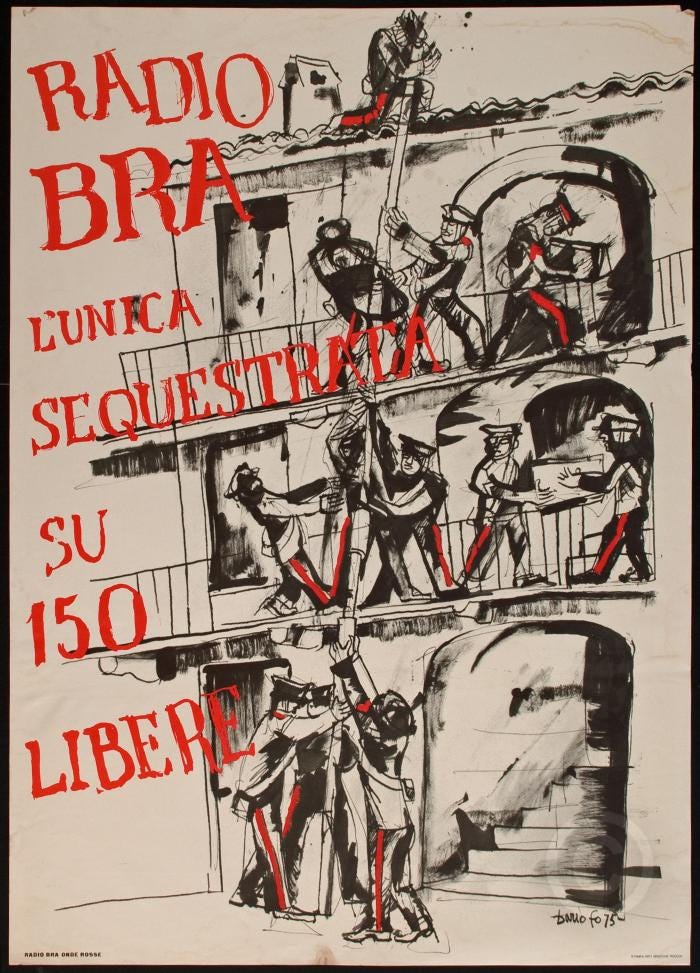
Dario Fo/9CentRo
The argument behind Slow Food, which he built in the late 1980s out of the Arcigola food-and-wine league, was that industrial food is not merely bad food but an instrument of capitalist homogenisation. If that’s true, then the opposite — joy savoured slowly, locally, and in common — could be a form of resistance. He captured this vision elegantly, with this tripartite slogan: food must be “good, clean and fair”. The radicalism lies in the and. If it’s merely delicious, or just pesticide free, it’s not good enough. It has to be grown and made under just conditions of production. Otherwise it devolves into the aforementioned circle-jerk.
That’s why Petrini was joy’s great democrat, not its connoisseur. He insisted, against a century of gastronomic snobbery, that taste belonged to the peasant, the fisher, the Indigenous forager, the line cook, the supermarket bagger, and the migrant herder as fully as to the critic; that biodiversity was a commons and hunger a policy choice; that a Terra Madre of food communities had more to teach than a guidebook’s rosette. He was, as one Italian paper put it, too much of a hedonist to be a hard militant and too political to be a food critic.
He was easy to misread. Friend of King Charles and of Pope Francis, courted by ministries, he could be made to look like the establishment’s pet rebel. But the Italian left’s own obituarists have no difficulty placing him. He was a man of the contestazione — the radical movements contesting the future of the country in the 1960s and 1970s — who had simply found a longer and more pleasurable road to the same destination.
Despite his commitment to Maoism and socialism, Petrini was fond of anarchism too. I never got to ask him specifically about Emma Goldman, but he always channeled her dictum that:
“I did not believe that a Cause which stood for, a beautiful ideal, for anarchism, for release and freedom from conventions and prejudice, should demand the denial of life and joy. I insisted that our Cause could not expect me to became a nun and that the movement should not be turned into a cloister. If it meant that, I did not want it. ”
Carlìn was cut from the same cloth, always impishly joyful, always having so much fun, and always wanting to make sure everyone else was free to do the same. He was infectiously delightful to be around. The photos circulating through the Slow Food website quote him thus: “those who sow utopia reap reality”. It is a fitting epitaph for a man who started with a confiscated transmitter and a members’ grocery, and ended having convinced a good part of the planet that the pleasure of eating well is one that belongs to everyone.
*Correction: A reader notes that the NY Times had two appreciations. One obituary was factually a bit wobbly (and still says Petrini studied philosophy when all the Italian language sources record sociology) and the other by Pete Wells did indeed mention that Carlìn was a communist, but implied that in starting Slow Food, he’d stopped being one. I mention this for the record, though as you’ll see above, I don’t think that reasoning holds. It’s not only possible to continue to be a communist and to believe in the principles of Good, Clean, and Fair, but necessary.)