

In a recent La Via Campesina paper on food system economics, I found the kind of graphic that normally makes my head hurt and my eyes cross.
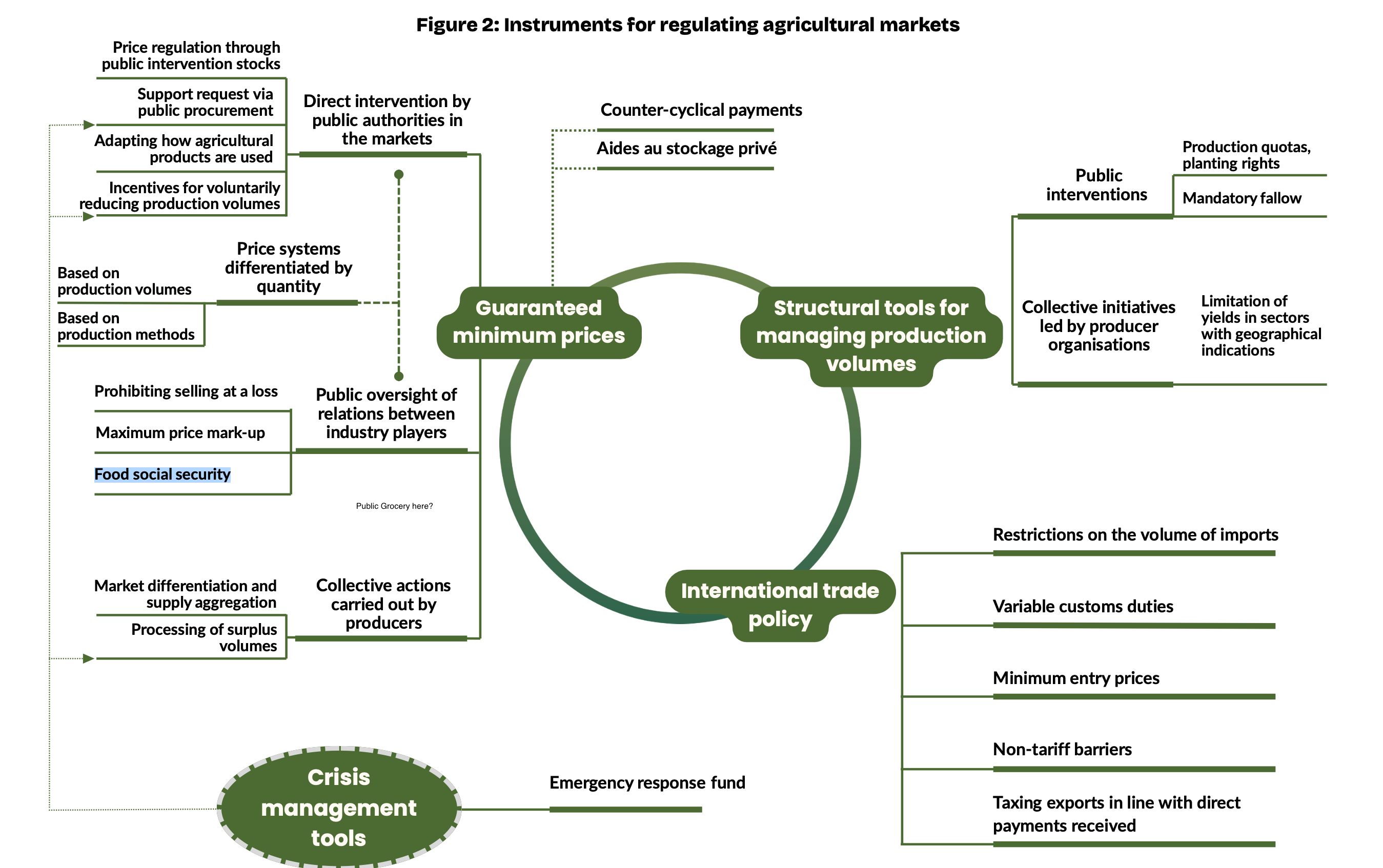
I’ll be going through all of this in greater depth over the summer, and sharing what I make of it all. Let’s start with the tiny bit of blue highlighting: a proposal for ‘food social security.’ It’s not something widely understood in the English-speaking world, so here’s a primer. If you prefer your introductions to come with video and/or academic citations, don’t worry. I’ll post an interview with one of the leading analysts, Gaëtan Vanloqueren, with whom I’m currently writing an academic piece, later this month.
1. What is Food Social Security?
Food Social Security — sécurité sociale de l’alimentation, or SSA — extends the architecture of public health insurance to food. Just as the founding of France’s Sécurité sociale in 1945 turned medical care from a charitable benefit into a universal right, financed by social contributions and governed through democratic funds, food social security would make access to good food the object of the same kind of entitlement.
It rests on three pillars:
Universality. The entitlement is tied to residency, not income. Every adult receives a monthly food allocation — modelled at roughly €100–150 (about C$150–225) — onto something equivalent to a health card. No means test, no application, no queue.
Democratic conventionnement. Local funds — caisses, think of them like properly-democratic food policy councils— staffed by elected citizens, producers, and workers decide which products and which producers are eligible to be purchased with this cash, based on social and ecological criteria the funds themselves set.
Financing by social contribution rather than charity or an annual budget line.
It is, in short, a demand-side institution that also reshapes the supply side — and explicitly not a reform of food aid.
2. Who came up with this idea?
It was proposed by Ingénieurs Sans Frontières–Agrista (ISF-Agrista), a French engineers’ association, which began developing the proposal in 2017, with Mathieu Dalmais a central figure.
The deeper intellectual roots run through the economist Bernard Friot and the Réseau Salariat collective. They understood the post-1945 French Sécurité sociale as a democratic, contribution-funded institution for governing the economy, alongside the idea of a “salaire à vie“ (lifelong wage). ISF-Agrista has said the idea crystallised at a 2015 gathering after members encountered Friot’s and Réseau Salariat’s work.
In November 2019, ISF-Agrista convened organisations at the Bergerie de Villarceaux and formed the Collectif national pour une Sécurité sociale de l’alimentation, now around 14 national member organisations — including Réseau CIVAM, the Confédération paysanne (La Via Campesina France), Réseau Salariat, VRAC and the Atelier Paysan. In Belgium the proposal was taken up by FIAN Belgium and the CréaSSA collective.
3. How does it work?
In practice, the three pillars connect like this.
The allocation. Each resident receives a fixed monthly sum, transferred onto a dedicated debit card. The flagship pilot in Montpellier pays €100/month, and the national proposal is usually pitched around €150.
Conventionnement. Yes, it’s French but I’m struggling to find a good English translation: ‘democratic accreditation’ is the closest and its still clunky. Here’s why: the €100/month allocation does not float in the general consumer economy. It can be redeemed only on products and in outlets that have been conventioned — certified — by a local caisse. The criteria are set by a food parliament (parlement alimentaire): an assembly that is at least half ordinary citizens, deciding on a one-person-one-vote basis what counts as eligible. That can mean agroecological practice, fair producer prices, animal welfare, local sourcing, or fair-trade standards for imports.
Financing. In the mature vision, the system is funded by a social contribution (cotisation) levied on value added and split between employers and employees — sitting outside the annual budget cycle, and looking like a social security contribution line on a payroll. In the pilots running today, financing is more modest (see Q14).
Absent a national infratructure, a Montpellier pilot has members contribute between €1 and €150 a month based on their to income, then everyone — regardless of what they paid in — receives the same €100, issued in a dedicated local currency (the “MonA”) that can be spent only at conventioned outlets.
4. So is it like food aid?
No! It is designed to be the opposite of food aid.
Food aid is charitable, residual and means-tested. It depends heavily on surplus and unsold stock channelled from industrial retail, and it is so stigmatising that, in France, roughly one food-insecure person in two does not use it at all.
Even if people did use it, as the authors of a proposed SSA law put it, food aid “cannot be the sole answer” to food insecurity. Food aid manages hunger - it can’t end it. The structure of tax write-offs around it means aid effectively absorbs overproduction rather than challenging it.
Food social security inverts each of those features. It is a right attached to residency, universal, with no application process and no queue. You qualify simply by living in a place, and nothing else.
5. So is it more like a basic income grant?
Superficially yes, but the philosophers behind food social security would be quite annoyed with you for thinking so.
A basic income is unconditional cash. It floats in the general consumer economy: you can spend it on anything, anywhere. Food social security money is earmarked and conventioned. It can be spent only on democratically approved products from approved producers.
Two differences matter. First, a basic income leaves the food question individualised: it raises a person’s purchasing power and lets the market decide what gets produced and how. Conventionnement makes that a collective decision. Second, and following from this, a basic income gives the consumer more money but gives the food system no new direction; food social security gives the demand side leverage over the supply side.
Put simply: a basic income changes purchasing power. Food social security changes the food system.
6. Ok so it’s more like a French healthcare system payout. What’s that even like?
The French social insurance system is the explicit template, so it’s worth being concrete about how French health coverage functions. Since most of you are in the US, public healthcare may appear magical and strange. Here’s how it works:
French health insurance (Assurance Maladie) has three features that food social security borrows directly:
It is funded by social contributions — payroll-based cotisations and the CSG levy — rather than from general taxation. The money is dedicated; it is not a line item that a finance minister re-decides every year.
It is administered through funds (caisses — the CPAM, caisses primaires d’assurance maladie) rather than run top-down from a central ministry.
It is universal, attached to residency.
The crucial feature, though, is what the French call conventionnement of doctors. A médecin conventionné is a physician who has signed the convention with the Assurance Maladie, agreeing to a set fee schedule; the public insurer then reimburses care delivered by conventioned providers. The public buyer’s power to admit a provider to — or exclude one from — the reimbursement pool is what disciplines the supply side. So, for instance, you can decide you want ivermectin for Covid - it’s just not what a conventioned provider would give you.
Food social security does for food producers exactly what conventionnement does for doctors.
7. How does this help shape the supply chain?
Conventionnement is a lever.
Because the allocation can be redeemed only with producers and outlets meeting the caisse‘s criteria, any producer who wants access to that huge pool of guaranteed, recurring public Euros has a standing incentive to meet the democratically-set conditions.
What this offers farmers is something the open market can’t: stable, long-term, predictable demand at fixed and fair prices. That predictability is the precondition for investing in an agroecological transition. Converting practices is risky when next year’s price is unknown. Because the conventioned market is simply where the secure income is, the transition is driven by an aligned incentive rather than coercion. Nobody is forced to convert; the conventioned channel is just the one worth converting for.
Early evidence from Montpellier is consistent with this: around 80% of products bought through the caisse are organic, and conventioned shops reported turnover rising by 2–7%.
8. Does it work?
The evidence is early, local, and encouraging, but there’s no national-scale trial yet. No country has run a universal food social security system, so the proof of concept exists at city scale and in modelling. Still, three bodies of evidence stand out.
Montpellier (field evidence). The Caisse Alimentaire Commune, evaluated by researchers from INRAE and the Chaire UNESCO Alimentations du Monde, found that quantitative food insecurity among participants fell from 11% to 5% — a halving — over the experimental period, with qualitative food insecurity down by roughly 28%, alongside gains in social participation.
Belgium (modelling evidence). The June 2025 “Factor X” study — economists Frédéric Chomé and Gaëtan Vanloqueren, commissioned by FIAN Belgium — is the most rigorous costed national projection produced to date. It models a 16-year rollout converting more than 850,000 hectares to organic production and cutting associated air pollution by 40%, set against roughly €90 billion a year in hidden food-system costs in Belgium.
Brazil (comparative evidence). The Programa de Aquisição de Alimentos (PAA), the closest large-scale public-procurement cognate, raised the production value of participating family farmers by 13.1%, with the effect strongest for the smallest and lowest-income farms — a peer-reviewed finding using difference-in-differences over 2007–2016.
9. But if this is about restricting what people can buy, how is it different from the draconian SNAP restrictions you say you don’t like?
The difference between SNAP and conventionnement turns on who decides, and over whom they decide.
Through 2025–26, under the “Make America Healthy Again” agenda, the USDA encouraged states to request waivers banning soda, candy and similar items from SNAP purchases; by early 2026 around 22 states had approval. Those restrictions are imposed top-down, by federal and state officials; they fall on the poor only — on benefit recipients, not on anyone else; and they police what recipients may not buy. No SNAP recipient voted on them. They treat poverty as a failure of consumer discipline, and they leave the food system itself entirely untouched.
Food social security’s conventionnement flips this on its head:
It is decided by the eaters and producers themselves, democratically, one person one vote, not by a ministry.
It is universal, not targeted at the poor. Everyone is inside the same scheme.
It works on the supply side rather than disciplining the individual consumer.
It is framed around building a food system, not punishing bad choices.
Both systems involve a constraint on what a given dollar can buy. But SNAP restrictions narrow the options of the poor while the food system carries on as before; food social security widens access to good food by changing what is produced. In one, the constraint is done to people. In the other, it is set by them.
10. Where has it been tried?
France and Belgium.
In France. Roughly 30 to 40 local experiments have emerged since 2019, most of them since 2023. The flagship is the Caisse Alimentaire Commune de Montpellier, created in 2022 and launched in February 2023. Others run in Cadenet (Vaucluse), Saint-Étienne, Dieulefit (Drôme), Paris, Lyon, and Bordeaux and the wider Gironde, with “around forty” experiments.
Belgium. Local caisses include the Ceinture Aliment-Terre liégeoise around Liège and the Caisse Locale d’Alimentation Solidaire in Schaerbeek, Brussels.
11. What have the results been?
Well, you’ve sort of asked this already, but here’s a deeper answer. The richest results come from Montpellier, where the caisse was run as a formal research-action project from 2022 to 2024.
Food insecurity: quantitative food insecurity among participants fell from 11% to 5%; qualitative food insecurity fell by about 28%.
Diet: about 80% of products bought through the caisse were organic and 20% fresh fruit and vegetables.
Producers and retailers: conventioned shops saw turnover rise 2–7%.
Democracy and wellbeing: a citizen committee of roughly 60 people — about half of them experiencing food precarity — governs the scheme; evaluators reported reduced stress, restored commensality (participants again able to invite people to eat, or accept invitations), and greater self-esteem, food knowledge and “pouvoir d’agir”.
Scale: the caisse is growing toward 600-plus beneficiaries, with a stated target of 1,200 households by 2029.
Belgium’s result is a modelling conclusion rather than field evidence: the Factor X study established economic feasibility.
12. Who is pushing it?
France. The bill was carried by the groupe Écologiste et Social — the Greens — with Charles Fournier as lead sponsor and rapporteur, alongside Boris Tavernier and Marie Pochon. It was co-signed across the entire parliamentary left: La France Insoumise (Clémentine Autain, François Ruffin, Loïc Prud’homme, Alexis Corbière, Manon Meunier, Danielle Simonnet), the Parti Socialiste (Stéphane Delautrette, Gérard Leseul, Chantal Jourdan, Christine Pirès Beaune), and the Communist / GDR group. There was no backing from the centre or the right.
Belgium. The push has been Greens-led (Ecolo/Groen) with cross-left support, while the civil-society engine is FIAN Belgium and the CréaSSA collective.
13. How far did attempts go in France and Belgium?
France: further than is sometimes reported. The bill (n°386, submitted 15 October 2024) was adopted in committee — the commission des affaires économiques — on 12 February 2025. It then reached the floor on 20 February 2025, on the Greens’ annual reserved “niche” day. Obstruction by right-wing deputies on the day’s earlier texts pushed the debate to roughly 11:35pm — and Assembly rules end a niche session at midnight. Debate was cut off after about 25 minutes and the bill was never put to a vote. In other words, it cleared committee and then died on the floor for lack of time, not for lack of a majority.
Belgium. The Brussels regional parliament held a hearing on 3 July 2025, and on 6 February 2026 adopted in plenary a Resolution — described as the first of its kind — that explicitly recognises food social security, invites the federal government to launch a feasibility study, and asks the region to make financing easier for local caisses such as Schaerbeek’s.
14. What mechanisms did the French propose to pay for the pilot project?
The pilot financing is not the same as the long-term SSA vision.
The mature SSA model would be financed by a social contribution akin to a payroll tax, like public health insurance, deliberately placed outside the annual budget. The pilot law, Proposition de loi n°386, does not create such a contribution.
Instead, the pilot law proposes tripartite financing:
A national experimentation fund (fonds national d’expérimentation), financed by the State, channelled through a not-for-profit association (governed under the 1901 law on associations) that also vets, monitors and evaluates the local experiments;
Contributions from the local authorities (collectivités territoriales) hosting each experiment;
Members’ own contributions to their local caisse primaire pour l’alimentation — and, crucially, the amount of that contribution is set democratically by each territory’s food parliament, not fixed in the law.
Other features of the law worth flagging:
It is an experiment lasting five years, for up to 30 experiments across at most 20 territories.
Each territory would be governed by an elected food parliament (parlement alimentaire) — at least half citizens, one person one vote — which sets the conventionnement criteria, the eligible products and shops, and the target publics.
A scientific-and-citizen evaluation committee in each territory must report within 36 months on costs, externalities and results.
So: the pilot is paid for by the State, local authorities and participating members together, with some funds coming from an extra tax on tobacco, with the full payroll-cotisation model held back for the future.
15. And what about the Belgians?
Belgium has not legislated a financing mechanism. What it has produced is the most rigorous costed model of what it might look like, and a parliamentary resolution.
16. What’s next?
France. The bill can be re-tabled in a future session. In the meantime the 30–40 local caisses keep running and scaling — Montpellier alone is aiming for 1,200 households by 2029 — and the civil-resistance campaign “Riposte alimentaire” continues to press for generalisation.
Belgium. The live question is whether the federal government takes up the Brussels resolution’s invitation to commission a feasibility study. Local caisses in Liège and Schaerbeek continue regardless.
17. How does this relate to public grocery?
Public grocery and food social security might sound as though they are rival proposals — or interchangeable ones. They are best understood as two halves of the same policy architecture, and each is weaker without the other.
Take public grocery on its own first. Publicly owned or municipally run grocery stores are having a moment: New York City is moving ahead with a pilot network of city-owned stores, with Atlanta, Madison and others are moving in the same direction. As a standalone policy, though, public grocery is exposed on two fronts. It invites the obvious objection — why should the state subsidise retail capacity, of all things? — and it carries the budget-cycle fragility that holds these experiments hostage to political fortune: a public store is only as durable as the next government’s appetite for it.
Food social security resolves both problems by giving public grocery a structural reason to exist. Inside the food social security, the public store is more than simply a public outpost where the private sector couldn’t make any money, and becomes the site in which a universal right is exercised, a place where the food allocation is spent, and where the conventioned supply chain physically terminates.
That changes the answer to “why retail capacity?”: the stores exist, and are sited in low-income neighbourhoods, because that is where the conventioned producer base meets the citizen, and where what is publicly financed stays publicly answerable. In other words, these stores are outposts for democratic engagement. Reframing the stores like this changes the durability problem too. Retail tied to an entitlement funded by a payroll tax contribution is far harder to defund than a discretionary budget line.
It also clarifies what public grocery is not. It is not an attempt to abolish the private sector, or any incumbent. Concentrated retail can keep its doors open; it simply will not be where the allocation is spent, unless it chooses to stock what the caisses have conventioned. Framed this way, public grocery is not a competitor to concentrated retail capital but the public counterweight to it — in exactly the way that public health insurance is not a competitor to private medicine but the institution that disciplines it.
Food social security is the demand-side institution: the right, the money, the democratic conventionnement. Public grocery is the retail body that institution needs in order to touch the ground. On its own, a public store lowers some prices for a while. Inside food social security, it becomes permanent civic infrastructure — and the case for building it stops being “the state should run shops” and becomes “a universal food right needs somewhere to be redeemed.”
18. Any other questions?
Reply to this post and I’ll see if I can find answers!
Great to read such a clear introduction to the topic. I’d add that Switzerland is also experimenting with this approach. In Geneva, the first Swiss ‘caisse’ was launched in 2025, have a look: https://calim-ge.ch/