

Not enough people in the Anglophone world knew about Edgar Morin. Although he wrote sixty books over his 104 years, his most famous legacy appears to be a single word: ‘polycrisis’. He died on May 29th, leaving behind a great deal more.
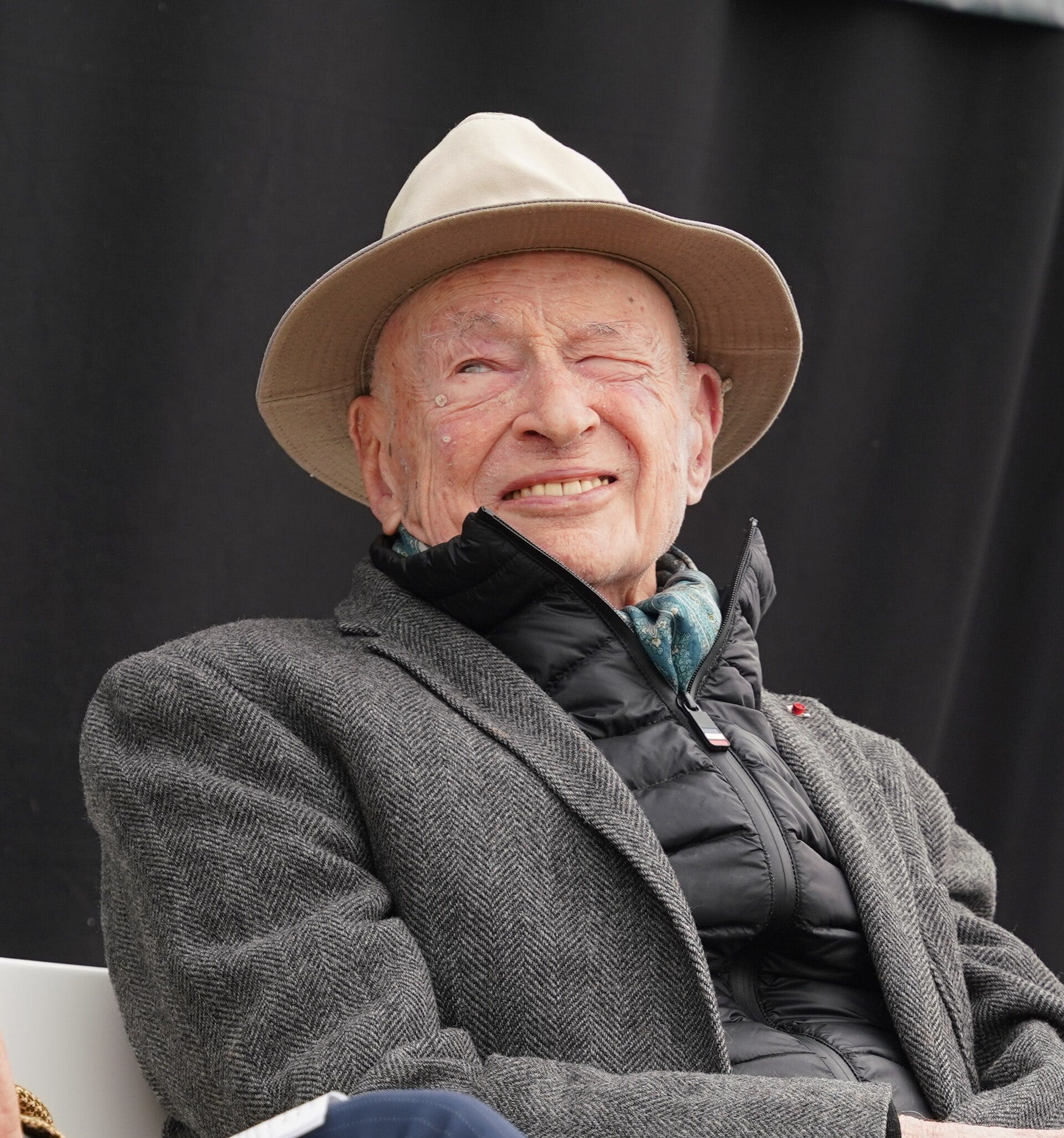
Gérald Garitan/ Wikimedia cc-by-sa 4.0
He was born Edgar Nahoum in 1921, into a family of Sephardic Jews from Salonica, the Ottoman city now called Thessaloniki, who cradled their exile west to Marseille and then to Paris. His mother died when he was ten. He joined the Resistance under the name Morin by accident: introducing himself in Toulouse with a name mangled from Malraux’s La Condition humaine: “Manin”. He was misheard, and he kept the error for the rest of his life, which tells you something about how he felt regarding fixed identities.
He joined the Communist Party in 1941 and was expelled in 1951 for criticising Stalin. He spent the decades afterward refusing to belong to anything cleanly. He called himself a braconnier du savoir, a poacher of knowledge, clipping through the fences between sociology, biology, anthropology, cinema and philosophy, taking what he needed and leaving before the gamekeeper arrived.
After a spring watching students pull up the paving stones of Paris, he arrived at this cliff above the Pacific. This is the Salk Institute at La Jolla, California. He was there in 1969 to study at the invitation of Jonas Salk.
(His first impression of Salk: “I think I’d expected to see this benefactor of humanity, this saviour of children, with a Pastor’s beard. His face surprised me: clean-shaven, small, smiling, courteous, vaguely distant: a party face, like ours…”)
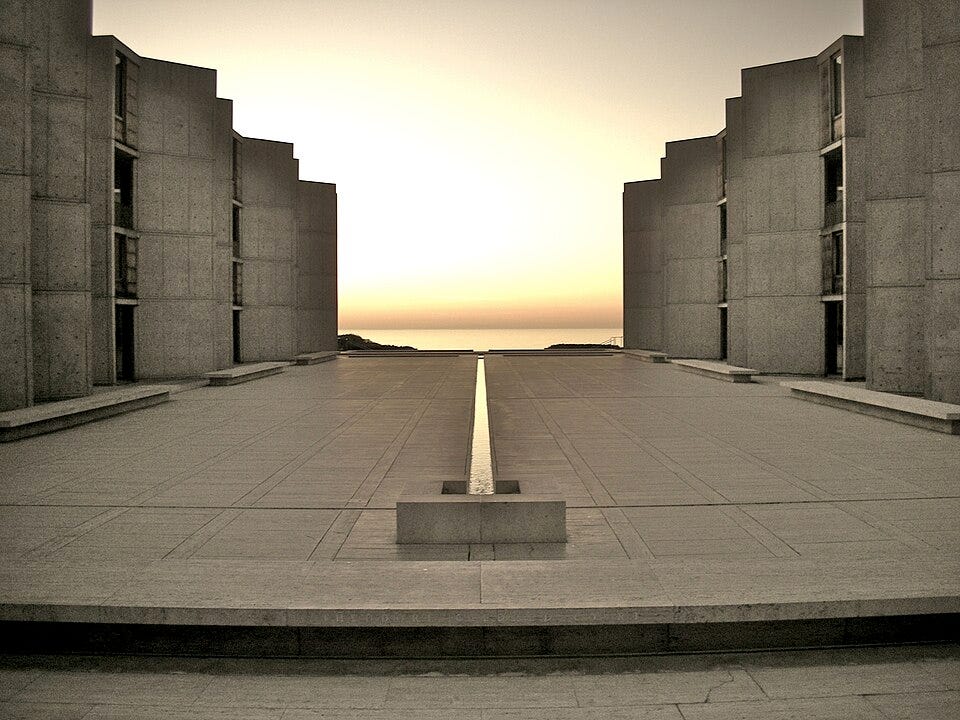
The Salk Institute / TheNose at https://www.flickr.com/photos/31968997@N00/339218853 cc-by-sa-2.0.
Morin did not coin “polycrisis” in California. But the habit of mind the word requires, the refusal to look at any one catastrophe without looking at all the others connected to it, is one that he developed among the biologists and the anti-war protests and gold bugs and Black Panthers in San Diego and Berkeley. Edgar Morin called California a terre en transes, a land in a trance, the questing antenna of spaceship earth. His notes from his time there comprise his Journal de Californie.
His intellectual legacy is La Méthode, six volumes written across nearly thirty years, an attempt to build a way out of thinking a world that appears comprehensible only when pre-sorted into disciplines. The argument is simple: reality is woven (relié, linked) and our schools, our sciences and our governments are organized to cut the threads. We are trained to separate. The planet requires us to connect. “Knowledge,” he wrote, “is navigation in an ocean of uncertainty through archipelagos of certainty.”
Morin distrusted the certainties. He thought they were where the danger lived. He liked to quote Hölderlin: “where the danger lies, there also grows that which saves.” This is less a consolation than a summons to look and find and use. The point of seeing how everything connects was never to be crushed by the totality but to find the one thing unique to the connection that can pull you through.
Which brings us back to ‘polycrisis’.
The word first surfaced in 1993, as a subheading in a small book called Terre-Patrie, written with his co-author Anne-Brigitte Kern and translated, six years later Homeland Earth. The idea was that the crises of the late twentieth century were no longer arriving one at a time, to be managed and filed, but were tangled together, feeding on each other through what they called inter-rétro-actions, circular loops in which each disaster makes the others worse, across timescales that refuse to line up. The whole, they warned, had become heavier than the sum of its parts. Beneath all of it sat what they called the problem of problems: humanity’s powerlessness to become humanity.
After kicking around in the Francophone EU for a little bit, Adam Tooze dragged the term back onto the agenda. By 2023 the World Economic Forum was running it up the flagpole. This is the joke history played on Edgar Morin. A word he had used to describe the failure of compartmentalized, technocratic, elite thinking became, in its second life, a favourite of exactly those elites. It’s a sophisticated ¯\_(ツ)_/¯, a way to say everything is on fire while changing nothing.
Morin had a name for this, borrowed from Rosa Luxemburg. He had spent his life describing the barbarie that hides inside cold, anonymous, bureaucratic competence, the cruelty that arrives as a procedure. (Structural violence is the more recent term.) He would have recognized the conference panel on the polycrisis as one of its purer specimens.
In his last years he pulled, again and again, on Gaza.
Here was a man of 102, then 103, then 104, with more than two hundred thousand followers on Elon Musk’s website, and he used them for one thing above all. Gaza sat at the top of his feed. In February 2024, at a book festival in Marrakech — he had married the Moroccan sociologist Sabah Abouessalam in 2012, and become a Moroccanophile — he spoke as a descendant of Jews expelled from Spain in 1492. He said he was both stunned and disgusted that the heirs of a people persecuted for centuries could colonize another and carry out a carnage.
He called out the silence of the United States, of the Arab states, of the European governments who, as he put it, claim to defend human rights. It was the same anticolonial instinct that, seventy years earlier, had set him against France’s war in Algeria. A few months later he asked, on Musk’s website, whether Netanyahu might be one of the engineers of the new antijudaïsme. He discovered, not for the first time in a life that had included writing the definitive study of an antisemitic rumour (lingerie shops in Orléans were alleged sites of human trafficking - think Pizzagate but with more sex and antisemitisim), how much trouble a Jewish man can buy by refusing to be silent in the approved way.
His last post, at the end of March, didn’t use his own words at all. It was a repost: an interview with Francesca Albanese, the United Nations rapporteur for Palestine, on torture and genocide.
He died in Paris on 29 May at 104. On 3 June the French state gave him a national tribute at Les Invalides, Emmanuel Macron presiding in personcalled him a “planetary humanist, irreducibly French”. It is a strange thing to watch the Republic fold Morin into its flag because for most of his hundred and four years, Edgar Morin was exactly the kind of person the French state deemed an irritant. From the left, Jean-Luc Mélenchon saluted him as an antifascist adding that he had taken his part in the protest against the massacre in Gaza.
This is the tension Edgar Morin leaves. He gave us a word for our era, and then watched the era use the word to avoid the work of addressing that polycrisis. He insisted everything was connected, and the connection he insisted on most loudly at the end is the one his mourners in the Élysée would prefer to leave out of the eulogy.
The threads are all still there. The danger is still growing. Is the thing that saves is growing with it? Morin himself was realistic. In his California Journal he offered:
“the source of the true future revolution… [is] still so feeble, without tools, without radar to detect true and false gospels….Of course, we are at the first wave, the one that will only produce failures, and there will be more failures and more failures, some due to an excess of rigid, dogmatic, doctrinaire communitarianism, others due to laxity and an inability to ensure and uphold a rule. But this is only a historical beginning.”
There’s still such a long way to go.
Thank you for bringing thing this moral giant to my attention. I’ve been enriched by your work Raj, and felt such solidarity reading this tribute.
thank you. May Gaza stay at the top of the woven threads