

In what’s likely to be the last good news for several months, the FAO’s food price index nudged down this month. Good grain harvests in the Black Sea have pushed cereal prices lower, weak Chinese demand helped dairy prices, and low ethanol prices in Brazil helped producers switch to making sugar.
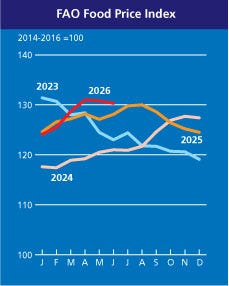
FAO Food Price Index
The relief is unlikely to last. Grocery prices soared after the spike of 2022 and remain roughly 35 per cent above pre-pandemic levels. What shoppers have lived through is not a spike but a ratchet that clicks upward with each shock and never quite clicks back. It’s what Isabella Weber calls seller’s inflation, and the next turn of the ratchet is already in the pipeline.
What the latest UN figures tell us
Five UN agencies have published their annual State of Food Security and Nutrition in the World report. Lest I be accused of accentuating the negative, let me begin with the good news: the new figures describe a better year. Hunger fell for a third consecutive year, reaching 645mn people in 2025.
But 2.7bn people, a third of humanity, still could not afford a healthy diet. And for the first time, Africa is home to more hungry people than any other region: one in five of its population.
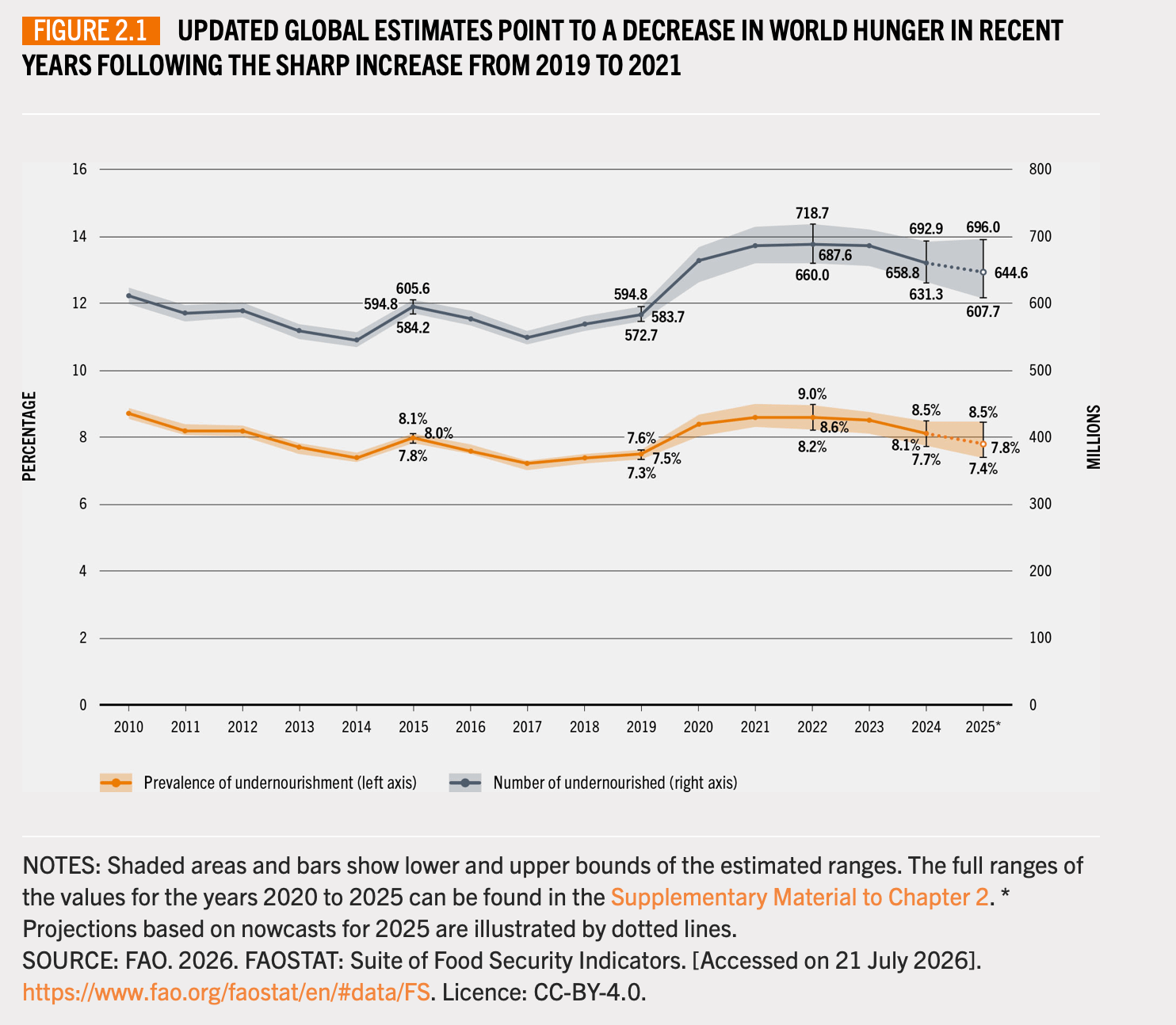
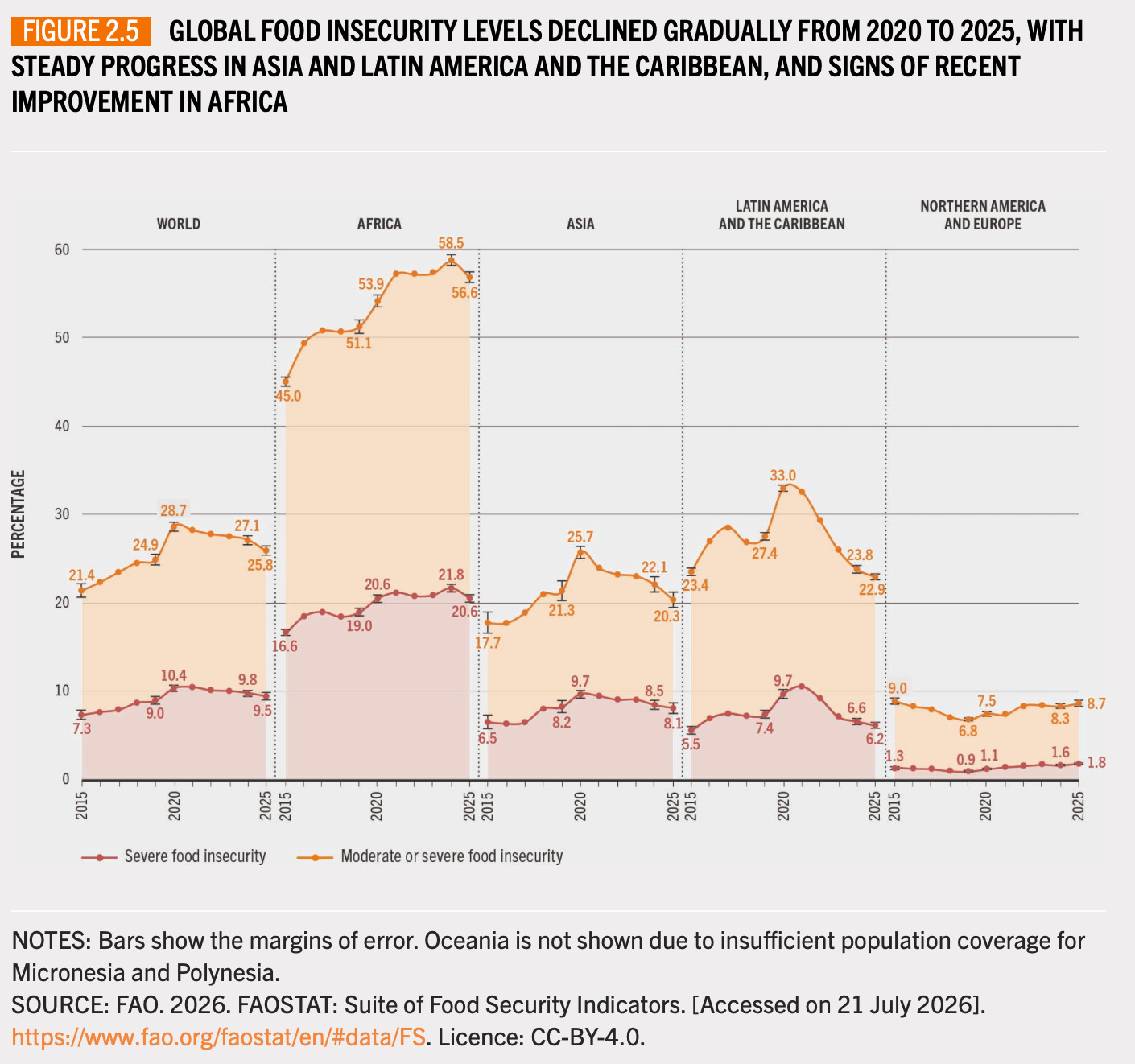
Have a look at when African hunger climbed, and you’ll notice that it coincides with the period when the Gates Foundation was most active with its Alliance for a Green Revolution in Africa. More on that in this Rosa Luxemburg Foundation report.
The headline in the Guardian is that 645 million people are hungry and one in three cannot afford a healthy diet. To be clear: this is a failure of political choices. Healthy food is becoming a luxury for billions, while farmers are paid less and consumers pay more. That’s the result of a food system where a handful of powerful traders, processors and retailers set the prices and pocket the profits. You cannot lower the cost of a healthy diet without asking who profits from an unhealthy one.
The crisis to come
The FAO statistics stop in 2025, before the conflict, the fertiliser shock and El Niño. The report itself warns that this year’s events threaten the progress it records. Official statistics will register the coming crisis only after it has happened.
Three forces are converging.
1. Fertiliser
This year’s conflict in the Middle East choked traffic through the Strait of Hormuz, the corridor for roughly a quarter of the world’s urea exports. By April, the World Bank’s fertiliser price index stood at its highest since October 2022, and urea prices are projected to rise nearly 60 per cent this year.
Fertiliser is natural gas transformed into crop nutrition, which is why a war in energy markets becomes a rise in bread prices. Farmers priced out of fertiliser this planting season will harvest thinner crops next year.
2. Weather
El Niño is here, and it looks like it might be the strongest ever recorded. Past episodes have shrunk Australian wheat harvests, cut sugar production in India and Thailand by a fifth or more, and parched southern Africa. This one is timed to peak just as the fertiliser squeeze reaches the field.
3. Fracturing trade
Tariffs, export restrictions and aid cuts are ripping through the supply chains on which the world’s hungriest people rely. The world’s food import bill hit a record $2.2tn in 2025, with the steepest increases falling on low-income countries least able to pay, deepening debt and dependence at the same time.
When shortages loom, exporters hoard, as dozens did in 2022, and import-dependent countries bid against each other for what remains. Put it together and the squeeze arrives through late 2026 and into 2027, landing first on countries that import their food, and eventually on everyone’s receipts.
The fourth ingredient: margins
There is a fourth ingredient in every food price crisis: margins. Buried in the UN report is a remarkable admission. Between 70 and 75 per cent of what consumers pay for food is added after it leaves the farm, in the midstream of traders, processors, distributors and retailers.
The report cites research on the UK banana trade showing that shocks to world prices barely reach the supermarket shelf because they are absorbed into the margins of intermediaries—what economists call the ‘missing middle’ of the food chain. A handful of trading houses move most of the grain that crosses borders, and in 2022 they booked record profits in the middle of a hunger crisis. Margins that swell during a shock have a curious habit of not shrinking afterwards.
What governments can do now
There are ways to avoid the worst. Transparency and anti-monopoly action in the middle of the chain can clip the margins of traders, processors and supermarkets when prices surge. Aggressive competition windfall measures ready where gouging is found can prevent future infractions and redistribute resources immediately. Public food reserves need to be filled now, while grain is relatively cheap, rather than bought in panic at the top of the market. In the medium term, supply management of the kind Canada practises, alongside the public stocks and regional reserves used in India and West Africa, can provide a buffer. And, of course, there needs to be sustained investment in regional food systems and in farming less hooked on fossil fertiliser, so the next shock finds shorter chains to travel.
A crisis in the pipeline is a crisis that can still be met. Governments have perhaps two seasons. When your groceries cost more next year, the weather and the war will take the blame. Save some of that ire for the business model, and for the governments that had fair warning, today, in writing, from the UN itself.