

At the turn of the millennium, among the few billionaires whose consciences pricked at night, Bill Gates was once king.
Gates offered the possibility of a redemptive capitalism, one in which monopolies like Microsoft might be tolerated because of the wondrous social good their riches might be redeployed to achieve. With the world’s largest endowment, the Bill & Melinda Gates Foundation announced itself as the pre-eminent development philanthropy. While international aid budgets stagnated, the Foundation deployed billions and tasked itself with achieving what the development establishment had failed to do: end hunger in Africa
In 2006, Gates partnered with the Rockefeller Foundation committing $150mn to establish the Alliance for a Green Revolution in Africa. Former UN secretary-general Kofi Annan was recruited as its founding chair, and he announced the grand ambition: AGRA promised to double agricultural productivity and incomes for tens of millions of smallholder households while halving hunger by 2020.
The total cost proved far higher, and the results far worse.
Over two decades, AGRA received well over $1.5bn, most of it from Gates. But foundation spending represents only the downpayment on the model for change based on commercial seed, synthetic fertiliser, and input-intensive production. Estimates suggest that African governments have spent nearly $1bn annually on input subsidies required to push the wider agricultural model AGRA promoted.
Philanthropic grants designed and legitimated a model whose recurring costs were carried by African treasuries. AGRA did not need to create, finance or administer any of this. Instead, it helped build the supply chains, policy architecture, and institutional consensus that made input intensification synonymous with agricultural modernisation. In other words, they created the conditions for only one thinkable way to end hunger: industrial agriculture.
Such expenditure might be defended had the model delivered. Eighteen years of national data suggest that it was a vast waste of money. Fertiliser use across the 13 countries AGRA prioritised more than doubled, and cultivated land expanded by 46 per cent. Yet staple yields grew by only 1.2 per cent annually, slightly below the 1.3 per cent achieved during the 12 years before AGRA.
Meanwhile, the number of chronically undernourished people rose from 94.6mn to 149.6mn, a 58 per cent increase that almost matches the rise across sub-Saharan Africa generally. In other words, AGRA’s focus countries gained no measurable aggregate advantage from the experiment, despite the billions they received compared to their neighbours.
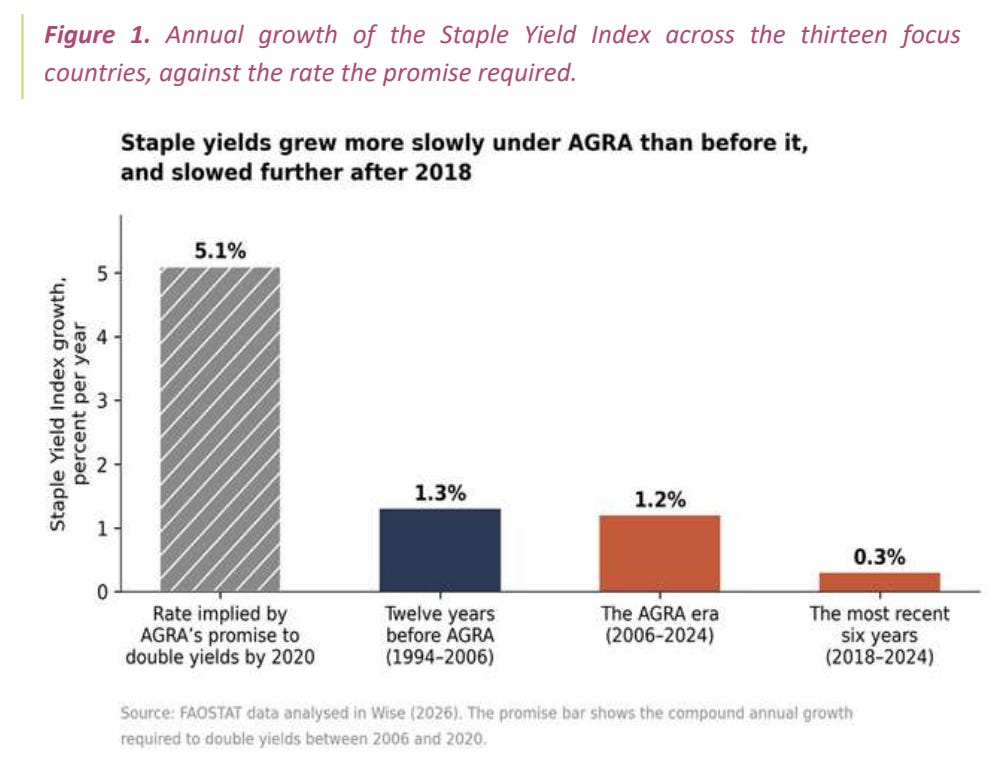
Source: The Green Revolution Has Failed Africa.
AGRA’s experiment came at vast public expense, as Tim Wise and the Alliance for Food Sovereignty in Africa have observed, and as I covered in an interview with Doug Henwood.
By 2022, input subsidies consumed 60 per cent of Malawi’s agricultural budget and between 72 and 75 per cent of Zambia’s. AGRA’s own 2024 policy briefs describe such programmes as a substantial burden on public resources, liable to crowd out research and extension. They document diversion in Malawi and elite capture in Tanzania, while a companion brief warns that corruption, politicisation and unequal distribution are “rampant across Africa’s” subsidy programmes.
It’s in these data that the real power of philanthropy lies. It’s not that Gates is rich, or that his foundation can shovel money into his hobbies. By being a 1000 lb philanthropic gorilla, the Foundation is able to hold government imaginations hostage. By blazing a trail with extravagant seed funding, the Foundation is able to mobilise multiples more from the public purse towards its projects, persuading governments that if it’s good enough for Gates, it’s good enough for them.
So what’s the consequence of failure? AGRA’s own donor-commissioned evaluation found that AGRA succeeded in initiating policy reforms - they were successful in influencing governments. They were, by an ambiguous definition, able to ‘reach’ millions of farmers, despite which they failed to achieve increased incomes and food security.
After that finding, the Gates Foundation doubled down. In 2023 alone, it committed another $105mn, $90mn and $5mn to AGRA.
The reward for failure was recapitalisation.
The Foundation also learned another lesson. As the consultants pointed out, AGRA’s greatest success lay in cultivating new institutional mechanisms for melding governments and philanthropy to goose up private sector expansion of fertiliser sales.
So it should come as no surprise that philanthropists and international development institutions are knitting themselves more closely together to do it again.
Last month at the October 2026 World Bank and IMF meetings in Bangkok, the Bank launched its inaugural Philanthropy Forum and a new Philanthropy Hub, described as “a single-entry point to the World Bank Group”. Its advisory group comprises eight foundation or philanthropic-network executives and one World Bank strategy director. There’s no representative of a borrowing government, farmer organisation, trade union or grassroots movement on the board.
The Bank’s language presents the goal baldly. Philanthropic partners will “help shape priorities and solutions from the outset”. Codifying the Gates model, philanthropy will take early risks and prepare ideas while governments and development institutions won’t have to worry their pretty little heads about what to do, and merely occupy themselves with the recurrent-cost financing and execution bits of the philanthropic agenda.
In other words, rather than faff about with influencing individual governments, foundations can combine with the proven power of an international development bank, and shape policy at its source.
AGRA shows why that invitation should be cause for alarm. Proximity to power is a fine way to insulate the authors of an experiment from the results of their actions.
Here, philanthropy is the unaccountable in pursuit of the untenable, without consequence or shame.
I made this argument recently in the Financial Times.
When the opinion desk at the paper urged me to seek comment before publication, the Gates Foundation didn’t reply. After the piece came out, Enock Chikava, the foundation’s director of economic opportunity in Africa, formerly of Bunge, Cargill and Monsanto, offered a more substantial response on LinkedIn.
Chikava acknowledged that AGRA’s goals “were not met” and wrote that, as a longtime funder, Gates shared responsibility. He said the foundation continued investing because AGRA’s revised strategy was more closely aligned with government priorities and placed greater emphasis on finance and markets (see above).
Chikava has also argued that AGRA represents just 1 per cent of agricultural financial flows in the countries where it works, so shouldn’t be held responsible for the project’s failure.
That government priorities are shaped by Gates remains an unacknowledged point. More significantly, one per cent financing is precisely the Foundation’s business model. Gates spent the private one per cent strategically enough to steer the remaining ninety-nine. And it still leaves the essential question unanswered: what consequence follows AGRA’s failure?
Chikava has invite public discussion. Good. Let’s do that in public. It should begin not with another LinkedIn post, but with a public audit. Release AGRA’s monitoring data. Commission an independent accounting of the public expenditure involved and the alternatives it displaced. Give farmers and civil society power over what happens next.
Some are asking for something more substantive than transparency. Francesca de Gasparis, executive director of the Southern African Faith Communities’ Environment Institute, puts the case plainly: “AGRA promised to halve hunger. Instead, 55 million more people in AGRA’s focus countries are going hungry today than when it began.” A campaign supported by 625 faith leaders and 360 organisations is demanding reparations for the social and ecological damage they attribute to the programme.
Repair must involve democratisation as well as redirected money: open data, independent evaluation, public accounting, investment in public extension, farmer-managed seed, a decision-making role for the people who bore the risks, and consequences for those who put them in that position.
Markets discipline firms that misallocate capital. Voters can remove governments that fail. Foundations can survive without fear or sanction. No senior figure has publicly lost their job because AGRA’s promise was missed.
Philanthropy is the last refuge of the anti-democrat who would still like to sleep at night. It is private power renamed public virtue. Open the books, make reparations and return public decisions to the public. If Gates wants the moral high ground, he should pay its rent.