

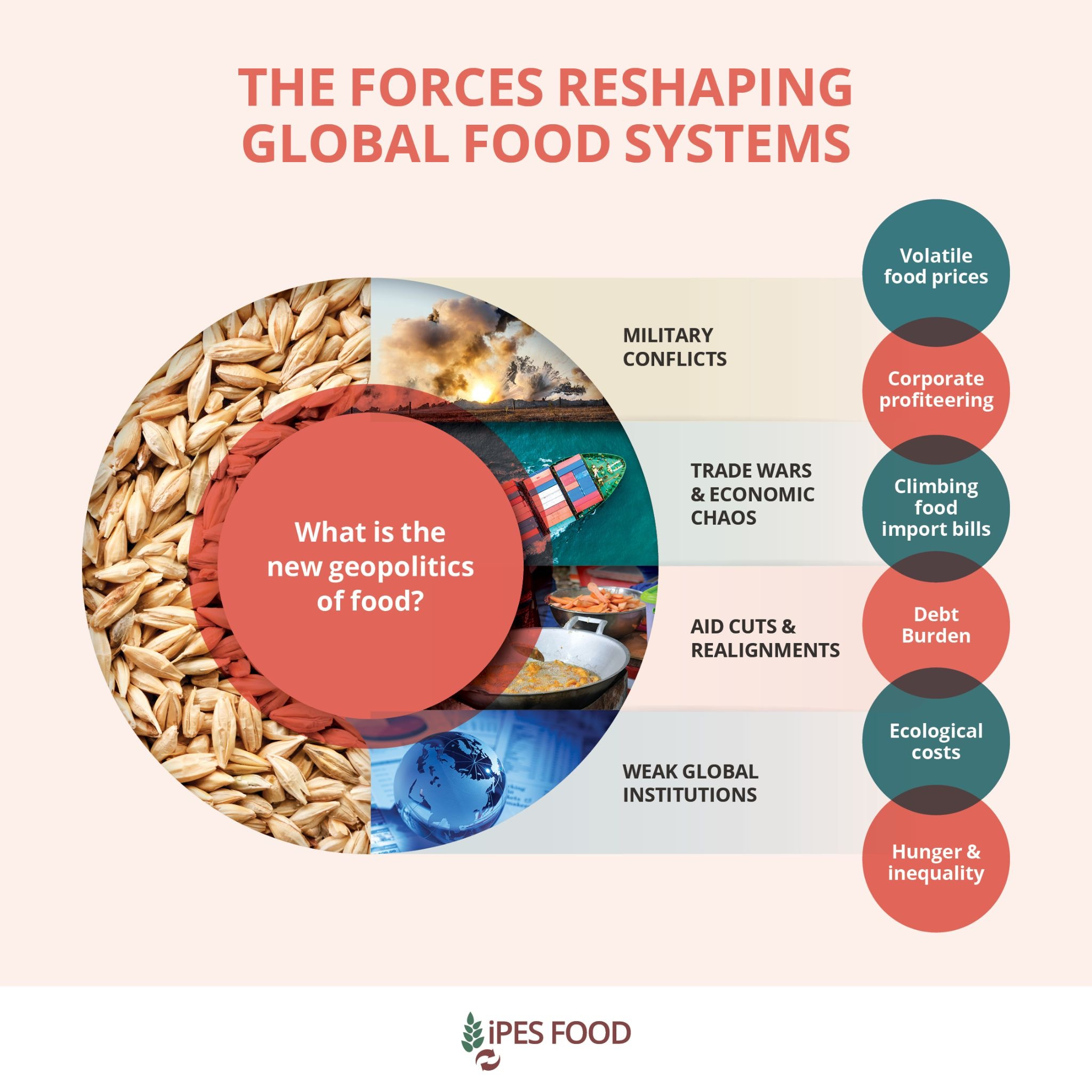
Sure, cereal stocks are robust at the moment — Argentina had a good year — and underlying commodity prices aren’t soaring. Yet food price inflation is already creeping up not because of what is in the granaries today, but because of what is to come tomorrow. Trade wars, military conflict, aid cuts, climate shocks (hola, El Niño), and the weakening of global institutions have all converged on a food system that’s structurally dependent on long supply chains and global markets. Food prices remain 35% above 2019 levels. Low-income countries pay the heaviest costs. The global food import bill hit $2.2 trillion last year. There are calmer voices, but they’re the ones fixed on stocks and prices, and not on the shortage of plastic raffia bags to transport rice in Asia.
The International Panel of Experts on Sustainable Food Systems, of which I’m a member, launched a report last week. The New Geopolitics of Food shows how the food system is “caught in the crossfire of a new geopolitical era.” The word “new” is doing a great deal of work, and I want to wrestle with it. Not because the report is wrong — it isn’t, and you should read it — but because the timeline matters for the future.
The current “new” geopolitics of food began in 2008. The September 2008 that most people remember is when Lehman collapsed and the financial system caught fire. The other 2008 happened in the northern hemisphere’s spring, when rice prices doubled, wheat tripled, and food riots broke out in more than thirty countries — from Haiti to Egypt to Bangladesh.
Yet 2008 didn’t happen by magic. The Great Recession was the cumulative product of three decades of agricultural trade liberalisation, structural adjustment in the Global South, and the financialisation of commodity markets. The IMF and World Bank had spent the 1980s and 1990s dismantling the very market management tools which our IPES report now argues we need to rebuild. By 2008, the system was extraordinarily efficient at distributing food across borders and therefore extraordinarily fragile when those borders flickered.
When the financial crisis hit, the world learned that the food crisis and the financial crisis weren’t separate. Speculative capital that had been blowing bubbles in housing and credit derivatives was also inflating commodity futures. Index funds found food and amplified the price spikes. The same deregulated finance that turned a mortgage in Phoenix into a tradeable asset turned a bushel of rice in Vietnam into one too. When the housing bubble popped, speculative money sloshed harder into food, and prices spiked again in 2010–11. The Arab Spring partly grew from that wave.
What was the response? In the rich countries, central banks rescued the banks, expanded their balance sheets, and waited. The deeper structural questions — about commodity speculation, corporate concentration, food system fragility, the abandonment of public reserves — went unanswered. Some technocratic patches were proposed at the G20 and the FAO. None of them seriously challenged the model. The system was stabilised, and beneath the wound, the real world festered.
That rot is what we are now watching reach its terminal stage, because every dynamic the IPES report deems new is perhaps better understood as unresolved business from 2008.
The mega-mergers in seeds and agrochemicals — Bayer–Monsanto, Dow–DuPont, ChemChina–Syngenta — were a direct consequence of the Great Recession freeing up the capital and the regulatory permission for further consolidation.
The grocery profiteering Kroger admitted to during the 2021–22 inflation, raising the price of milk and eggs beyond their own cost increases? That was only possible in markets so concentrated that competition no longer disciplines them — concentration that accelerated after 2008.
The over-indebtedness of net food-importing developing countries? That is the debt regime built in the 1980s, then deepened by post-2008 dollar dynamics, now squeezing governments who must choose between feeding people and paying creditors.
Trump’s tariffs, Putin’s grain blockades, India’s stockpiling fights at the WTO, all of these are best interpreted as symptoms of a longer malaise; they are instances of weather in a climate that — as we’ve said in the past at IPES — is tuned to generating perfect storms.
This is why our report’s framing of “resilient self-reliance” is the right one but needs careful reading. Self-reliance is neither autarky nor isolationism nor the politics of the border wall. It is the rebuilding of public infrastructure — public stocks, supply management, agroecological investment, cooperative regional trade — that neoliberalism dismantled. India’s public distribution system, ECOWAS’ regional food security reserve, Canada’s dairy supply management, and Norway’s cooperative milk system are not new inventions. They are the survivors of an older social contract, the clauses of which survived the shredder of neoliberalism.
The danger now is that two very different politics of “self-reliance” are emerging. One is reactionary: the tariff wall, the deportation, the food-as-weapon, the contempt for international cooperation, the consolidation of corporate power behind a flag. This version is currently the noisier one, and it wears the costume of looking after ordinary people while it transfers more wealth upwards. The other is what the IPES report sketches: solidaristic, equitable, ecologically grounded, internationalist in the cooperative sense — fair partnerships rather than dependency. The term you might know for this is food sovereignty.
The reactionary version is what you get when the political fact of the wound — that the global free-market consensus has broken — is recognised, but the structural causes of it are deflected onto migrants and foreigners rather than capital concentration and financialisation. The liberatory version is what you get when you actually do the structural analysis, and have democratic politics to deliver on change. The reactionary version can be performed quickly with very little cost to the people who own the system. The liberatory version requires building things — institutions, infrastructure, regional cooperation, public capacity — and politically that’s slow work.
Which is why permanent vigilance, as ever, is the only honest position. Public food stockholding in India has fed something like a billion people; it has also failed to end Indian hunger. Canada’s dairy supply management has kept family farms alive; it has also enriched a relatively small group of quota-holding farmers. Norway’s cooperative model preserves small farms and rural communities; it also leans on import protection that can shade towards the exclusionary. None of these tools is automatically progressive. They are tools. They become liberatory only when they are accompanied by the politics that drove them at their best: a politics that takes seriously the rights of peasants, fisherfolk, pastoralists, workers, and people who eat — which is to say, everyone.
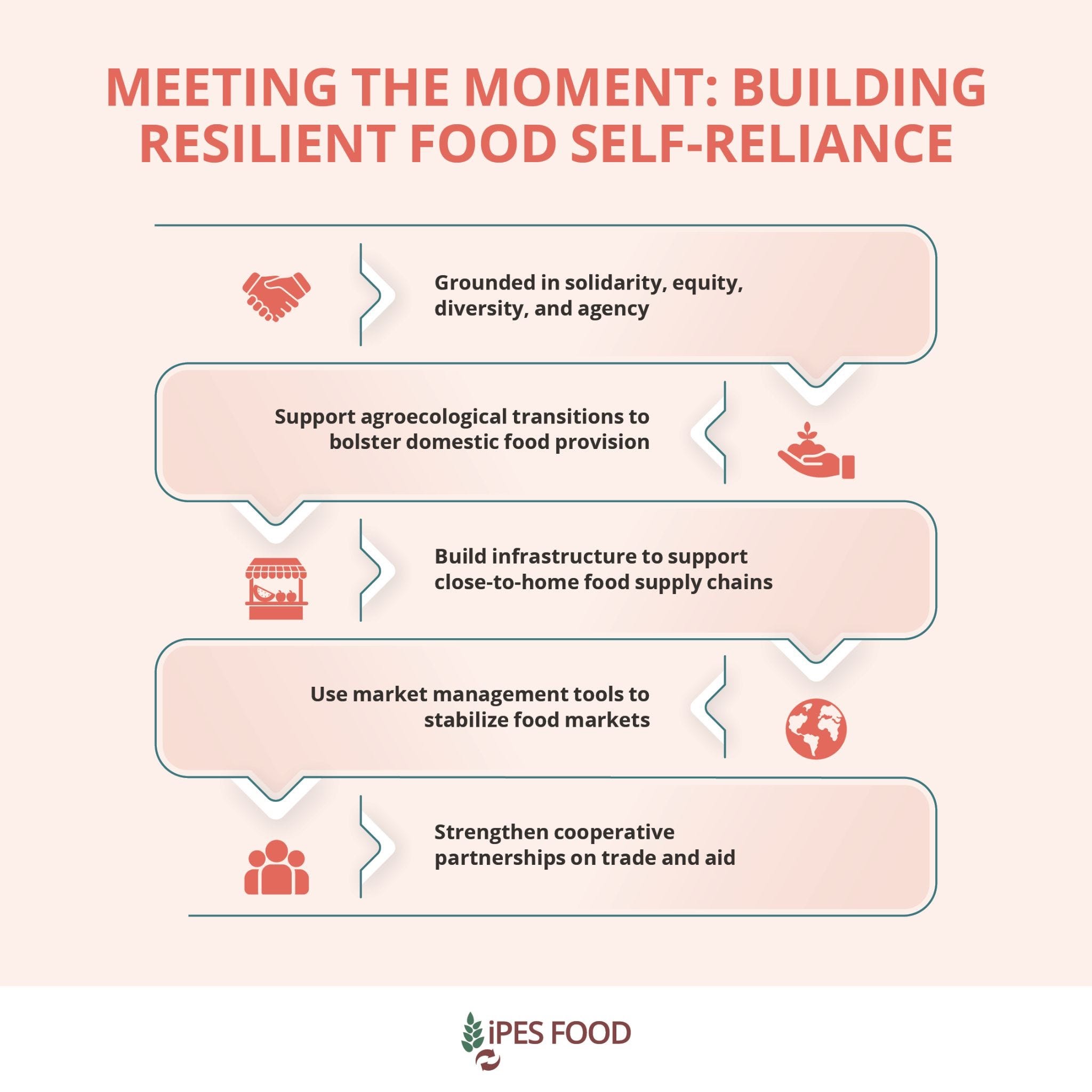
What 2008 actually broke was the credibility of leaving food to the market. We are still living with the consequences of having declined to admit it. The IPES report points to the institutions we need. The question now is who gets to build what comes next. The reactionaries are already laying the foundations of their version.
Gratitude to IPES Food! Such clarity and so important. And thanks to you, Raj for distributing.