

In 1802, a young Quaker named Luke Howard stood up at the Askesian scientific society in London and gave the clouds their names. Cirrus, cumulus, stratus, and the compounds that ran between them. Before Howard, clouds were a byword for vagueness. After Howard, they had a strict taxonomy.
Goethe was so moved that he wrote Howards Ehrengedächtnis (In Honour of Howard) a cycle of poems marvelling that a man had pinned the clouds like butterflies, that he “Bestimmt das Unbestimmte, schränkt es ein” (defines the indefinite, limits it). Naming the unnameable felt, in that imperial age, a conquest worth celebrating.
It took the better part of a century to finish the job. In 1896, following a recommendation of the International Meteorological Conference at Munich, the first International Cloud Atlas appeared: it had twenty-eight coloured plates, with definitions in French, German, and English, instructions for observers, and a single governing ambition: to make cloud observations “internationally comparable.”
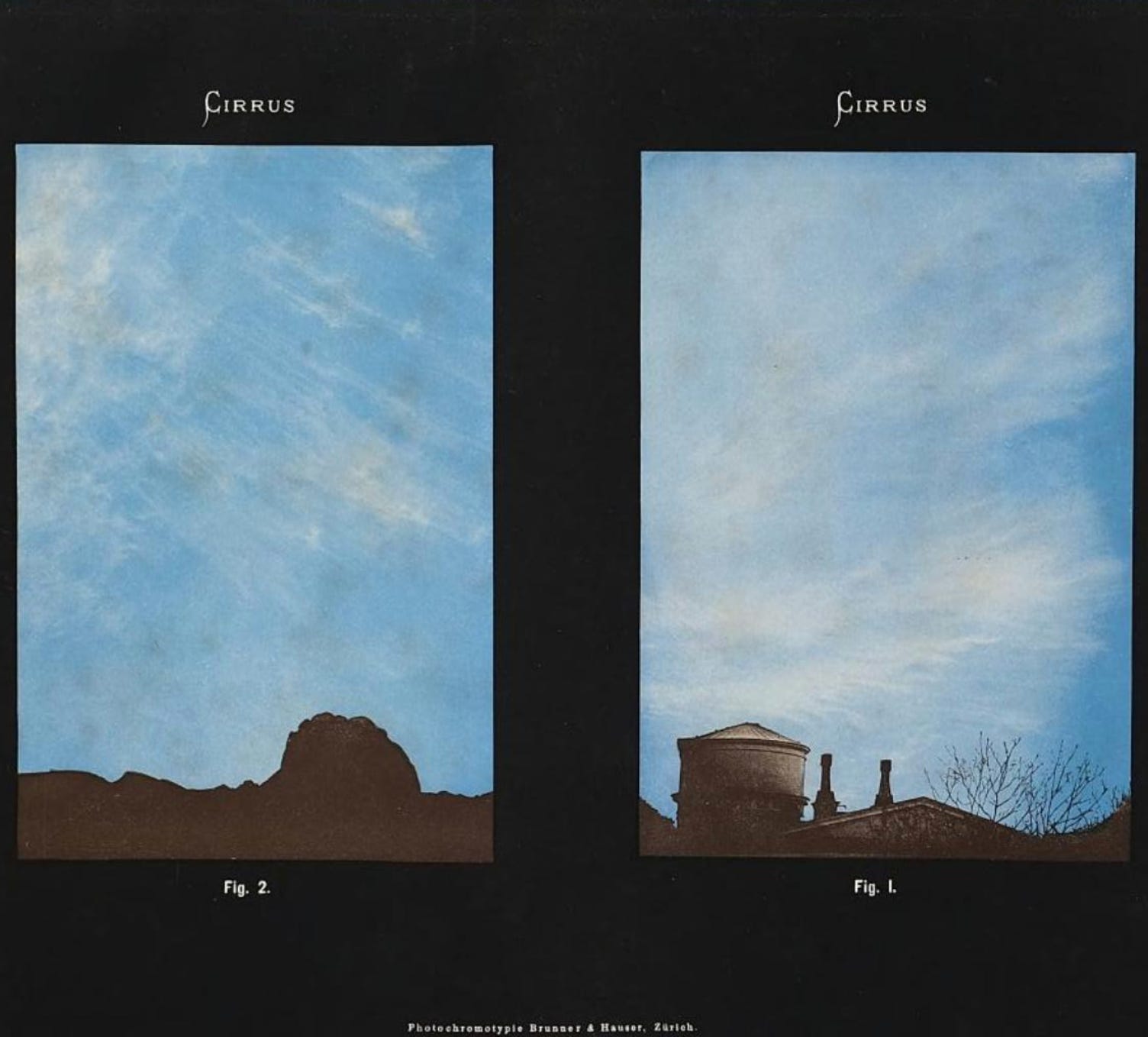
Plate from 1896 International Cloud Atlas/Google Books
It was an immediate de facto standard and has remained in print, revised by treaty, for almost a hundred and thirty years. Today it carries legal status under the World Meteorological Organization’s Technical Regulations. There is a correct way to see a cloud, and it is binding on member states.
Like any taxonomy, the cloud atlas is an accounting tool. It makes clouds commensurable, sorting the formless into ten genera so that a cumulonimbus over Uppsala and a cumulonimbus over the Grand Canyon can be entered in the same ledger, compared, predicted, and governed. An atlas is an instrument for rendering the world legible to management.
The Cloud Atlas Sextet
David Mitchell’s 2004 Cloud Atlas is a set of six stories nested inside one another like Russian dolls. A notary on a Pacific crossing in the 1850s, a broke composer in Belgium in 1931, an investigative journalist in 1970s California, a publisher, a clone in a future Korea, a goatherd after the fall are each interrupted at their midpoint and then the stories resumed in reverse. A comet-shaped birthmark recurs on a shoulder in every age, hinting that these are the same soul, or the same struggle, wearing different costumes through time. The other connection is that the weak are meat, the strong eat.
The slaver, the poisoner, the energy corporation covering up a reactor’s flaws, the corporate state that grows its servants in vats and recycles them are the same appetite in successive technologies. The composer of the middle story, Robert Frobisher, writes a piece he calls the Cloud Atlas Sextet: six overlapping soloists, each taking up and breaking off the others’ lines, a form that is also its content. Our lives are not our own: we are bound to others, by each crime and every kindness.
It is a sentimental book about an unsentimental fact, that power finds new ways to sate an old hunger. Which brings me to the third atlas, the one we have learned to call the cloud.
The Magnificent Seven in the Cloud
I learned about The Institute for Technology in the Public Interest — TITiPI, a transnational gathering of artists, engineers, and theorists — from Saskia Colombant last week. (This newsletter began with a set of questions she and I discussed on a sidebar conversation at an IPES-Food meeting.) Saskia has been following TITiPI’s work on ‘the cloud’, about the servers and mining operations and legislative chicanery and finance and theft which constitutes the infrastructure behind the Magnificent Seven tech giants– Alphabet (Google), Tesla, Microsoft, Nvidia, Apple, Meta and Amazon, and more recently the AI leviathans. TITiPI offer an analysis that doubles down on the idea of cloud accounting and infrastructure. Their advice:
Stop calling the cloud an infrastructure and start calling it a regime.
“Infrastructure” invites you to think of plumbing: neutral pipes that carry whatever you pour through them. A regime is a political economy with a direction of travel and relations of power. The cloud is a software paradigm of continuously updated services, rented rather than owned, and fused to a model of accumulation that runs on the grabbing of land for data centres, the extraction of energy and water to cool them, the mining of minerals to build them, and the harvesting of data and racialised labour to feed them.
It has become the dominant way to deliver computation across finance, health, logistics, government, and agriculture. I’ve overheard several conversations recently in which at least one person can’t imagine living without its services. That feeling is not an accident of the technology. It is the regime’s central achievement.
What the technological cloud does is what Luke Howard did to the sky and the 1896 atlas did to the planet’s weather: it takes things that resisted counting and renders them legible and comparable. The 1896 atlas standardised clouds so that empires could predict their weather. The modern cloud commensurates us.
At the dawn of the first cloud atlas, capitalism’s great project was to pry a lucrative corner from the web of life: to isolate, name, and then conquer ‘nature’. Under today’s cloud regime, the taxonomies that matter most are the ones that map human action within the web of life. Clouds are a tool of commensuration as conquest, scaled to the whole of life.
Head in the cloud
In February of this year, IPES-Food published a report called Head In The Cloud about what happens when Big Tech and Big Ag join forces to digitise farming: when Amazon, Microsoft, Google, and Alibaba sit down with the agribusiness giants and propose to run agriculture through artificial intelligence, precision platforms, and proprietary algorithms, all of it sold under the banner of climate resilience and productivity.
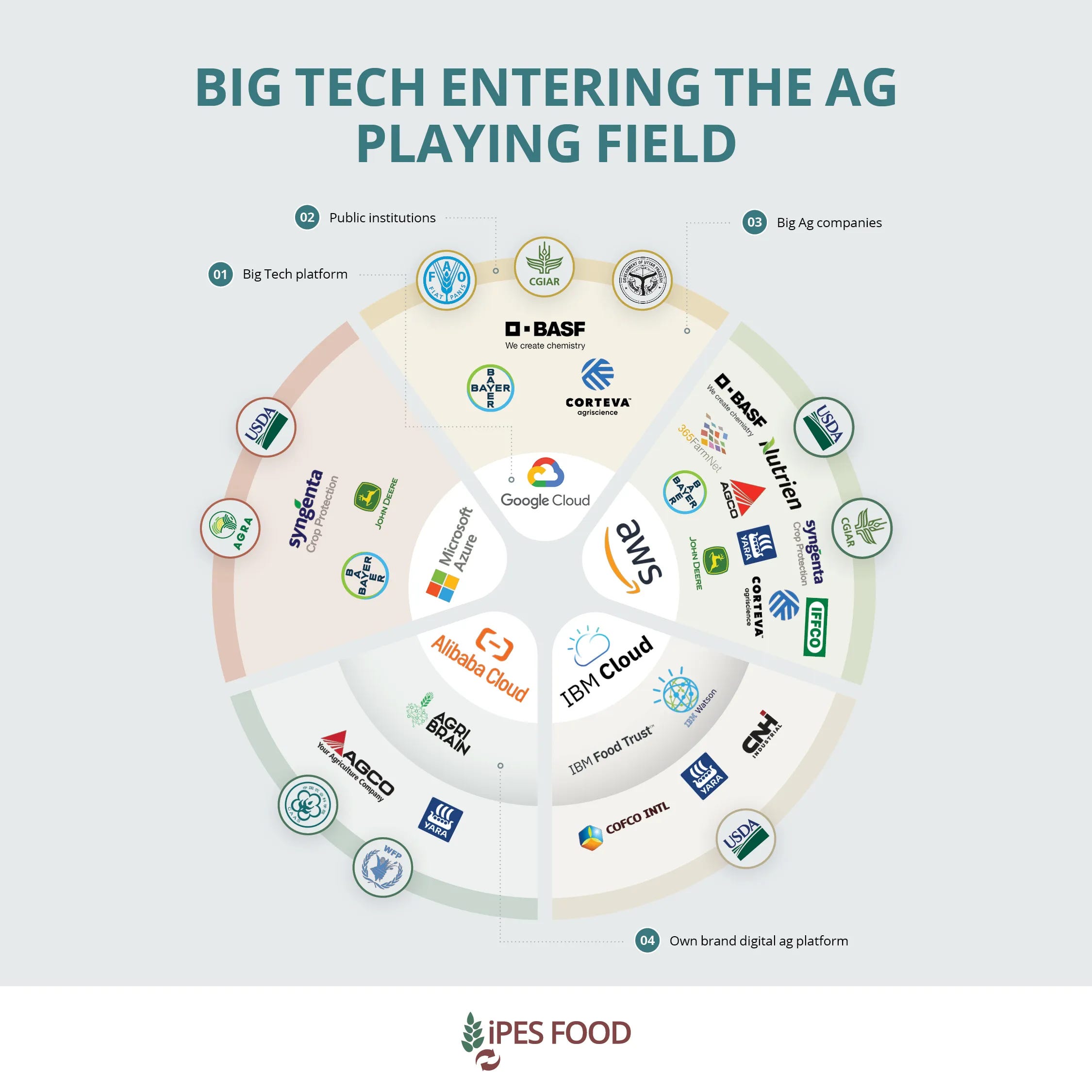
What the report describes is, structurally, an act of atlasing. The knowledge a farmer holds is extracted, processed, and turned into a corporate asset. The mechanisms are mundane: subscription platforms, data-sharing arrangements between corporate partners, algorithmic price-setting that quietly erodes a grower’s bargaining power.
When the same firms point AI at the genome by scanning, characterising, and patenting traits that communities have stewarded freely for millennia, the appropriation becomes total. A farm is rendered as data; the farmer is dispossessed of the very knowledge that was the farm. Farming by algorithm, IPES-Food observes, is not the future farmers asked for.
The atlas has a material body, and it is mined from the usual places. The cobalt comes from the Democratic Republic of Congo, the lithium from Bolivia, the copper from Chile, the coltan from Rwanda, and with the mining come the land dispossession and the poisoned water that have always followed it, in the same Global South that grew the cotton and the sugar. The cloud is not weightless. It weighs on exactly the people it always has.
Faced with this, IPES-Food reaches for a counter-instrument. They call it data sovereignty: the principle that farmers, Indigenous Peoples, and local communities have the right to decide what data is collected from their lands, how it is stored, who may see it, and what it is for.
The aim is not to abandon digital tools but to embed them in governance frameworks that serve the public good. It is a reformist’s hope, and a decent one: that the atlas can be taken back, re-owned, governed from below.
Dual abuse
But can it? Can these tools be repurposed?
The conventional frame for technology that can be used for both peaceful and military ends is “dual use.” It is a Cold War term, coined to regulate the trade in materials that could become either a power station or a bomb, and its premise is that the technology is neutral, the responsibility the user’s. The honest term, argues TITiPI, is not dual use but dual abuse: these infrastructures are engineered ready for abuse, and the fiction of neutrality is precisely what “exonerates entire industries and economies from their criminal responsibilities.” Tom Lehrer put it nicely in his song about Nazi missile scientist Wernher von Braun:
Don’t say that he’s hypocritical
Say rather that he’s apolitical
“Once the rockets are up, who cares where they come down?
That’s not my department!” says Wernher von Braun
If that seems like a stretch, here’s the modern day version. When Microsoft was asked in May of last year whether Azure had been used to harm civilians in Gaza, it said it “does not have visibility into how customers use our software on their own servers or other devices.”
Google, defending Project Nimbus internally, conceded in a report obtained by The Intercept that it was “not permitted to restrict the types of services and information” that the Israeli government and its Ministry of Defence chose to run on its cloud. These are not failures of the system. They are the system. The whole architecture of software-as-a-service is built around the abdication of the question of use. The provider supplies the capability and, by design, looks away.
So the question of whether a given act of computation is good or evil is rendered, at the level of the infrastructure, undecidable, and that undecidability is sold as a feature. Ask a language model what to do with a day in Amsterdam, and it returns a tidy itinerary of the most-visited attractions. The same model can deploy its taxonomies to select a target by silhouette and walking pattern. The model does not change; only the output differs. To trust the system in the first case is to ratify the regime that operates the second.
Project Nimbus is a $1.2-billion contract under which Google and Amazon supply cloud and AI infrastructure to the Israeli government and military. Its terms, according to reporting in The Guardian, contractually forbade the companies from suspending service under boycott pressure, and contain a mechanism to alert Israel secretly if another government requests access to the data held under it.
A +972 Magazine investigation found that purchases of cloud services by the Israeli military rose sharply after October 2023, and that intelligence gathered through the mass surveillance of Gaza’s population was stored on commercial servers. The targeting systems that have moved through that infrastructure carry names like the Gospel, Lavender, Where’s Daddy. The farm-data platform and the military data pipeline are not the same application. They need not be. They belong to the same political form: a regime that turns life into data, moves that data into proprietary systems, and then sells back the power to act on it.
Here the third atlas does both of the older atlases’ work at once. It commensurates — renders the soil and the face into the same legible data — and in the same motion it feeds the oldest hunger in Mitchell’s book. The weak are meat; the atlas tells the strong where to eat.
The non-manifestness of manifest evil
So far, this may feel like well worn ground. But the reason to set up the analysis like this is that I was lucky enough to spend a couple of hours with Ayça Çubukçu this week. As always, she knocked me sideways. Her recent thinking makes me wonder about the reformist impulse in thinking around The Master’s Tools might just be fantasy.
In a 2025 piece in the Journal of Genocide Research, Çubukçu reflects on the problem of moral judgement in relation to Palestine, reading the anthropologist David Scott on the evil of New World slavery alongside Hannah Arendt’s essay Personal Responsibility Under Dictatorship. Çubukçu’s question is not whether the violence is evil. Her question is why its evil is not manifest — why what is self-evidently a grave wrong to some is, to millions of others, morally justified or simply unseen. The horror, she insists with Arendt, is that it is carried out and enabled not by monsters but, in Arendt’s phrase, by the most respected members of respectable society. And where all are guilty, no one is.
Rereading Microsoft’s sentence — that it does not have visibility into how its software is used — clicks something into alignment. The cloud is a machine for the non-manifestness of manifest evil. It is engineered so that no one, at any node, ever has to judge.
The engineer ships a capability; the executive cites the terms of service; the procurement officer migrates a workload; the academic logs into Azure to mark an essay. Each performs a discrete, legal, deniable act, and the system is arranged so that the moral whole never assembles in any single pair of hands.
Arendt thought the precondition for refusing to be a cog was thinking, the silent internal dialogue between me and myself in which a person asks whether they could live with what they are about to do. Software-as-a-service is, among other things, an apparatus for abolishing that dialogue at scale. It distributes Eichmann’s desk across a hundred thousand login sessions, and asks each of them only to be convenient.
Çubukçu calls the Western academy a “zone of interest” and the universities she means are the ones that run, as mine does, on the rented cloud. The complicity is not metaphorical. It is contractual, and it is invisible by construction.
The master’s tools
Which returns me to a question that inaugurated this newsletter, on whether data is the master’s tool. I began part 1 by suggesting that data might be less a tool than a raw material, that a soil reading is a soil reading whoever holds it, and that the milk a cooperative runs on a colonial railway is still the cooperative’s milk.
I complicated that in a second essay with Donald MacKenzie’s distinction between a camera and an engine: some data merely records, but some — GDP, a doing-business index — is built to move the world toward particular ends, and changing who owns such an engine does not change where it is pointed. The next installment was to ask what a counter-hegemonic data system might look like. What a good atlas would look like.
I am no longer sure that installment can be written in the key I intended, and the materials in this essay are the reason. IPES-Food’s data sovereignty is a version of the good atlas, the cloud re-owned, governed from below. But Audre Lorde’s warning was never only about ownership. Here’s her insight, aimed as Çubukçu’s is, at the academy:
Those of us who stand outside the circle of this society’s definition of acceptable women; those of us who have been forged in the crucibles of difference—those of us who are poor, who are lesbians, who are Black, who are older—know that survival is not an academic skill. It is learning how to take our differences and make them strengths. For the master’s tools will never dismantle the master’s house. They may allow us temporarily to beat him at his own game, but they will never enable us to bring about genuine change. And this fact is only threatening to those women who still define the master’s house as their only source of support.
The master’s tools will never dismantle the master’s house: not because the tools are in the wrong hands, but because some instruments produce the relation they appear merely to measure.
An atlas is a way of making lives legible for management. A sovereign atlas is still an atlas. To ask whether farmers should own the data extracted from their fields is already to have conceded that the field should be rendered as data, that the relevant political question is who administers the legibility, rather than whether the act of rendering-legible is itself the thing being done to them.
Çubukçu, reading Scott, lands on a formula in response: there is no way out but through. You cannot exit the hegemony of the present by wishing yourself outside it. TITiPI say the same in the register of infrastructure. To disengage from the cloud, they write, is a fiction. It’s satisfying on the individual and consumerist level, understandable as a tactic, but terrible as a strategy. You cannot unplug your way to freedom.
But neither, they insist, is the work a matter of swapping evil technologies for good ones, or even of reliably telling useful computation apart from abusive. So the two clean exits both close. You cannot leave the house, and you cannot renovate it with the master’s tools. What is left?
What is left
TITiPI do not answer the question. What they offer instead is a practice they call infrastructural rehearsal, drawn from Ruth Wilson Gilmore’s idea of abolition as life in rehearsal. It’s an unfinished way to model the future from the present, in the ruins of the thing you cannot yet leave, learning collectively to move in a way no one quite knows how to move.
It’s what I’ve been calling movement science. I would drop the word rehearsal, which holds the future at arm’s length, as a performance still to come. The practices I have in mind are not preparation for the real thing. They are the real thing: knowledge made and tested in experiments of collective struggle, generated from below rather than deduced from the instruments of the order being struggled against. I have traced two cases at length here.
The mondine, the women who weeded the rice paddies of the Po Valley, built a science of endurance and refusal out of song, mutual aid, and the strikes that won them the hours of their own days.
The Black Panther Party met the crisis of social reproduction head-on with free breakfasts, people’s clinics, and sickle-cell screening, turning the provision of food into political praxis and, in the doing, producing testable knowledge about how to live otherwise through practices the cloud cannot file because they were never rendered legible for management in the first place.
This is more than permission to stop looking for The Good Cloud. It is a claim about where the tools to move through the cloud regime are already being made: in the food sovereignty movements that refuse to render the farm as data, in the workers fired for declining to build the targeting cloud, in the campaigns that withdraw a single institution’s consent at a time. Not a tactic that fails as a strategy, but the slow production of the knowledge a different order would need.
Robert Frobisher’s Cloud Atlas Sextet is six overlapping soloists, each taking up and breaking off the others’ lines; you cannot hear the whole of it from any one chair, and you cannot hear it at all without playing. The first cloud atlas, for all its legal force, never made a single cloud hold still. They go on forming and dissolving, indifferent to the plate that named them. The world exceeds the map.
Movement science is the procedures for thinking, for making knowledge that escapes the atlas in the same way: made in the moving, impossible to file. The weak are meat, the strong do eat, and the infrastructure of eating improves every year. Whether the sextet has a second voice is not, in the end, a question you can answer from the cloud. You answer it by joining in the great experiments in what comes next.
Immediately after reading your latest article, I stumbled across what seemed like a fitting example of the pattern that you document.