

“Oh look, it’s Jeffrey Epstein.”
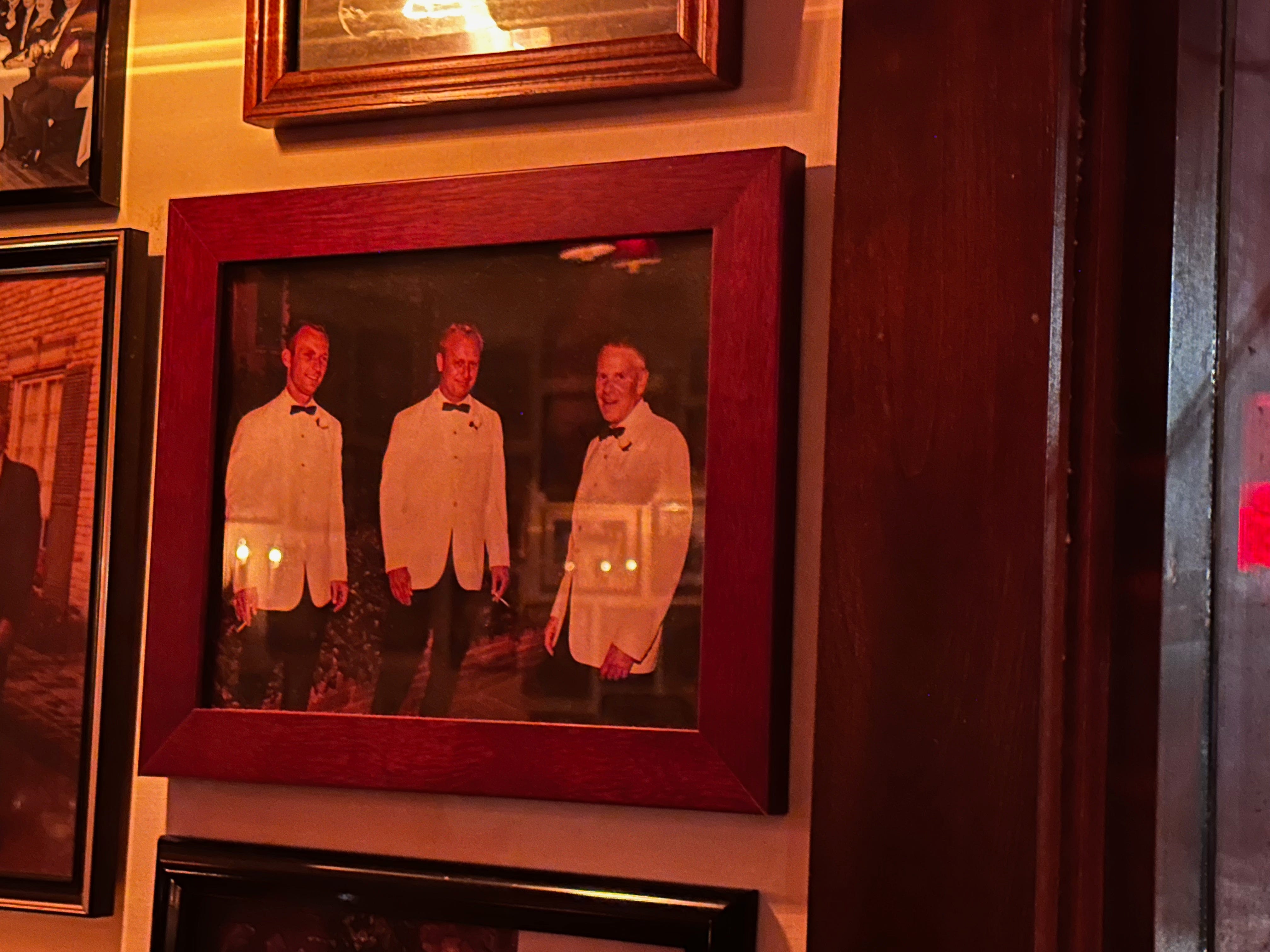
I’d never visited Sammie’s, a newish red sauce joint in Austin, where the aesthetic is high-dollar-club-with-celebrity-pretensions. The lighting is low and the wall-to-wall photos aim to conjure a venue into which the Rat Pack might have spilled after a show. Among the photos was this one, of clients who’d have been dead long before this post-Covid restaurant opened its doors. Something about the face, the build, the ease of the grin looked, for a second in the dim light, like Jeffrey Epstein. I’m pretty rubbish at recognising faces, and I admit that it’s a stretch. Does this make him look like Epstein a little more?
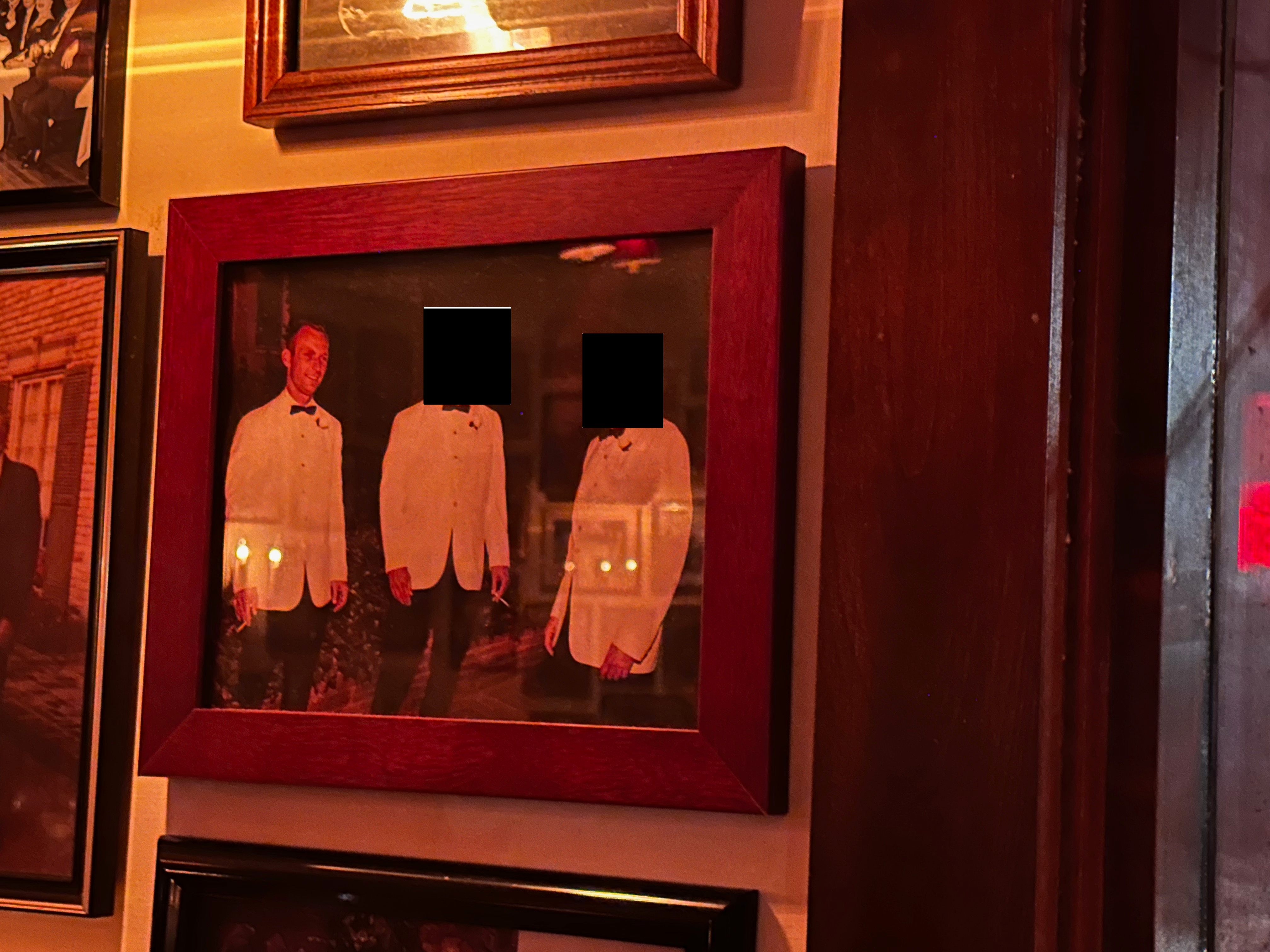
I’d just been reading the latest discoveries in the files. That I thought I saw Epstein tells you something about what’s happened to the way I see a certain kind of photograph, in which men of a certain class are smug and over-exposed. The visual grammar of mid-century leisure — the tuxedo, the cigarette, the ballroom, the closed circle of bros who belong — has acquired a new layer of meaning. Not because every man in a dinner jacket is a predator, but because the anonymous photography of those men has, in new ways, become horrifying.
I. Overlook Anonymity
Sammie’s opened in 2021 (on the site of Hut’s Hamburgers, which served reliably greasy fare from 1969 until 2019). The old place was gutted and refashioned for Austin’s creative class. The décor cites an older time, an invented past in which this stretch of Sixth Street was somehow adjacent to Las Vegas circa 1962. The photographs on the walls — men in evening wear, women in gowns, everyone, as far as I could tell, white — are not of anyone in particular. They are a vibe.
No-one in these photographs needs to be hidden because no one person is being depicted. The past is manufactured industrially, like libraries for sale by the yard, and the anonymity is a feature. You’re not supposed to ask who these people are, or spend too much time worrying about them. Their aura of tuxedoes and three martini lunches is there to enable another round.
It’s pleasant. It’s also, if you look at it long enough, a little eerie, in part because Kubrick has us trained to expect a close inspection to reveal in the centre, grinning, a Jack Torrance or similar. The end of The Shining permanently changed the meaning of this kind of photo:
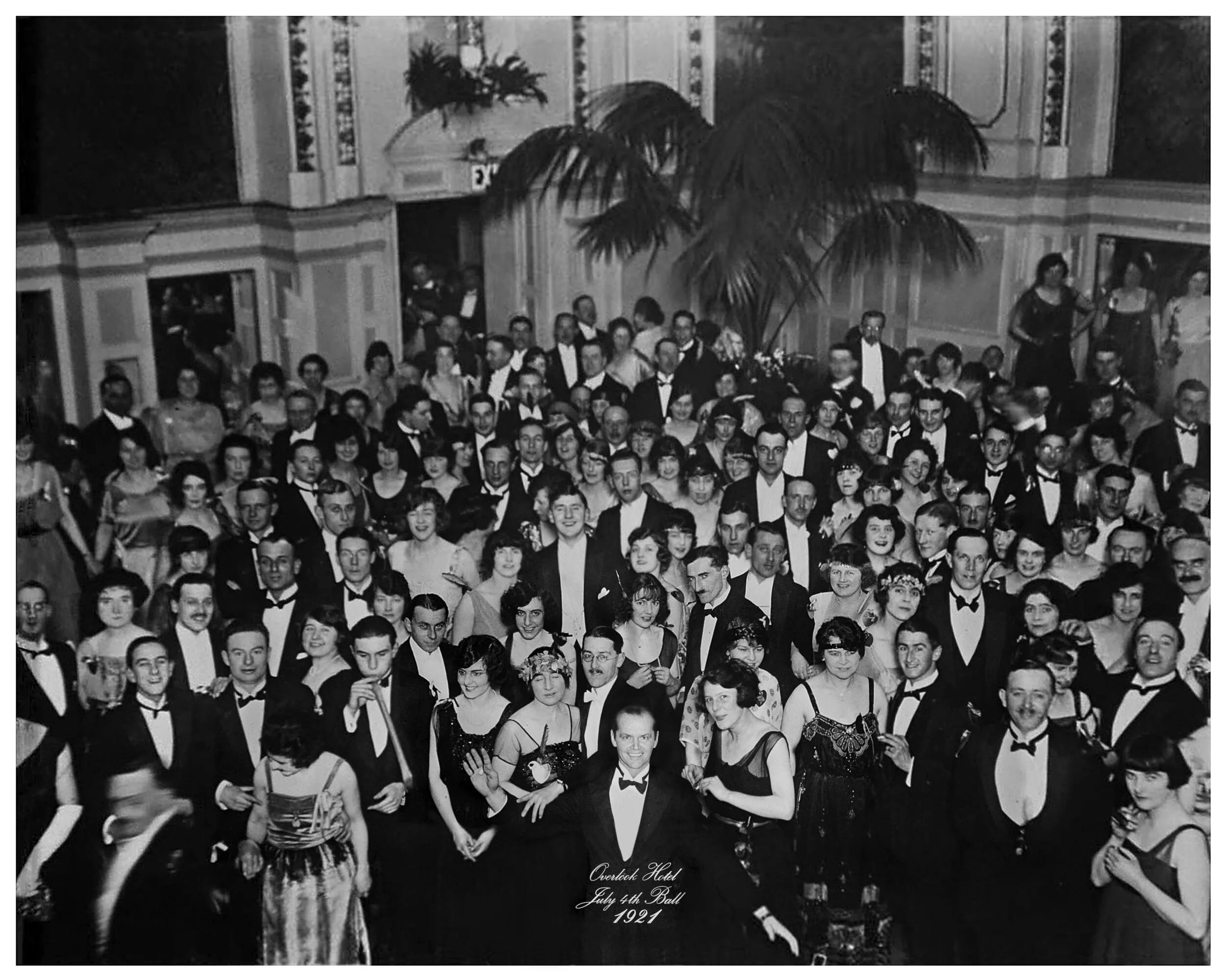
Sammie’s isn’t the Overlook. But every wall of anonymous vintage photographs is doing a version of the same work: these people were here, they had a wonderful time, don’t ask any more questions because there are no answers to be had.
II. Performative Anonymity
In the first season of Succession, Tom Wambsgans takes Cousin Greg out to eat ortolans as part of a crash course in how to be rich. The ortolan is a tiny songbird, fattened in a dark box, drowned in Armagnac, and roasted whole. Eating them is a signature of distinction. Brillat-Savarin observed that if you pop one into your mouth chew the whole thing, vous goûterez un plaisir inconnu au vulgaire, you’ll enjoy a pleasure unknown to the vulgar.
Eating these birds is a rite of passage into the upper class; when Gigi was taught to eat Ortolans, she carved the bird into four pieces and ate it bones and all while being challenged to hold a conversation.
More recently, the consumption has developed an accompanying ritual. You do it with a large napkin draped over your head.
There are, apparently, three reasons for the napkin. Aroma: the cloth traps the scent of the bird and the brandy. Etiquette: it hides the mess of crunching through a greasy skeleton leaving only the beak. And shame: the napkin shields the act from the eyes of God.
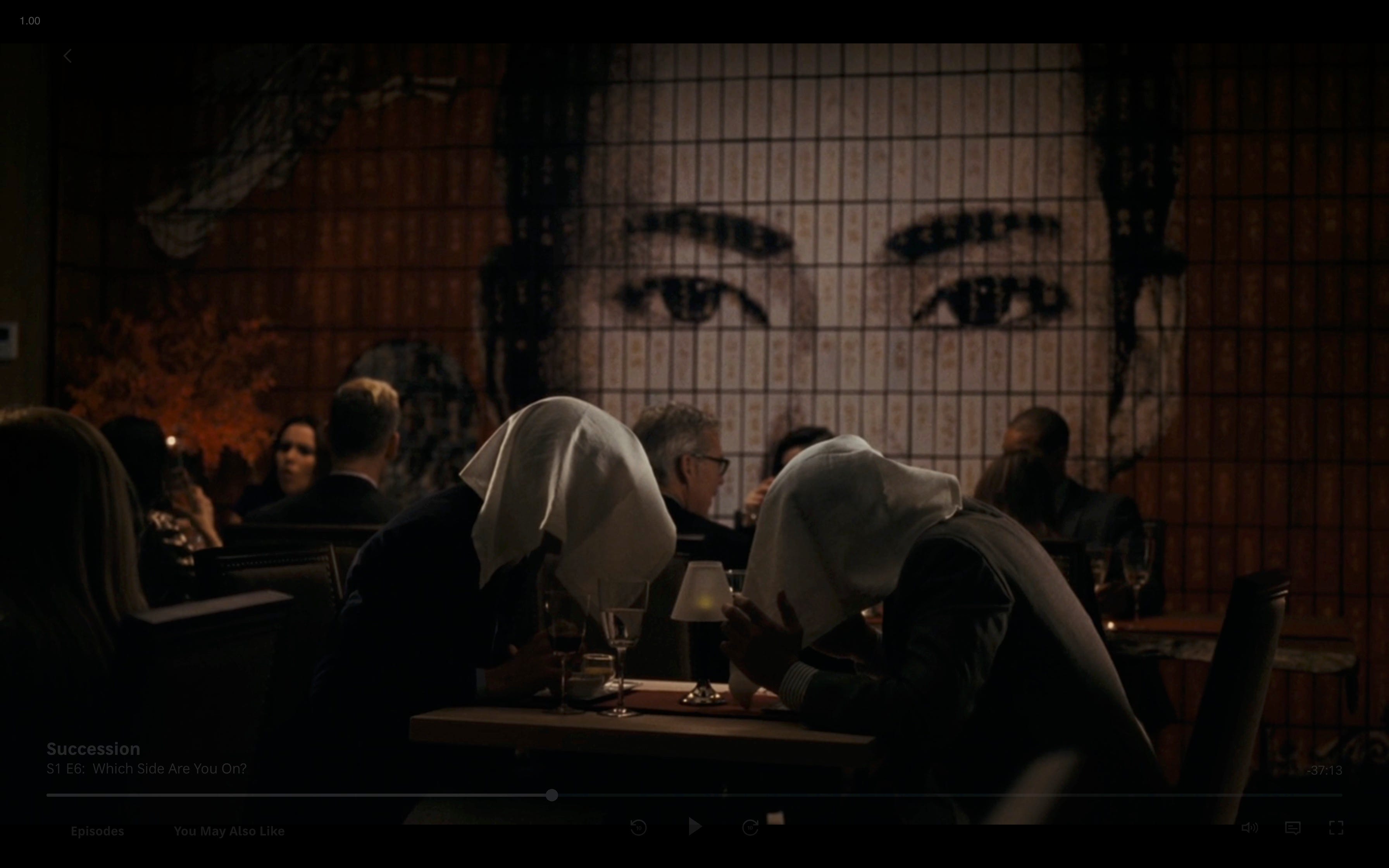
Behind a dimly lit Tom and Greg, a vast artwork of a woman’s face looks down on them — seeing everything — and they duck under their white napkins like schoolboys hiding from the teacher. The napkin is not really concealing anything. Everyone at the table knows what’s under the cloth. The concealment is a ritual gesture, a piece of theatre of cruel pleasure.
The shame behind the napkin, I’ve discovered, is fairly new. This video from the 1980s is the first I can find of the Landes practice of using the napkin, and there’s no reference to shame here, or in any of the French language material I’ve seen. Not even in Mitterrand’s Last meal, the story of how former French President Mitterrand’s final meal before he died of cancer a few days later, a hymn to high gastronomy that included the eating of ortolans.
The idea that this is shameful emerges not in France but in the US, after Michael Paterniti’s article in Esquire about Mitterrand’s last meal, and as George Reynolds suggests, after the French government starts taking the enforcement of the laws against ortolan consumption more seriously. Eating them is illegal somewhere, but under the napkin all is forgiven.
The napkin over the head serves the same purposes as a velvet rope (invented at the Waldorf Astoria in the 1800s but perfected at Studio 54), or the tint of a window on an SUV, or the members’ club with no sign but a doorman. It is concealment by power, for power. And because it’s Succession, this is all shown as part of an act of massive and consequence-free incompetence. (Tom, prompted to reveal a secret he says “I can’t reveal my sources, but it’s Greg”.)
This aesthetic of anonymity invites the viewer to feel excluded. You’re on the other side of the velvet rope, the tinted glass, the napkin. You know something is happening in there. You can’t quite see it, but you know it’s suspicious and you wouldn’t be able to get away with it. The media of exclusion is the message.
III. Redactive Anonymity
The third aesthetic is the black box.
With the photographs released from the Epstein files, the court documents, the newspaper archives comes a thick black rectangle stamped over a face.
When you redact the faces of two of the three men in the Sammie’s photograph their anonymity stops being nostalgic or charming. One man grins openly at the camera. Two have been disappeared. So who decided which face stays visible, and which ones get erased? Who are they protecting? What did the other two do?
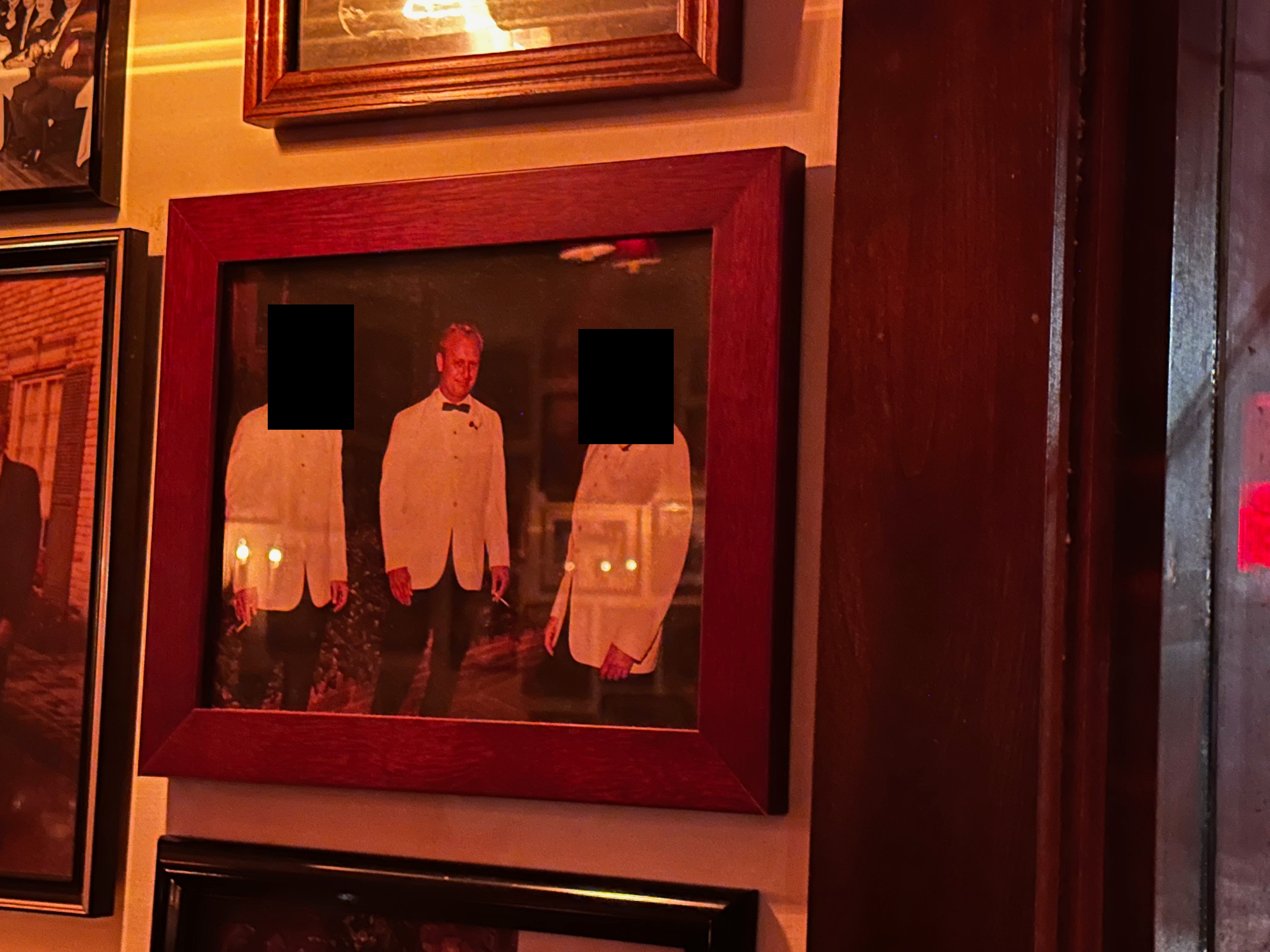
This is a different kind of anonymity.
The napkin is placed by the person eating the bird. The black box is placed by someone else entirely — by the justice system, by the intelligence services, by the lawyers, by the apparatus of the state. The napkin is a choice made by the powerful. The black box is a service provided to them.
Although the stated aim of the redaction is to protect the innocent, in this moment it serves to protect the guilty. The living associates, the powerful friends, the men whose names appear in the flight logs and the deposition transcripts — their faces are obscured, their identities removed, their involvement rendered, officially, into a black rectangle. Epstein himself — the one person who cannot be tried, who cannot testify, who conveniently cannot name names — his face is everywhere. I saw him even where he was not.
The victims are offended against once again. The women and girls who were trafficked, exploited, abused are only sometimes protected by the black box. For many, their names, their testimonies, and their suffering circulate unredacted. The apparatus of concealment for survivors operates as an alibi for the redactions of those who did the harm, or laughed nearby as it happened.
The Department of Justice is acting as censor and as fig leaf, acknowledging that something happened, controlling what you are permitted to see of it, and calibrating the strip-tease of facts to the tastes of those who can still write cheques and make phone calls. The black box is the aesthetic of impunity — not the kind that plays at being hidden but the kind that is hidden, structurally, by institutions whose stated purpose is disclosure.
IV. The Fratriarchy’s Range
Melinda Cooper’s recent essay on Epstein family values names a fratriarchal system in which male elite networks reproduce their power through the fraternity, the club, the private dinner, the closed circle. The Epstein network was a fratriarchy in its purest form. The walnut panelling and the calfskin chairs were infrastructure for the trading of favours. What the aesthetics of anonymity reveal is the fratriarchy’s operational range. It doesn’t have a single mode. It moves between them, fluently, depending on the stakes.
At the low end — the Sammie’s end — the fratriarchy operates through nostalgia: the production of an imaginary past in which men in evening wear ran the world and it was charming. This is the fratriarchy at rest. It doesn’t need to actively conceal anything because the mythology does the work. The anonymous photograph says: this is how it’s always been, and isn’t it nice.
In the middle register — the napkin — the fratriarchy operates through performance. The private island. The members-only club. The walnut-lined rooms where favours are exchanged over ortolans. Here the concealment is active but social: it’s maintained by the participants themselves, who enjoy the ritual of hiding as much as they enjoy what they’re hiding. The napkin is theirs to put on and take off. The tinted window is theirs to lower. The anonymity is a luxury good, purchased and maintained by its beneficiaries. And the rest of us are invited to press our noses against the glass, knowing that something is happening inside and accepting that it’s not for us. This is where the fratriarchy has traditionally lived: in the space behind the velvet rope.
But the Epstein case reveals a third register that Cooper’s analysis opens up — one that is far more consequential. This is the fratriarchy operating through the institutions of the state itself. The black box on the photograph is not placed there by the man whose face it covers. It is placed there by the Department of Justice. The sealed deposition is not sealed by the person it protects. It is sealed by a judge. The redacted name in the flight log is not redacted by the passenger. It is redacted by the intelligence services, or the prosecutors, or the lawyers, or the vast apparatus of legal and bureaucratic machinery that has the power to decide what the public sees and what it doesn’t.
This is the fratriarchy’s most powerful move: the privatisation of the state’s concealment apparatus. The brothers don’t need to hide themselves. The state hides them. The institutions whose ostensible purpose is transparency and accountability — courts, prosecutors, regulatory bodies — become, in practice, the fratriarchy’s wardrobe department, fitting black boxes over faces and sealing depositions and classifying documents and doing, with the full force of law, what the napkin does with a piece of cloth.
V. What Lifting the Box Reveals
There is a natural assumption — one that drives the public fascination with the Epstein files, the campaigns to unseal documents, the demands for full disclosure — that the answer to the black box is transparency. Remove the redactions. Publish the names. Lift the box, and justice follows. The instinct is sound: secrecy is corrosive, and the asymmetry between who is protected and who is exposed is obscene. But the assumption that lifting the box will produce accountability runs into a problem.
As James Butler observed in a recent London Review of Books discussion of the Epstein files — alongside Peter Geoghegan and Ethan Shone, who have tracked the scandal’s tendrils through British lobbying and government — much of what the files reveal is not actually criminal. The favours, the introductions, the exchange of confidential government information for access and influence, the cosy traffic between ministers and financiers, the revolving door between public service and the private advisory firms that monetise the connections forged in office — almost all of it is legal. Not because it’s innocuous, but because the regulations that might have constrained it have been systematically weakened by the very people who benefit from the traffic. Lobbying regulation in Britain captures approximately four per cent of actual lobbying activity, according to Transparency International. The register is a sieve built by the people who need to pass through it.
This means that lifting the black box doesn’t necessarily produce a crime scene. It often produces something more depressing: a system that is functioning exactly as designed. The favours and exchanges and introductions that constitute the fratriarchy’s daily business are legal, even when they run against the public interest, because the fratriarchy has also been in charge of writing the rules about what counts as a favour and what counts as corruption. Leon Black paid Jeffrey Epstein $170 million for tax advice that saved him over a billion dollars. Epstein had no law degree and no accounting licence. An independent review cleared Black of wrongdoing. The system worked.
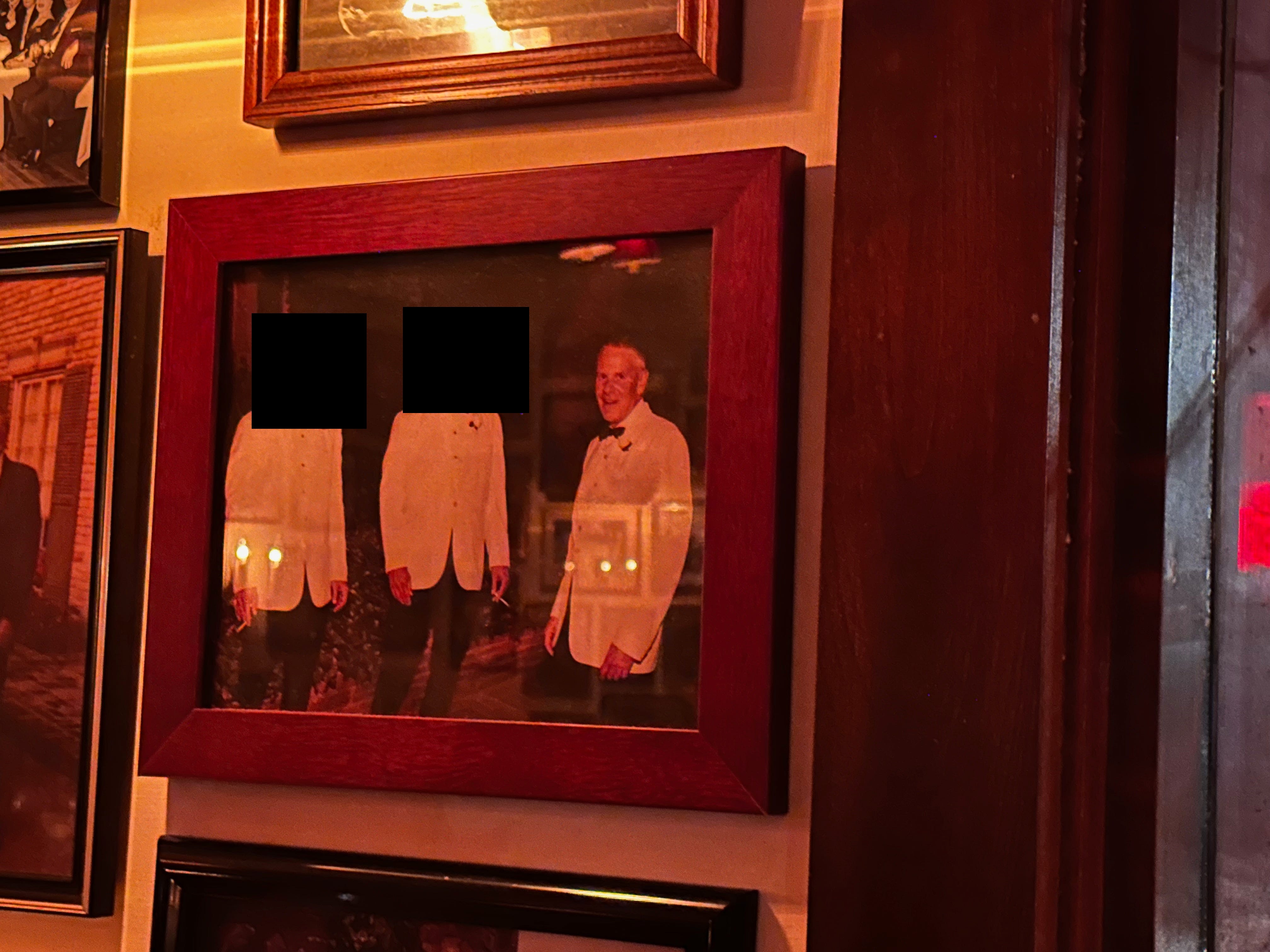
So we arrive at a bleak conclusion about all three aesthetics of anonymity: none of them is where the real work of impunity happens.
The nostalgia at Sammie’s is harmless. Nobody is hiding anything because there’s nothing to hide — just a pleasant fantasy of a past that never existed.
Underneath the napkin, the rich are still eating the ortolans. The performative anonymity of the velvet rope doesn’t conceal anything of consequence. Everyone in the room knows who’s there and what they’re doing. The napkin is a game, and the game continues with or without the cloth.
And behind the black box? Lift it. Remove the redactions. Publish every name, every flight log, every email. What you will find, in many cases, is not a prosecutable offence but a system of legal impunity so thoroughly constructed that exposure alone cannot dismantle it. The box is as useless as the napkin — not because it doesn’t hide things, but because what it hides is a machine that runs perfectly well in the open. The fratriarchy doesn’t need the black box. It’s nice to have, but it’s not load-bearing. The structure stands without it, because the structure is the law itself, and the law was written by the bros whose photograph I mistook for Jeffrey Epstein.
Well said. The crimes slip through the very well places cracks and vanish into mist. The thing is not the thing. It blob-like has reformed on the layer below. Until we match this shape, reveal it and dissolve it, it will keep on keeping on. Nora Bateson's Warm Data has helped me understand this.