

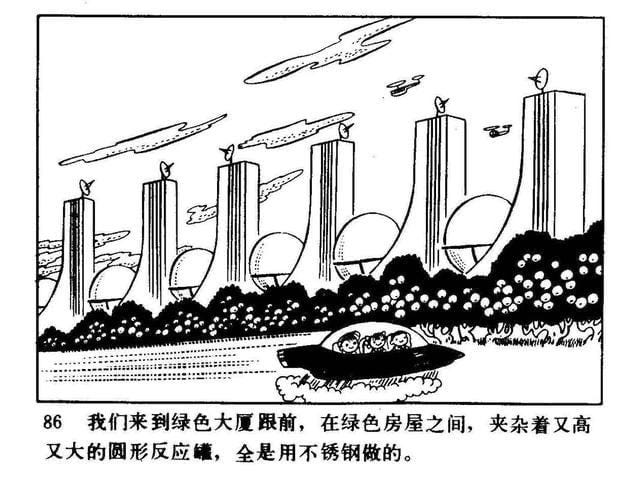
“We came to the front of the green houses, and between the green houses, there were tall and large round reaction tanks, all made of stainless steel.” Little Smarty Travels to the Future By Ye Yonglie 叶永烈, Pan Caiying 潘彩英 (adaptation),Du Jianguo 杜建国 and Mao Yongkun 毛用坤 (illustrations) translated by Adrian Ewald, Lena Henningsen, Lars Konheiser, Elena Mannich, Federica Monchiero, Franziska Roth, Joschua Seiler, and Sen Wei (Freiburg University), from Ohio State University’s Modern Chinese Literature and Culture Resource Center © September 2020
A few of you have sent me Adam Tooze’s charts and links to a report commissioned by the Gordon and Betty Moore Foundation on China’s Food Future. Here’s my quick response: someone’s been reading Little Smarty.
Ye Yonglie’s Little Smarty Travels to the Future, drafted in the early 1960s and a three-million-copy sensation when it finally appeared in 1978, sent a boy reporter — Little Smarty — into a Chinese "Future City" of floating cars, hydroponic crops grown on lakes, and sunflowers as thick as telephone poles. It's a children's book pitched directly into Deng Xiaoping's Four Modernisations: agriculture, industry, defence, and science & technology.
A fair number of the panels deal with how Little Smarty eats. He tries synthetic rice, and sees protein made from paraffin-eating bacteria. Long rows of artificial meat, milk, and eggs line the agriculture plant. Technologies prevent food spoilage. There’s even a discussion of washing-up after a meal — a task rendered far easier by an impervious coating that lets toughened porcelain shrug off grease, which means you can do the dishes with a quick dip in the sink.

“Little Tiger washed the dishes very quickly, cleaning them with nothing but tap water. It turned out that a magical “decontamination oil” was applied to the surface of the plates and bowls, so it would not be stained with dirt, water, or grease. When you put dirty dishes and bowls into the water, all dirt [just] falls off into the water.” Little Smarty Travels to the Future By Ye Yonglie 叶永烈, Pan Caiying 潘彩英 (adaptation),Du Jianguo 杜建国 and Mao Yongkun 毛用坤 (illustrations) translated by Adrian Ewald, Lena Henningsen, Lars Konheiser, Elena Mannich, Federica Monchiero, Franziska Roth, Joschua Seiler, and Sen Wei (Freiburg University), from Ohio State University’s Modern Chinese Literature and Culture Resource Center © September 2020
Living creatures make a few cameos in Little Smarty’s journey, entertainingly at the movies (screened with smells for a fully immersive experience), but also as food. Giant watermelons are swollen to the size of tables by the judicious application of “Plant-growth-regulator-stimulation-preparation”. Apples are as big as washbasins, and from the seat of Little Smarty’s flying car, the food stretches for miles.
All of these ideas appear in this year’s China’s Food Future in one form or another. The report’s premise is that China is driving the transformation of the food system because of the domestic demand for animal protein. So far, so Malthusian.
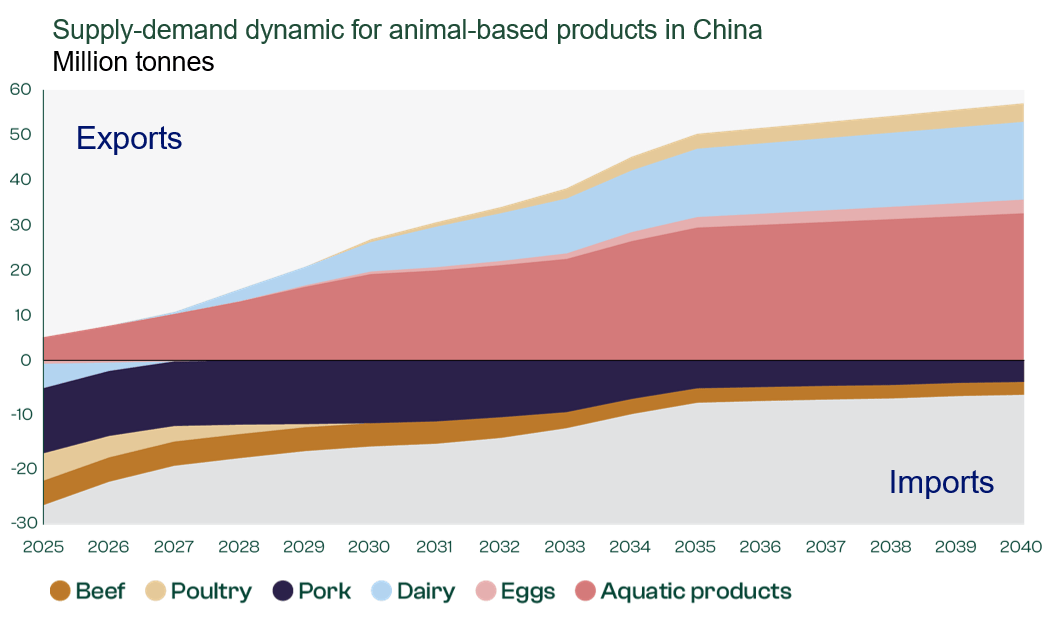
China’s Food Future/Systemiq
Then comes an unwarranted analogy to China’s impact on global energy markets. Recognising that it has limited reserves of domestic fossil fuels, and an appetite for energy that far exceeds its coal capacity, China has invested billions in developing clean energy technology. This investment is rippling through the world, sending cheap solar panels to parts of the planet that desperately need them, speeding the energy transition. China is also investing in agricultural technology, the report argues, that may do the same for food. By 2050, the report projects, alternative proteins — fermentation-derived, plant-based, cultivated — will supply 35 to 55 percent of Chinese animal protein demand, and China will lead a new bio-based industry the way it now leads in batteries.
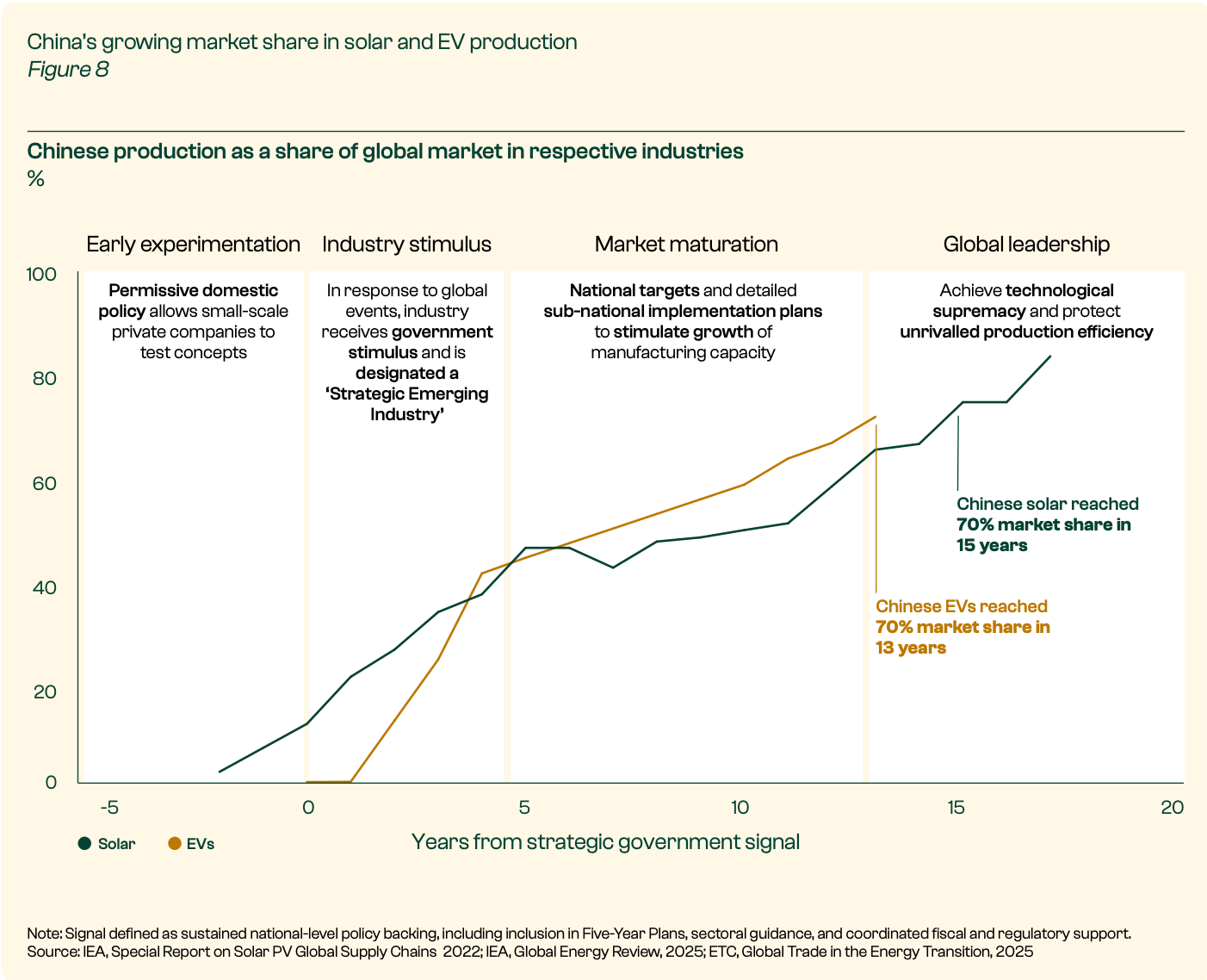
China’s Food Future/Systemiq
Let’s set aside the amnesia about the zones of extraction that make such energy futures possible. The entire premise is a disanalogy. Consider the seven concrete strategies the report features as the characteristics of China’s bold food future. Five aren’t new at all, but merely intensifications of existing industrial agriculture: feed reformulation, high-standard farmland (read: more irrigation in a country whose per-capita freshwater is already well below the global average), genetically modified crops, controlled-environment vertical livestock facilities — the “giant towers of pigs” that Mindi Schneider’s work has so eloquently parsed — and aquaculture expansion. Only two — fermentation and bioreactors — even gesture beyond mid-20th century technology, and the report doesn’t imagine them too radically different from the machines Little Smarty whizzed through in the sixties.
Yet it’s hard to see how China will leapfrog into a post-livestock food system when the reporting shows it doubling down on industrial agriculture, with all the metabolic vulnerabilities that implies. African Swine Fever killed an estimated 140 million Chinese pigs between 2018 and 2021, in part because hyper-concentrated production is precisely what allows zoonotic viruses to do their work. The proposed response is more concentrated production. The same report that notes flooding damaged 2 percent of cropland in 2023–24 proposes to lock in further mechanised, irrigated, monocultural systems on the very same ground.
In the report’s own 2050 scenario, China’s maize imports double — to roughly 50 million tonnes annually — because alternative protein production turns out to be ravenous for feedstock.

‘Plant-growth-regulator-stimulation-preparation’ can stimulate the growth of crops. After you put it on ordinary corn, it grows as high as a tree so that you would need an elevator to break off the corn. Once stored, you can see that the corn seeds are even bigger than washbasins.”Little Smarty Travels to the Future By Ye Yonglie 叶永烈, Pan Caiying 潘彩英 (adaptation),Du Jianguo 杜建国 and Mao Yongkun 毛用坤 (illustrations) translated by Adrian Ewald, Lena Henningsen, Lars Konheiser, Elena Mannich, Federica Monchiero, Franziska Roth, Joschua Seiler, and Sen Wei (Freiburg University), from Ohio State University’s Modern Chinese Literature and Culture Resource Center © September 2020
Perhaps most damning is the absence of any serious treatment of climate change: the one thing that Little Smarty never had to worry about. This isn’t just a Chinese phenomenon. Alastair Iles reminded me recently about a 1970 National Geographic article on the future of farming, which ends with similar encomia to farms operations characterised by pesticides from ‘jet powered helicopters’, with waste whisked away by monorail. The only appearance of weather in the Nat Geo article is in an aside about its impact on prices. When the fictions of future food systems shrug off the terrifying reality of 21st century global warming, no-one wins.
The other similarity between a high capitalist and a high communist agriculture-of-tomorrow is, as Virginia Conn has noted, a future whose central aesthetic achievement is the disappearance of the peasant. The vista of future food — the panoramas are usually depicted from the sky, as seen from the cockpit of flying cars — takes for granted the erasure of human hands in the food system. It’s all robots and chemistry and conveyor belts and nothing other than a supervisory role for humans.
Herein lies the central irony. Peasants on the front lines of 21st century agriculture are in the vanguard of technological change, managing the failures of chemical intensification, zoonotic disease, and extreme weather. If you want the analogy of a place where a huge investment in new technology, driven by a recognition of the limits of fossil fuels, has created huge benefits for those looking to leapfrog the current state of the art, you’d be better off not projecting the 20th century out inth the 21st in China, but looking at agroecology — properly understood as a knowledge technology rather than a hardware one — in Andhra Pradesh. There, you can find new technologies and practices, being spread across continents, so that other food systems can wean themselves off the fertilizer that is currently being held hostage by the war in Iran.
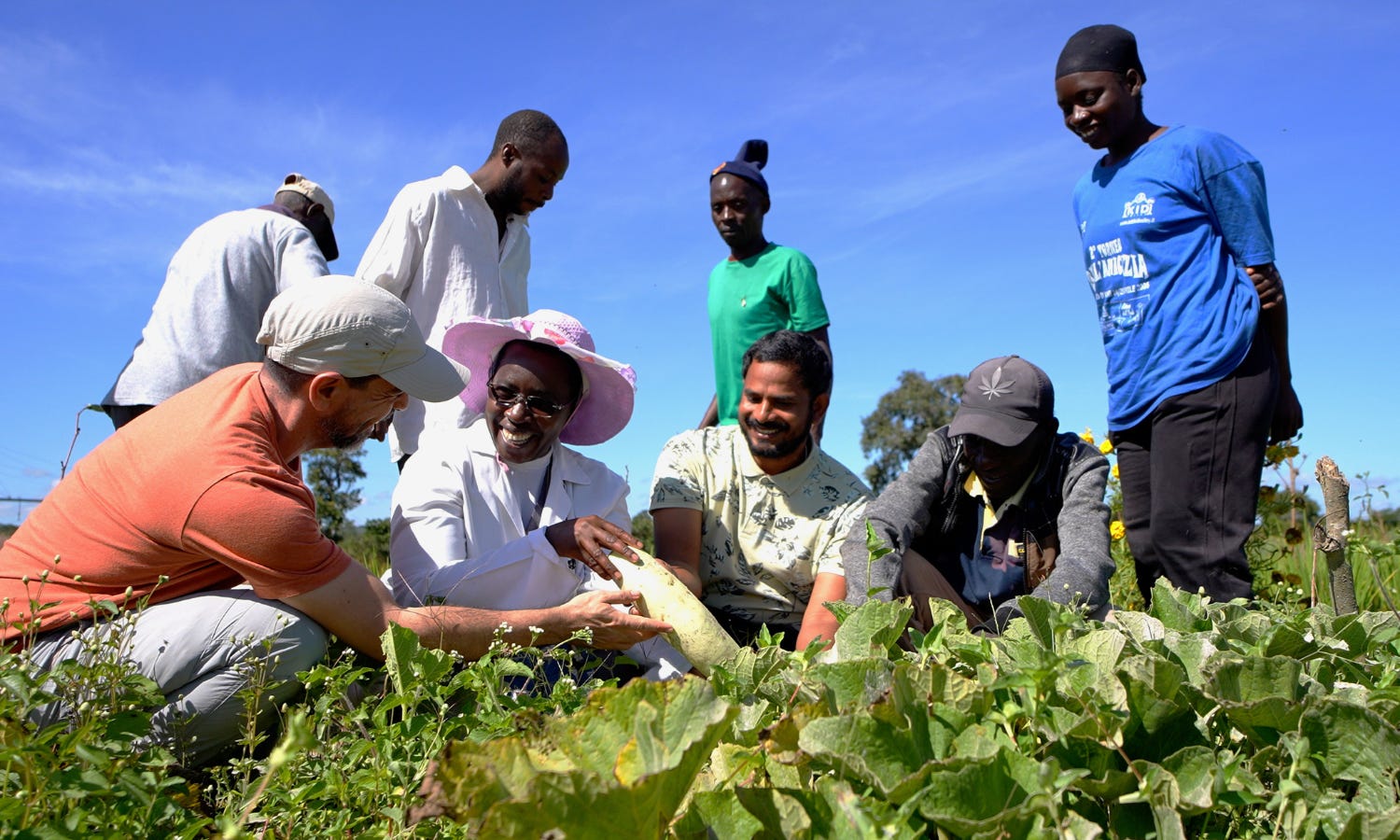
Scaling Natural Farming: Zambia/NOW Partners
Just as solar panels circulate because of China, agroecology is spreading because of Andhra. And in that story, peasants and their labour have decidedly not been edited out of the future.
Wonderful essay, Raj! Could the next one imagine in detail a transition to agroecology mentioned at the end? There are experiments like Little Donkey Farm and some others I saw a decade ago in China. I bet you know more or can find out.