

Today’s post also appears at The Checkout, Errol Schweizer’s essential overview of the $1 trillion US grocery industry.

In the 1970s, in a newsagent’s in central London, when my family was shorthanded and there wasn’t childcare, I’d sometimes be bundled into the store with my brother at the crack of dawn, wiping the sleep from our eyes, blinded by the sodium streetlight right outside, while my folks opened the shop.
The bundles of newspapers would be dropped off, sometimes still warm, and as I riffled them out on the counter, the ink would smudge my fingers. The smell of fresh newsprint mixed with London air thick with the muck of leaded petrol. From the stockroom wafted the warmth of packaged tobacco. Threading through everything was the thin sweetness of incense from my parents’ morning ceremony — a prayer to the goddess of prosperity that she might attend the store.
Add to that the sugary drift from the confectionery shelf, and you had the smell of Mr Patel’s. Punters read newspapers, people smoked, a family prayed, kids bought sweets. The store smelled like the life that ran through it. Everytime I smell newsprint, I’m yoinked back there, like a petit bourgeois Marcel Proust.
Proust spent seven volumes and 1.2 million words on a problem caused by a biscuit. In In Search of Lost Time, his narrator dips a madeleine into lime-blossom tea and is overwhelmed by a childhood memory so vivid it obliterates the present. What follows is a forensic investigation of consciousness conducted from the inside, by a man who noticed that the senses — smell above all — have access to parts of the self that the thinking mind cannot reach.
Marcel Proust’s would, I think, have a confusing time in the modern grocery aisle, not just because he’d be baffled by the idea of self-service or ultraprocessed food, but because every scent is trying to open up a sense-memory trap-door into which you, and your wallet, are engineered to fall. There’s one thing he would recognise, though: it all begins with baked goods.
Barney Kroger’s bread
In the beginning, in 1901, Barney Kroger became the first grocer in the United States to establish his own bakery. The economic logic was impeccable. Bread was the most basic of staples and something he sold a lot of. If he could bake it himself, he’d cut out the middleman, lower his costs, and offer customers a fresher loaf at a lower price. It worked. Within a year he’d incorporated the company as the Kroger Grocery and Baking Company, with 40 stores and its own bread operation.
The smell of baking was, for Kroger, a byproduct. It was evidence that production was happening on site — that labour, flour, water, yeast, and heat were being combined in a specific place at a specific time. The aroma indexed the real labour on site.
Over the next six decades, as the American supermarket consolidated from 5,575 Kroger stores in 1929 to the sprawling suburban formats of the postwar era, the in-store bakery became standard equipment. By the 1960s, supermarkets were adding bakery and deli departments partly to compete with the fast-food industry’s promise of immediacy. In 1977, 55% of US stores had an in-house bakery. Today 90% of stores do. The smell of baking bread became part of the store’s self-presentation, its claim to freshness in an environment increasingly dominated by canned goods and frozen dinners.
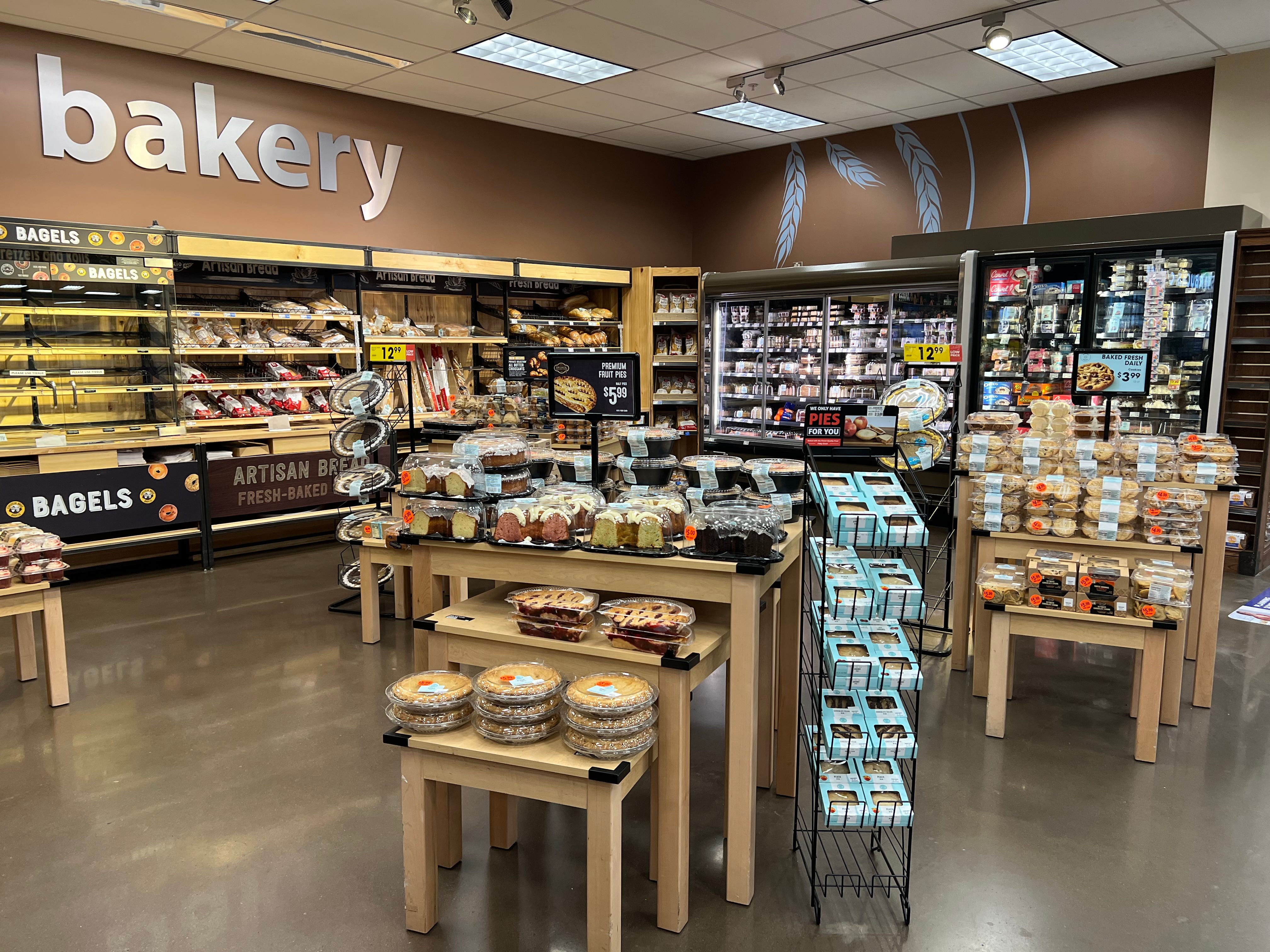
If you look at the formats of modern grocery stores, the bakery has been migrating — physically and conceptually — from the back of the store to the front. Yes, the nice stores now have a cafe and bakery out front. But the main purpose of the bakery is as a source of smell.
A mechanical Proust
In many supermarkets, the HVAC system doesn’t just regulate temperature. It recirculates air from the bakery into the shopping aisles while extracting air from around the fishmonger’s counter. The infrastructure that keeps the store at a comfortable 68 degrees is also doing curatorial work — amplifying some smells, suppressing others. For as little as $100 - and usually multiples more - an aroma diffuser can pipe in missing smells, and zone them appropriately (so that, for example, you’re not sending the smell of chocolate into the meat department, something that has been tested with the result that fewer people buy meat).
The commercial scent marketing industry - which will soon be a $1bn business - offers hundreds of synthesised aromas designed for retail environments. A Brooklyn grocery chain called Net Cost installed machines that pump artificial chocolate and baking-bread scent into the store; sales in the produce department rose by at least seven percent.
Some retailers have gone further. Albertsons ran a limited-time campaign with Philadelphia Cream Cheese in which scented diffusers pumped the aroma of baked cheesecake through select stores, timed to the Easter sales season. The explicit goal: disrupt typical shopping behaviour and encourage purchase.
As Grocery Nerds already know, CPG companies pay slotting fees to secure eye-level placement for their products. The same companies are now, in effect, purchasing nose-level placement — buying not just the sightline but the airspace of the store. When Kraft pays to pump cheesecake smell through an Albertsons, that’s a slotting fee for your nostrils.
The scent diffusers can be programmed via smartphone to release different aromas at different times of day. Rotisserie chicken in the afternoon, when shoppers are starting to think about dinner. Cinnamon rolls in the morning. The store doesn’t just look different at 10 a.m. and 5 p.m. — it smells different, and that means different fees for different zones and times. You can’t lose.
How to smell like a pretzel
Smell is the only sense that bypasses the thalamus — the brain’s relay station — and travels directly to the limbic system, including the amygdala (which processes emotion) and the hippocampus (which forms memories). A recent study described this pathway as a superhighway from smell to the hippocampus.
This is why researchers call it the Proust effect: odour-cued memories are more emotional, more vivid, and reach further back into autobiography than memories triggered by sight or sound. The smell of baking bread doesn’t just make you hungry. It makes you feel home, childhood, and safety.
The modern grocery store has industrialised the Proust effect. It takes the neural architecture that once bound you to the people who fed you and repurposes it to sell cream cheese. The scent machines in the modern supermarket are prosthetics for a food supply that has had its smell industrially removed and then artificially restored at the point of sale.
The logical conclusion of this trajectory is not merely that the store smells like a product, but that you do. In a move that suggests the marketing industry has finally conquered the atmosphere, Auntie Anne’s pretzel store in 2024 released a fragrance called Knead, a boutique scent designed to make the wearer smell like a buttery soft pretzel.
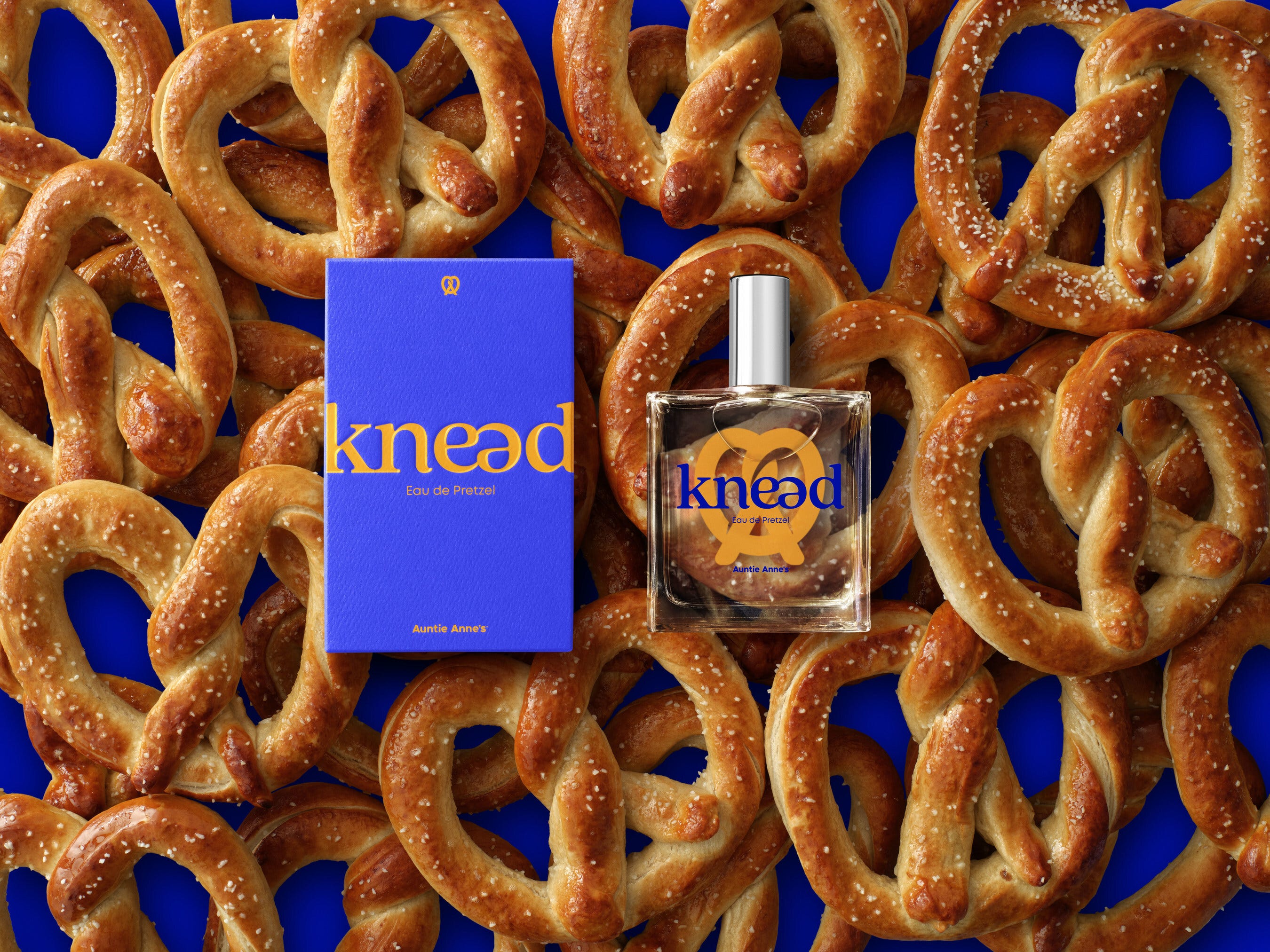
This is a profound shift in the history of human vanity, and as Virgie Tovar notes, it coincides with the rise of GLP-1s. For centuries, we wore perfumes to smell like flowers or musk—natural scents that signaled health, status, or a certain sophisticated distance from the damp reality of being an animal. Now, for a modest fee, you can signal to the world that you are the carbohydrate-delivery system for which you no longer have any appetite. I checked and, yes, you can buy the smell that inspired À La Recherche Du Temps Perdu - a 2oz spritzer of madeleines is yours for $8.50. Memories not included.
The question for anyone who cares about the future of grocery is whether there’s a way back to a world where smell and labour are reconciled. Public grocery models, community food hubs, cooperatives, farmers’ markets — these spaces tend to smell like their own reality. They smell like weather and soil and the person who brought the eggs in that morning.
My parents’ shop smelled like the truth. Newsprint, tobacco, incense, sweets, and London. I didn’t know it at the time, but that was the smell of a world that hadn’t yet learned to lie through your nose.
---
Raj Patel is a Research Professor at the University of Texas at Austin’s LBJ School of Public Affairs and the author of Stuffed & Starved. He is, like Errol Schweizer, a member of the International Panel of Experts on Sustainable Food Systems.
So cynical - another good reason to stay out of supermarkets. My world is shrinking
due to all of the things and places I'm forsaking!