

I’ve only known Suzan Erem since 2021 and it feels like we’ve been lifelong friends. She founded the Sustainable Iowa Land Trust, and we filmed The Ants & The Grasshopper with her. She introduced me to a friend and donor who ended up becoming a friend and donor to the film. She’s cleaned toilets, unionized janitors, and is one of the most gifted writers on Substack - as evinced by the legions subscribing to Postcards from the Heartland. Right now, in what appears to be a farming-related attempt to snip off her fingers, she’s not able to write as much. But the back-catalogue is magnificent. Here’s a favourite from earlier this year. Like what you read? Please subscribe to the newsletter, and visit Draco Hill.
How Farms Die: One at a time and alone
Jan 07, 2026
I drove by the old gal one summer night as she stood in her yard in her nightgown, two white spindles in slippers sticking out below the hem, pale knobby hands clasped in front of her, tousled gray hair blowing in the breeze.
I couldn’t tell if she meant to be there. It was a warm night in front of her simple, well-kept home. No harm in standing in the yard while the sun set, remembering her husband or the kids she raised on the place, the day they planted that tree in the yard and the dog house they kept in the shade of it.
She was one of the last generation of rural folk, like the farmer just a mile north of her I also drive by regularly. His house has been left to fend for itself. Paint hangs in thin strips off bare siding. One window of the ramshackle front porch is busted out, winking at me from under its tipped hat of a roof.
During the season maybe a hundred sheep graze the roadside pastures bordered on the end closest the house by tin-roofed wooden shacks.
One day as I passed by, I saw sheep grazing in the ditch. They were working their way toward the road, so I pulled around to the back of the house where the driveway ended.
I was surrounded on four sides by various farm buildings tilting in different directions – a silo, a barn, an old coop, a grain bin. They were placed efficiently for walking between them – the last generation of such a farmstead.
I banged on the back door. A ragged screen hung on worn wood. I suddenly noticed my remarkably clean hand, the newer Subaru still running behind me, the nicer town clothes I’d worn for my doctor’s appointment.
I now regretted stopping, afraid he’d assume I share the insipid arrogance that others with (comparable) wealth give off. But the sheep were out. That mattered more.
I knocked one last time, then turned to leave. A thin, bent old man emerged from the dark. He was unshaven and half dressed in threadbare coveralls.
Maybe he just woke up. Or maybe he was just as neglected as his house.
He grunted at me as he grudgingly opened the door a few inches. We spoke through the busted screen anyway.
“Your sheep are out,” I said. “I thought you’d want to know.”
“They’re not my sheep,” he grumbled, “but I’ll get ‘em.” He shot me such a look I dared not laugh. On the contrary, I shrank like plastic wrap on a lit match. He disappeared back into the dark. I left.
You see, there’s an old joke about a salesman walking up to a farm fence. A big dog runs up barking ferociously across the fence at the salesman.
“Does your dog bite?” the salesman asks the farmer walking toward him.
“Nope,” the farmer says.
The salesman climbs over the fence and the dog takes a pound of flesh out of the guy’s leg.
“I thought you said your dog doesn’t bite!” he yells at the farmer.
“That’s not my dog,” the farmer says.
But this wasn’t a joke. This was The Grapes of Wrath, 2025 edition.
A younger couple bought that farm recently and moved a large four square farmhouse onto a foundation up the hill. They grow grassfed meat, so maybe this farm gets another chapter.
The old house is still there for now. I don’t know if the old man is. The old woman south of him is another story. Last week, a bulldozer took down her ancient barn. Fire hazard, I figured.
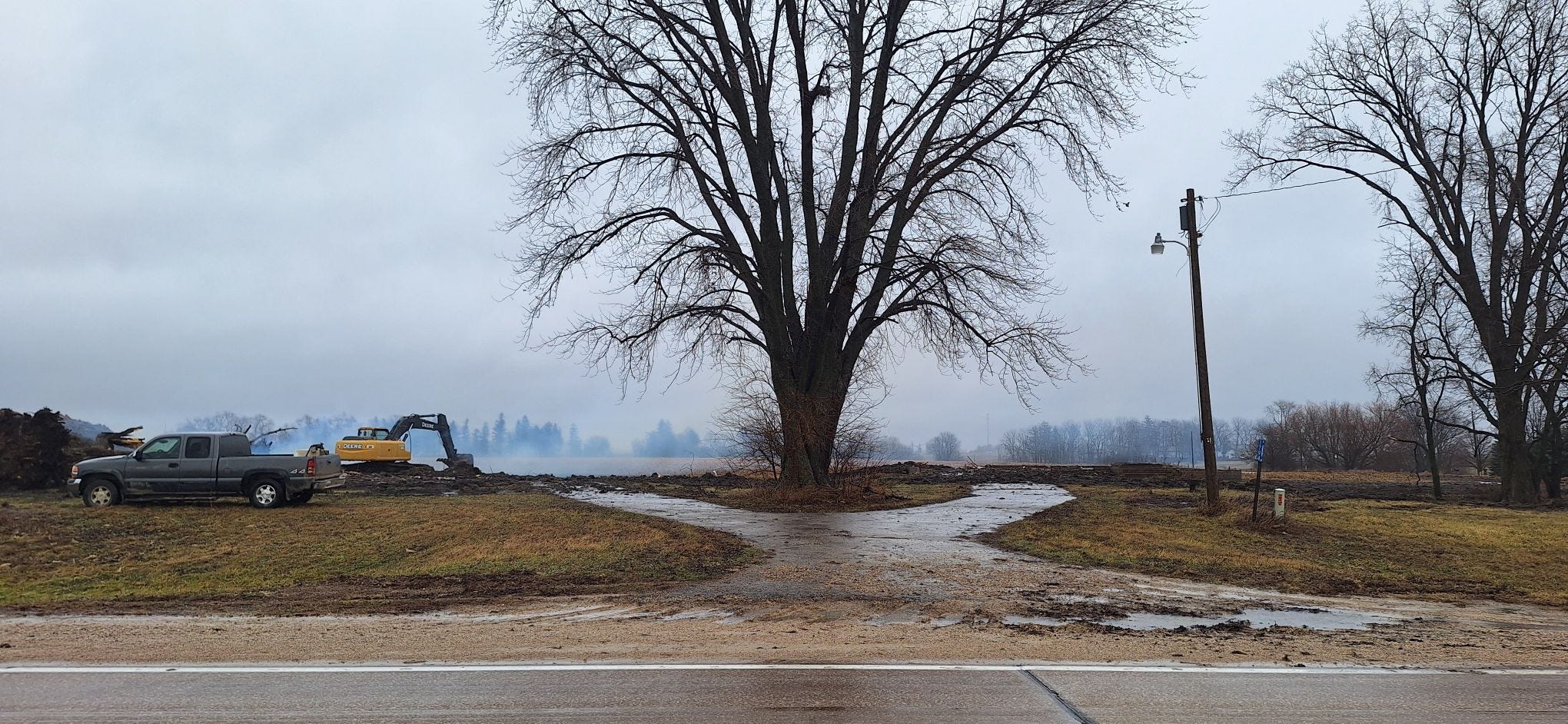
But last Sunday, as Paul and I drove home from church, we saw flames from a mile off shooting up through a downpour.
Then as we got closer, we saw it: The entire house was gone, torn down in one morning. All that was left were basement walls and a burn pile.
The man in the backhoe was steadily clearing the rubbish, burning and burying a lifetime so someone could plant more corn.
It’s a long game, you see. The corporations can wait. So-called family LLCs can wait. That’s what happens when you give corporations that don’t die the same rights as humans who do.
Your kids who moved to a better place to raise their kids will get a reduced price for the land you lived on, sweated into, bled for and worried over for decades because the new owners have no need for yards, homes, dog houses or trees. They are things to burn. They are things to bury. And buyers think that is an expense they shouldn’t have to front.
This generation is one of farm operators, soon to be replaced by robots*. They’re little more than foreman making a wage, middlemen between the government, a market and the bank. They get pennies on the dollar of everything you eat. They use tax deductions and government programs to survive while posting “GET THE GOVERNMENT OFF OUR BACKS” billboards on their road frontage.
And when it’s over, they sell to the highest bidder.
After a lifetime of growing corn, they realize the land is the only commodity worth anything.
For every one of these corporate-scale farms there are maybe 50 family-scale farmers we know still hanging in there, ones with more family members than employees working the land, who care about stewardship, answer to their local communities and do right by their neighbors – values Americans once held dear and guarded closely.
But even I can remember when there was just a smattering of corporate-scale farms. Then a family farm was sold to the neighbor, the next bigger farm or at auction by heirs or the bank that had foreclosed on it. Then another one. And another. Each retired farmer who gleefully cashed out at top dollar to move to Florida or Phoenix helped create this landscape, too.
There’s no one to blame but the system.
We can’t change that system until we recognize it. And even then, we’re a trash fire in a storm that’s been pouring down on us for decades.
But I’ll help keep it lit if you’ll join me.
Because now you know. Now we can get to work.
Subscribe
*See that story at Barn Raiser, a national publication of rural progressive news.
I’m a proud member of the Iowa Farmers Union. We’re a grassroots organization of farmers and friends that fights ag consolidation, speaks for independent family farmers and demands a cleaner, healthier rural Iowa. Nonfarmers welcome! Join today to amplify your voice in Des Moines and D.C.