

I’ve just finished Rosa Luxemburg’s Herbarium, a new edition by Claudia Horn published by O/R. It’s a collection of Luxemburg’s own pressings and drawings, together with letters, and a few short essays by Horn. It’s the best kind of book - filled with conversations and Marxism and plates like these:
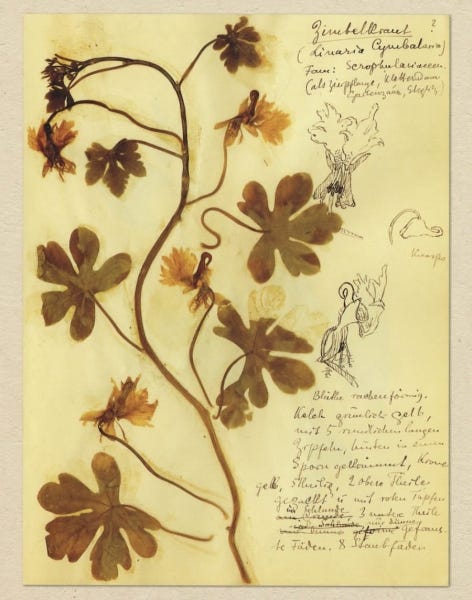
Rosa Luxemburg/Açık Radyo
Among the pressings that most delighted me was the goosefoot, an unshowy weed that I’ve just finished writing about (in my next book - more on that in the coming months). Luxemburg pressed the European species, Chenopodium album, lamb's quarters, but her fascination reaches across to its American cousin Chenopodium berlandieri, which the farmers of the Eastern Woodlands domesticated some two thousand years ago, breeding it patiently toward thinner-husked seeds long before maize arrived to eclipse it.
Lambsquarters is considered a weed here in the US, more collateral damage under the regime of glyphosate in the midwest. Luxemburg had an eye for the weeds, the everyday testament to life all around us. Not for her the aesthetics - and accompanying politics - of bourgeois environmentalism. When in prison, she had nothing but contempt for a fellow inmate who
lived with the firm conviction that nature began in the Tyrolean Alps, with a spectacular sunset. If someone had told her that here, at Barnimstraße No. 10, where she stood and walked, she was surrounded by nature from morning to night, she would surely have thought they were making fun of her.)
Given her early training in zoology and her lifelong habit of thinking in terms of metabolism, the Stoffwechsel that Horn traces so well from Marx into the plantation, I was hoping Luxemburg might have sketched and enthused over fungi, those small gods of metabolism. I realise it’s an anachronistic hope. In Luxemburg’s day, fungi were still filed as cryptogams, along with moss and algae: their method of reproduction was cryptic. Luxemburg’s care over social reproduction finds its resonance in the attention her notebooks give to flowering things.
The corollary, which Horn draws out beautifully, is that Luxemburg was well aware that colonialism was never a project of humans alone but a rearranging of whole living communities, a multi-species undertaking. That insight, arrived at between prison walls with a pressed weed in hand, is one that leaps out from her letters and Horn’s fine commentary.
Having read it twice now, the impression that I’ll carry most is of someone deeply and passionately attuned to the web of life, who understood the violence of capitalism’s operations on the web-of-life, and who understood how precious it was to be able to touch the world beyond the cycle of exchange and commodities. It’s the spirit behind this exhortation to Hans Diefenbach, on 6 July, 1917:
This day is a gift to you, like a rose in full bloom, lying at your feet, waiting for you to pick it up and press it to your lips.
Diefenbach, a doctor and close friend, was killed at the front that October. Luxemburg herself was murdered by the Freikorps on 15 January 1919.
Oh, you elitists and your damn advance copies cause me all sorts of frustration! (But thanks for the tip!)
And ordered. I look forward to reading this book and hearing more about your next one soon.