

Andor’s Luthen Rael is almost an anagram of Audre Lorde.
“The master’s tools will never dismantle the master’s house,” Audre Lorde wrote in 1979. Whether that’s true is a permanent question (and, friends, I’m on Substack asking it, in a glass house throwing stones).
Last week, IPES-Food launched a report on digital agriculture. I’m an IPES-Food member and this is a report in which I had a hand. The cover of Head In The Cloud is magnificent:

The report covers the convergence of Big Tech and Big Agriculture around AI, proprietary algorithms, and data platforms. Amazon, Microsoft, Google, Alibaba have joined forces with the old agribusiness giants, and the result is a quiet revolution in who controls the decisions that shape how food gets grown.
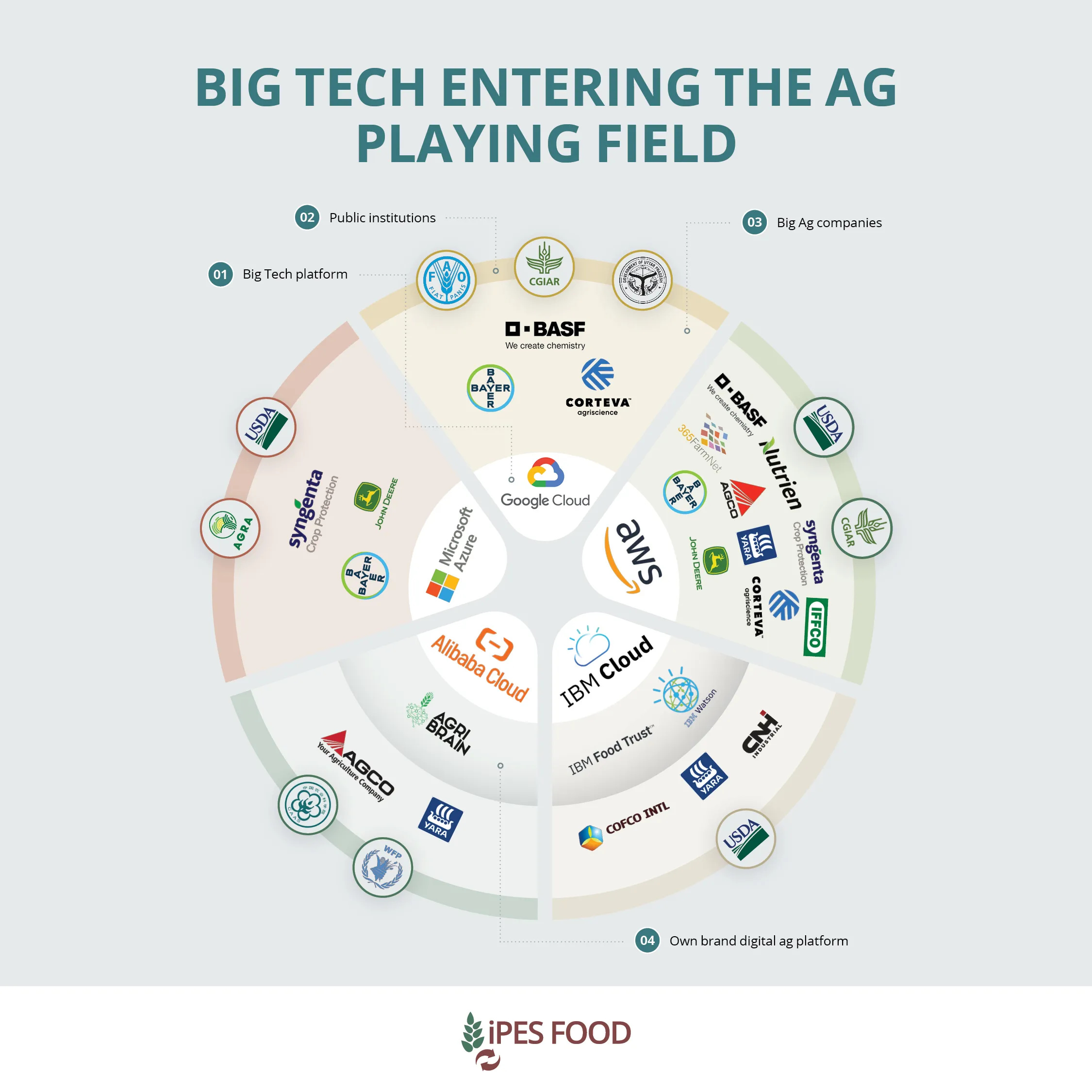
Note how seamless the links are between the providers of compute, agribusiness, and the state and international organisations.
You can read the full report here, and the press release captures the headlines. The Guardian covered it all nicely.
The case for alarm is plain enough. Farming decisions are increasingly mediated by proprietary algorithms; companies are harvesting data from farms for profit while farmers lose control of their own information; capital costs push smaller producers to the margins; and data-intensive systems consume vast energy and resources while locking agriculture deeper into the input-intensive monocultures that got us here.
But I want to sit with a question the report raises without fully resolving it, because I haven’t resolved it either. The data that these platforms collect — soil moisture, pest pressure, microclimatic variation, crop performance under stress — is it the master’s tool? Is it so thoroughly shaped by the system that built it that it can never serve liberation? Or is data something else: raw material that could, under different ownership, answer different questions entirely?
Here’s the first of at least two ways of looking at it.
The Master’s Railway
My family has land in Dharmaj, a village in Gujarat’s Charotar region. Under the British, Charotar was part of the Kaira district in the Bombay Presidency. Tobacco was the cash crop that made the Charotar plain worth administering. The region earned the name “the Golden Leaf area.” Tobacco cultivation expanded rapidly in the Charotar talukas through the late nineteenth century — roughly doubling in acreage between 1876 and 1887 — because it served twin colonial demands: a cash crop that generated tax revenue, and a commodity the British wanted for the international market.
There’s still a railway station in Dharmaj — station code DMJ, Western Railway zone. The line connects through Anand to Ahmedabad and onward to Bombay. Under colonial administration, that’s the route the high-quality kalia tobacco travelled: by rail from Charotar to the markets of Ahmedabad, Broach, Surat, and Bombay, and from there to the world.
The extraction was not subtle. When famine and drought destroyed crops across Kaira district in 1918, the British insisted on collecting full land revenue anyway. The farming families faced confiscation of property and livestock for failing to pay taxes on harvests that didn’t exist. It took Gandhi and Vallabhbhai Patel organising the Kheda Satyagraha to force even partial tax suspension. The railway had no trouble running when there was tobacco to ship.
Had Lorde been writing about colonial India, the railway would have been exhibit A. The railway was the master’s tool. You couldn’t easily reroute the track from Dharmaj to connect Charotar’s villages to each other. The tool was shaped by the master’s hand, and it shaped the landscape in his image.
Head In The Cloud makes a version of the case. The platforms are built to sell inputs. The algorithms optimize for yield within systems that depend on purchased seeds, fertilizers, and pesticides. The data flows one way: from the farm to the corporation. The farmer gets a recommendation; the company gets a market.
But here’s where I start to argue with myself. And, gently, with Lorde.
Milk on the Master’s Tracks
The same Patidar farming community that the British taxed into famine later built something very different from the same soil. In 1946, dairy farmers in the neighbouring town formed the Anand Milk Union Limited — what became Amul. The cooperative’s infrastructure — collection centres in every village, processing plants, cold chains, distribution networks — was designed by and for the people who actually produced the milk.
The milk went to Bombay on the same railway lines the tobacco had.
The tracks built for extraction carried a cooperative’s products to market. The master’s tool — the colonial railway — turned out to be usable for purposes the master never intended. Amul grew into one of the largest food brands in the world. It is now itself a behemoth, with all the complications that entails. But the conceptual case holds: the master’s tool could carry milk as well as tobacco. The colonial infrastructure could be repurposed for collective benefit.
Data swords could become data ploughshares — even if the ploughshares eventually get very, very large.
The information that a precision agriculture platform collects about soil moisture, pest pressure, crop performance under stress — that information doesn’t intrinsically serve only one master. A dataset on soil carbon levels collected to sell you more fertilizer could, in principle, also tell you that you don’t need fertilizer at all. A satellite image processed to recommend herbicide application could reveal that a farmer’s neighbour, using agroecological methods on the adjacent plot, is building soil health without it. Data is not steel. It doesn’t have a fixed gauge or a permanent gradient. It can answer different questions if different people are asking.
Could. In principle.
Building Your Own House
Head In The Cloud documents what happens in practice, not in principle. And in practice, the farmer-led innovations that are already working don’t come from repurposed corporate data. They come from entirely different systems of knowledge production.
The report highlights participatory crop breeding programmes where farmers and researchers collaborate to develop climate-adapted varieties — integrating scientific and local knowledge rather than replacing one with the other. It documents open-source tools and ecological pest management approaches pioneered by communities who’ve been innovating for generations without waiting for Microsoft to show up. Farmer-led seed systems in China, soil restoration in West Africa, decentralised innovation networks across Latin America — these aren’t parasites feeding off corporate data infrastructure. They’re parallel systems with their own logics, their own epistemologies, and their own track record of results.
This is the part that vindicates Lorde. These bottom-up innovations prioritise autonomy. They’re not asking Big Tech for better algorithms. They’re not trying to repurpose the master’s data. They’re building their own house with their own tools — and the house works. As Nettie Wiebe, one of our panellists, put it: real innovation doesn’t come from Silicon Valley. It comes from farmers, farmworkers, Indigenous Peoples who’ve been adapting agriculture to local conditions for millennia.
Pat Mooney, another panellist, sharpened the point further: Big Tech and Big Ag are jointly advancing technologies that “narrow diversity when we need more of it, lengthen supply chains that should be shortened, and concentrate information that ought to be shared among farmers.” The problem isn’t just the direction of data flow. It’s the concentration itself — and concentration is exactly what the master’s tools are designed to produce.
Both Things Are True
So where does this leave the question? I think both things are true, and the tension between them is productive rather than paralyzing.
Lorde is right that the master’s tools — in their current configuration, under their current ownership — will not dismantle the master’s house. A Microsoft platform optimised to sell inputs will not spontaneously begin serving agroecology. A data pipeline built by Bayer to lock farmers into proprietary seed-and-chemical bundles will not liberate anyone. The design encodes the politics, and the politics of Big Tech agriculture is extraction.
But the Amul story suggests that infrastructure built for extraction can be repurposed — that the railway from Dharmaj could carry milk as well as tobacco — if the political conditions change. The data itself is not the master’s tool in the way the railway was. Data is raw material. The tool is the platform, the algorithm, the ownership structure that determines what questions the data is asked to answer. Change the ownership, and you change the tool. Change the tool, and the same data can serve different ends.
And the farmer-led innovations in our report suggest something even more important: you don’t have to wait for the repurposing. You can build your own systems. The most effective agricultural innovations documented in Head In The Cloud don’t depend on corporate data at all. They depend on communities controlling their own knowledge.
The report’s recommendations point the way:
Strengthen public policy for just and responsible innovation. Data governance frameworks that treat agricultural data as a commons, not a commodity.
Redirect research and funding to bottom-up, sustainable initiatives. The open-source tools and farmer-led networks documented in the report receive a fraction of the funding that goes to Big Tech platforms. This is a political choice, not an inevitability.
Break up the power of Big Tech and Big Ag. As long as a handful of corporations control the platforms, the hardware, the seed supply, and the data, no amount of wishful thinking about repurposing will change the direction the trains run.
Recognise innovation. The word “innovation” has been captured — it now means whatever Amazon and Bayer say it means. Reclaiming it requires showing that the most effective innovations in agriculture are already happening, in farmers’ fields, without the cloud.
Where I Land
I’m still not sure. One of the best engagements I’ve had on this has been with Morgan Ody, the General Coordinator of La Via Campesina, a peasant leader and a small-scale vegetable farmer from Brittany, France. She brought up one of the most important and impossible systems thinkers, Alexander Grothendieck, in defence of the argument that such data might irredeemably be the master’s tool.
Next week, I’m going to make a fool of myself by trying to explain how peasant leaders can find these arguments in Grothendieck’s politics. If you haven’t yet read it, When We Cease to Understand the World by Benjamín Labatut has a beautiful chapter on Grothendieck. I’ll have a crack next week at using Inception to explain his mathematics, and how that in turn might explain his suspicion of technology. So, watch Inception, read When We Cease To Understand the World, and I’ll see you here next week.
Head In The Cloud was published on 25 February 2026 by IPES-Food. I served as a member of the expert panel. You can read the full report, the summary, and the press release. Social media graphics from the report are available to share here.
The history of tobacco cultivation and the colonial railway trade in Kaira district draws on Ashish Kumar Mishra, “Commercial Agriculture in Gujarat During the Colonial Period: Tobacco and Sugar Experiments,” Proceedings of the Indian History Congress 73 (2012): 799–808; and Crispin Bates, “The Nature of Social Change in Rural Gujarat: The Kheda District, 1818–1918,” Modern Asian Studies 15, no. 4 (1981): 771–821.
Thank you, Raj, and thank you, IPES-Food!