

I’m on the advisory board of the Climate + Community Institute (CCI) here in the US. They’ve done some excellent work on housing, transportation, and even public grocery. All daily struggles for working class communities, all climate issues. Past green movements failed by trying to manufacture a 'Teamsters and Turtles' red/green alliance, rather than recognizing that working class issues are already woven into the web of life.
Below, Daniel Aldana Cohen introduces the logic behind the actions that Mayor Mamdani, and others, are already doing: Green Economic Populism.
Daniel Aldana Cohen is Strategic Co-Director of CCI. Matt Haugen is CCI’s Research and Editorial Manager.
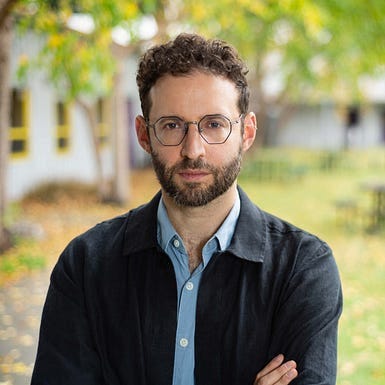
Matt Haugen: Let’s start with New York. What are you working on?
Daniel Aldana Cohen: I’m finishing work on a book, Street Fight: Climate and Inequality in the 21st Century City. It tracks the evolution of low-carbon politics in New York City and São Paulo over the last 20 years, and it shows how battles over cost-of-living crises, in transportation and especially housing, explain when ambitious low-carbon policies have failed, and when they’ve had success. That book research, and especially my early research in São Paulo on housing movements, taught me to see that climate politics is not just about people who use the words “climate change,” but really everyone whose actions have some significant impact on carbon pollution. In the humanities and social sciences over the last 50 years, we’ve done a lot of important work to show that not just rich or white or famous men are cultural actors and political actors and economic actors.
All actors are climate actors, and there’s some really important climate actors that are traditionally not thought of at all in our analyses. Housing movements are, in particular, a really essential one. A big part of what the book’s research shows—and I think recent events have borne out—that housing-oriented movements are climate protagonists of really significant heft, and they are able to slow down or even block climate policies that they don’t like and that threaten them with gentrification and displacement. These movements also have the ability to hold down coalitions that are broad enough to actually get really potent and powerful climate policies passed.
One straightforward example in New York would be Local Law 97, which is probably the country’s most ambitious low-carbon buildings bill. It never would have been passed if it had not been for really strong support from housing-oriented organizers in New York who put protections for low-income tenants at the core of that bill, and that gave them the political muscle to overcome opposition from real estate.
So it’s an exciting time to be finishing this book. I think there’s a lot that the Mamdani administration can actually learn from the climate politics fights of the last 20 years in New York. Although the phrase “green economic populism” is new, the idea of embedding climate in a broader working class struggle for economic well-being and working class power, that’s a little bit older than the [Zohran] Mamdani campaign. I think we’ve learned a lot from experiences so far, and those experiences give us a lot to be optimistic about.
Mamdani has a strong climate record, but he didn’t really talk about that much in his campaign. What do you think about that, and the potential for climate and environmental action in New York City going forward?
Mamdani has shown himself so far to be a climate champion, and he has continued to be really outspoken in favor of public power in New York and the Build Public Renewables Act, BPRA. And he has been pretty unflinching in his defense of Local Law 97, a really important low-carbon buildings bill. His transit agenda is the low-carbon mobility agenda, and his schools agenda is the green schools agenda.
That being said, these are not the points that he emphasized in his top-line messaging. Politically, I think it is smart to embed climate in economic populism. Indeed, to me, embedding is really the key verb for climate politics right now. Not climate or economy, not climate or affordability, but embedding climate in what feels like a holistic, working class economic agenda. When you do that successfully, you can and should talk about climate, even if it’s not the first word that comes out of the mouth.
By contrast, if I’m being honest, we’re having a lot of really unhelpful debates about whether or not you should talk about climate, when the debate needs to be: how do you talk about climate? I think Mamdani showed the answer to that is that you lead with economic populism and then you embed climate within that. When people ask him about it, he doesn’t run away from it. But as he said, famously, in an interview, the climate agenda and the economic agenda are the same agenda.
That being said, you are not going to transform the biophysical basis of human civilization in like 30 years without talking about it. But that is what is required to stabilize the climate. So, to me, the question is not: should we or should we not talk about climate? Today, the question is: how do we talk about climate? And then, politically, over the next few years, in New York City and beyond, what can we do on the climate left, supporting the affordability agenda in particular ways, to earn the right to make climate a top-tier issue in 2029 when the re-election campaign happens? I think that should be our level of ambition. And that would be my other key verb: earn. We on the climate left have to earn this shift, through coalition building, and through the deep economic and material analysis that we need to substantiate those coalitions, and our proposals for green economic populism.
But static, anti-contextual debates about should we say the word “climate” or not, as a general rule, it’s a waste of time. And in this moment, I think if we’re going to ask: what does it mean to earn climate? Then I think we have to ask: where does climate hit the nexus of the affordability agenda in everyday life?
Look at the NYC mayoral primary. The day that Mamdani won the primary election in June was the hottest day in New York City in 12 years. I have a lot of research in process showing that extreme heat exposure is a cost of living issue, because people either can’t afford to buy an AC or to operate an AC at the desired temperature. Or if they do those things, they’re choosing to cool instead of buy medications, or they cool and go into utility debt or what have you. How is it that you run a campaign on affordability, that everybody is practically dying of dehydration at your election night party, that people in polling stations are sweating their entire liquidity out, and you, Zohran Mamdani, champion of climate and affordability, get up and you don’t even talk about climate during your election victory speech, in a room that everyone has basically described as an oven? That, to me, shows that, as the climate movement, we haven’t done our job of connecting the dots sufficiently. We did not earn a way of talking about climate that connected the dots between extreme heat and the cost of living crisis. We have to own that failure.
To have some grace toward us, we had an extremely high-profile billionaire mayor in New York City, Michael Bloomberg, who ruled for three terms, and he really branded himself and climate into one unified package. And he did not at all make it seem like an affordability agenda for working people. On the contrary, he reinforced this idea of climate as a luxury good, an aspirational good.
So it is going to take some time to recover and rebuild a different “brand identity” for climate, based on what this issue is, in an objective material way. Climate is a working class issue of life or death on the extreme case, but of economic survival day-to-day. And, again, what we have to figure out is: how do we earn that cultural common sense among working class people in New York City and elsewhere? How can we figure out, in dialogue with the Mamdani administration, what the specific policies, campaigns, messages, and literal material interventions are that he can embed climate action in economic populism right now, and earn its place as a prominent working class talking point in a way that feels common sense? I don’t mean asking for a professorial version of Mamdani, in 2029, informing the people of New York City that climate is an economic issue for them. We should think about his reelection campaign in 2029 as a “structure test,” as we say in union organizing. We will find out if we have done enough to make climate resonate as a top-tier, working class political issue that connects to affordability and tangible solutions to everyday problems.
What would be your heatwave political agenda?
There are a lot of parts of the country where it is illegal to cut off the power, and certainly the gas, in the winter so people don’t freeze to death. And I don’t really understand why it would be legal to cut off electricity in the summer; I don’t think that should be legal. At that point, you ask yourself, Well should it ever be legal to cut off power? This is a bit of a spoiler for some policy work that some of us are doing, but I think we need to move toward something like Social Security for safe and affordable housing, and we can start with policies that essentially abolish energy poverty for the most vulnerable tens of millions of households in the US. I think it’s time to treat safe, healthy housing as an entitlement in the same way that we think it is basically illegal to be a senior citizen to live in extreme poverty with no income coming in.
It should be illegal for a person to not have access to housing that is healthy enough to comfortably sleep through the night, basically. And that is only possible if we turn down the heat, and if people aren’t impoverished by cooling their homes. We have to earn the reality in which every American has the right to a full night of sleep—or day if they sleep during the day, if they work at night—and that includes the temperature being sufficient to support that. There’s abundant research showing that people who don’t have access to safe temperatures at home are not even getting the same quality of sleep.
Capitalism and climate change are literally robbing people of their dreams. They’re literally robbing people of the dream time at night, during which the spine and the brain and the rest of the body are cleaning themselves out, because sleep is a metabolic necessity for mammalian life. We’re not even getting into socialist dreams here, but under capitalism, if we have social rights, that should include the right to sleep and to be in a safe temperature home.
Now, we could talk about all kinds of policy measures to implement that, and I think there’s everything from national policy to very specific stuff you can do around appliance rebates. There are solutions ranging from heat pumps to building upgrades to neighborhood cooling, etc. But let’s not start with an abstract debate about technology, let’s start with the imperative of human beings right to a safe and healthy home. There’s going to be a lot of battles, especially around landlords and tenants, and we should look forward to those and we should win them.
I know you’ve done work with CCI about Vienna. It’s well-known as being this great example of social housing and the type of housing we might want to strive for. What are the lessons from Vienna, and what can we learn from Vienna here in the US?
I think the basic facts of Vienna are: it’s frequently ranked the most livable city in the world—and if not number one, number two or number three—it has the lowest rent of any major city in Western Europe, and it is the global capital of social housing.Half the city’s population lives in social housing. You put those three facts together, and they destroy every single myth about how only the private sector can deliver high-quality housing at scale. That cannot be true if a medium-sized capital of a European country houses half of its people in social housing, offers a better quality of life than basically any other city, and, by the way, is the lowest-cost of these cities to live in. And by the way, social housing in Vienna has become one of the city’s primary levers for greening and decarbonizing Vienna, which it’s doing a pretty job of.
So even if we are not going to become Vienna—and we shouldn’t—in the United States, there has to be something we can learn. One is that there’s not a single magic silver bullet of policy. As one New York housing advocate—a good friend of mine, Sam Stein—pointed out, New York City has every single one of the basic policy frameworks that Vienna has. They’re not as well developed, but achieving some version of what Vienna does, that is absolutely feasible here.
Essentially, what you have in Vienna is three sets of actors: motivated experts; organized, working class communities; and political leaders. When all three of them converge on housing as a human right, and they launch a serious social housing development agenda, and you get this broad social consensus, then you build the momentum to just keep at it, year after year. Even, as the political economy and the political context changes, that sort of triangle is strong enough to adapt the policy. So Vienna’s social housing policy has changed quite a bit over the last hundred years, but what’s been consistent is the provision of housing as a human right to a broad swath of people. As a result, the Social Democratic Party associated with this has never lost a free and fair election.
Once you get going, once you build that snowball and that momentum and you build the organized constituency around it, that is what really matters; it’s not the exact policy detail. We could talk more about financing and all that, but we already have spreadsheets that make the numbers work. CCI has its version, other people have theirs. The harder question is: how do you build the political infrastructure that then makes that policy inevitable? So I think in the same way that in the US the right just cannot get rid of Social Security, in Vienna they just cannot get rid of social housing. It’s just a question of: how are you going to operate it? So again, how do we cement a political infrastructure that just gets this going?
The other thing I would say that with Vienna’s social housing, the architecture and the technological innovations are absolutely incredible. I think that helps to demystify the idea in the United States that if you want to max out on technical innovation, you have to put up with a certain amount of Darwinian, savage market competition. Because the myth says, ok, the public sector might deliver the units of housing, but they’re not going to be interesting or pretty or good quality homes. Or we can let the market do it and you’ll get all this dazzling innovation, but it might leave some folks behind. So in the US mythology, you have to choose between social provision and innovation.
What we’ve seen in Vienna is that a public sector-led system delivers spectacular innovation—really interesting technical stuff, with major benefits for everyday life in the housing. In fact, across Western Europe, green social housing architecture is winning global architecture prizes. So what you learn from the Vienna example—and not just Vienna—is that a public-led approach can absolutely deliver you all the innovation and technical wizardry you could ever want, and that that does not depend on savage free market competition.
One of the things I find so compelling about Vienna and some other social housing experiments is not just the public sector and the lower rents and the climate possibilities, but the social aspects of how it’s intentionally designed to foster community and things like that. I feel like that’s really underappreciated, and something that there’s a lot of potential for in the US. It’s increasingly recognized as a problem, the alienation and the decline of third spaces and whatnot.
Yeah, we need to literally build community. Right now smartphones are the suburbs in our pockets. The antidote to that, at some level, is politics. It’s people like Zohran Mamdani. Or in Atlanta, Kelsey Bond, who had a very similar style: they built a whole social life and culture around the campaign. So at that point, the phone becomes the means of social engagement, not the end; digital organizing becomes just a step toward getting people together. And then I think it’s not a coincidence that these candidates’ politics are a politics of literally building communities to facilitate that face-to-face interaction—it’s social housing, it’s public transit. I’d say it’s a much more left-wing version of this “15 minute city” idea, which in and of itself is neither left nor right.
But if most working people can get most of their needs met within a walk in their community, that’s great. Originally, that is a feminist dream that goes back to New England in the 19th century. This became a big banner in Vienna. You don’t want to have a suburban environment where dad goes to work on the train, and then mom’s at home with the kids by herself in the house. You want to have a full community where different kinds of people can live different kinds of lives and people are able to see each other.
I think one of the great betrayals in the American built environment was that the right-wing version of public housing, that was enforced by the real estate industry, led to isolated towers in the park instead of these more integrated forms of community planning. You did have some architects who were very fascinated by this tower in the park, but I think most people have always known that that wasn’t the ideal model. I’m not saying you can’t have towers, but you can do better planning around those. And part of what we’re talking about today is, we do have the opportunity to take some of those public housing complexes and actually reconstruct them to put in buildings of varying heights, to fully interconnect the streets with the paths in that housing.
There are architectural drawings that are all widely available on the internet, circulating in New York City, that could even take some of the most challenging physical setups of public housing communities and make them into beautifully designed spaces with new green investment. And that’s not about displacement, and nothing should happen without extensive consultation and leadership from public housing communities. But certainly, we should reject the idea that public housing has failed, it should be torn down and replaced. No, the project is engagement, uplift, upgrades, building community in some new and ambitious ways with local leadership.
I think something we’re going to be talking about more and more is, to your point, there’s a social goal of building real, interconnected communities that public housing agencies with a bit more governance reform and better investment could be really the leaders in. What does it mean, let’s say, if the power goes out in your community in New York City and you’re like, Where am I going to go plug in my phone? And it’s the community center in the public housing complex. By the way, in a heat wave, if your power went out, that’s where the cooling center is that you love to go to.
Because we’re talking about these public housing complexes, you have the ability—as they do often in Europe—to offer much lower rent to ground floor retail, so it doesn’t have to be just a CVS. If you go to the gentrified neighborhoods of these huge buildings, they always have a CVS on the ground floor, which can afford the rent. But when you do social housing development properly, you have a local florist. You can have cheap, affordable, organic groceries—something AOC talked a lot about in the Green Deal for Public Housing era. You have daycares. You can have non-market or subsidized segments of the built environment to locate essential services that make life better. It’s not just the government office of yoga; it can be a neighborhood yoga studio. There could be public groceries, or it can be a halal cart.
There is just this enormous opportunity to rebuild our literal, physical community fabric to bring in the community. That hasn’t always been the mission of public agencies. We have to understand that’s because those public agencies were fundamentally deformed by real estate interests. We all know how to do better, and I think the movements that elected Mamdani are the working class forces that could unlock new modes of living together in community.
I do think that’s another shift for those of us in “think tank world” to make. I think sometimes, and I say this of myself too, we imagine that we are coming up with the policies to hand over to the working class organizations and people and communities to then get what they want. When I look around the world, I think the greatest success comes from people doing this “knowledge work” in dialogue with communities. We’re trying to develop frameworks that empower working class communities and organizations, that empower these folks to then go out and rebuild the world in truly democratic and egalitarian ways. We are serving that process; we are not providing the answers. We in leftist think tanks are doing work which should always be seen as open-ended. It may be that people in public housing hate this vision that I’ve laid out, so they can have another one. My job isn’t to tell people what to do, but offer them some resources.
Six years ago, I was invited into a room in the Bronx to talk to public housing residents about what a Green New Deal for Public Housing would be. I didn’t talk about carbon pollution, I talked about appliances and upgrades to their units. I basically said the best chefs in the world now, in places like London, are using magnetic induction cooktops to cook food in a fast and clean way. Why don’t you have access to this stuff? It’s an outrage. What the Green New Deal means in these communities is that you have access to the best living environment that is on offer. Folks were enthusiastic, so we got to work together.
Imagine what we could do, and what we will be able to do, when we are really building serious progressive and working class power. Even with those movements just a bit on the rise, you’re seeing these transformations. People deserve to live at a really high quality of life to benefit the most from green technology. I think that’s a vision we’re starting to get in our public institutions and housing. In think tanks, we have a ton of work to do to hammer out policy options, to do economic analysis, to explore the full range of possible solutions and to get those ideas out there to different audiences. And if we’re doing our part, I think that can support working class movements taking more leadership in defining a new climate agenda, embedding that in green economic populism, and making climate a top tier political issue in a new and more effective way than ever before.
At CCI, we are putting forward real, actionable solutions for a greener, fairer future for all. You can find our full reports and other publications on our website or connect with us on Bluesky, X, or Instagram. Stay subscribed to our Substack for the latest on creating climate policy you can touch.
In solidarity, the CCI Team