

From time to time, I’ll find a data point in popular debate that irks me. In the past, claims about the Green Revolution prompted me to structure a bit of teaching, to help my students develop some statistical curiosity about whether the claims were bullshit. So when I saw this graph in circulation on a list or two, I knew it was time to dust off the databases.
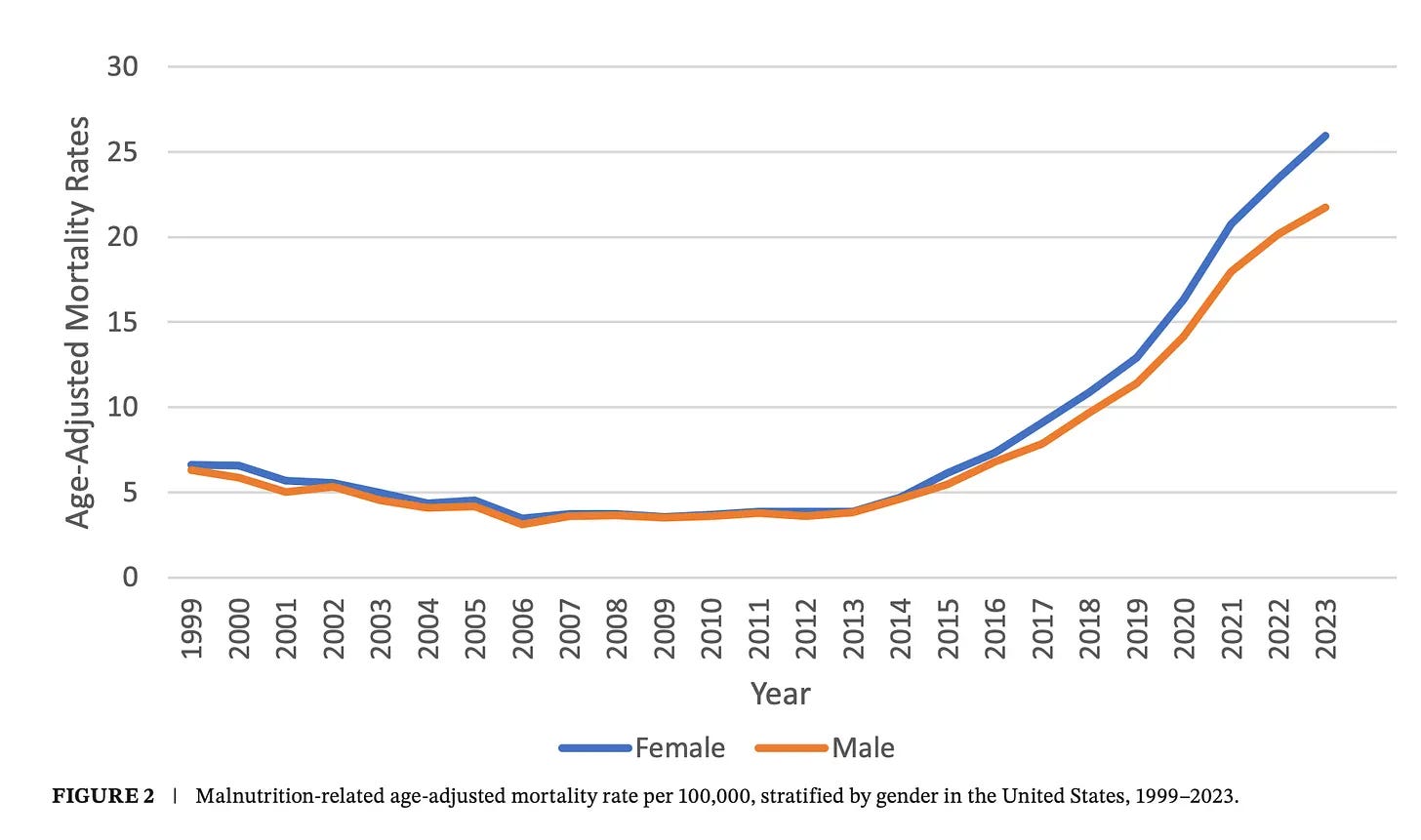
This graph, from this peer-reviewed article, seems to show that in the US, the number of adults who died of malnutrition has gone up between four and five times over the past 20 years. Incredible if true. That’s a lot of Americans starving to death. But is this actually happening?
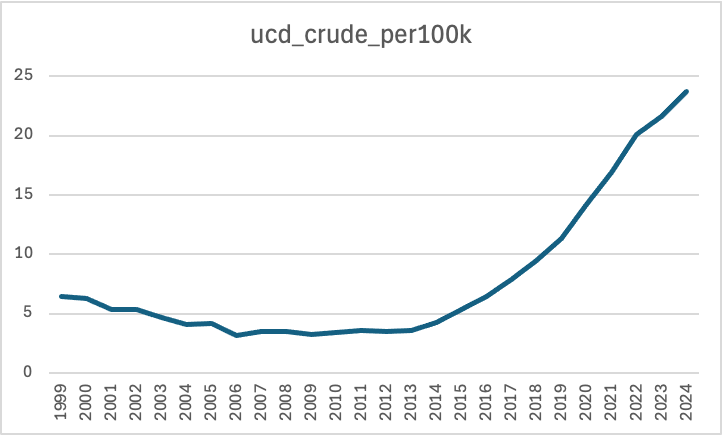
Malnutrition-related age-adjusted mortality per 100,000, US adults 55 and over
If you head to the CDC’s WONDER database, you can recreate this yourself, as I have above, using ICD-10 codes E40 to E46, restrict to adults 55 and over, and group by year. Because the series spans two WONDER files, you stitch 1999 to 2020 onto 2018 to 2024, and it comes out as you’d expect. So something’s happening in 2013, and we need to figure out what these numbers are actually recording.
Is what’s happening that older people are getting hungrier? In part, yes. Leung et al in JAMA Health Forum tracked hunger using a far more robust measure, a cohort study from the Panel Study of Income Dynamics, and found this:
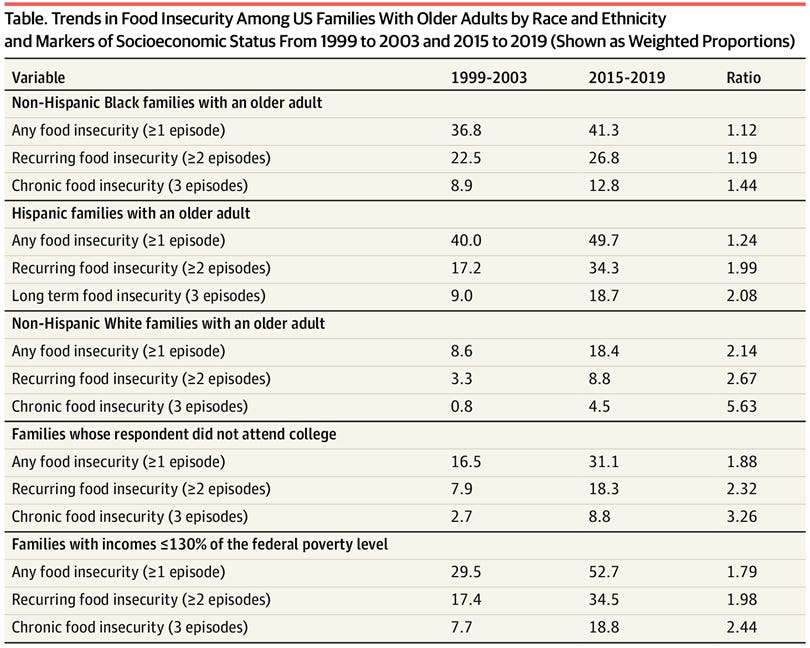
There definitely is an increase in food insecurity and poverty, particularly for elderly Americans in the austerity period. But it’s nothing like the increase that crops up in the fatal malnutrition data. So what happened in 2013? Something changed in what physicians were willing to write in the top half of a death certificate.
In 2012 the Academy of Nutrition and Dietetics and the American Society for Parenteral and Enteral Nutrition published a consensus statement giving clinicians a six-characteristic checklist for identifying adult malnutrition. This is a fine instrument, and it’s important to be vigilant for malnutrition. So is it that people read the annals of the academy and started adopting it widely? Not quite.
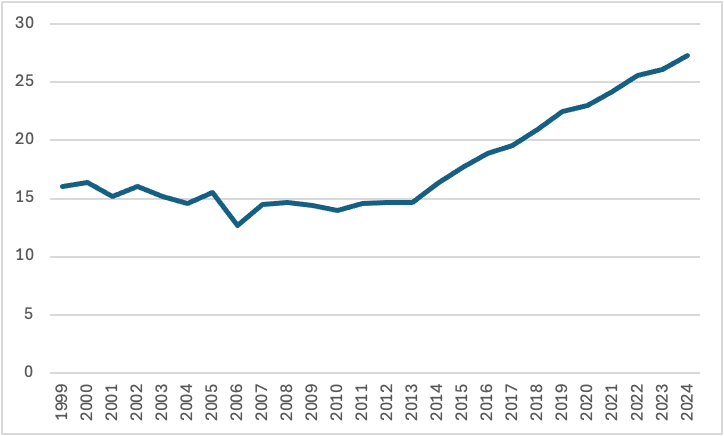
What proportion of death certificates mentioning malnutrition name it as the cause of death?
There was a good faith effort to increase the screening for malnutrition. And then there was the apparatus that gets used to pay for all this. Under Medicare's prospective payment system, the severe malnutrition codes E41 and E43 count as major complications or comorbidities, which means adding one to a claim can move a patient into a better-paying diagnosis-related group. So if malnutrition isn’t just present but responsible for people dying, there’s money in it.
Problem solved.
The diagnosis of malnutrition, and its promotion to the main cause of death, lined up. Even, um, when it wasn’t. In a 2020 audit, the Inspector General noted:
hospitals did not correctly bill Medicare for the remaining 173 claims. For nine of these claims, the medical record documentation supported a secondary diagnosis code other than a severe malnutrition diagnosis code, but the error did not change the DRG or payment. For the remaining 164 claims, the billing errors resulted in net overpayments of $914,128. These errors occurred because hospitals used severe malnutrition diagnosis codes when they should have used codes for other forms of malnutrition or no malnutrition diagnosis code at all. For these claims, hospitals provided medical record documentation that did not contain evidence that the malnutrition was severe or that it had an effect on patient care. On the basis of our sample results, we estimated that hospitals received overpayments of $1 billion for our audit period.
The over-coding for malnutrition is one that another study corroborated. Wildly, they found that while the coding for malnutrition went up over their sample, the death rate went down, which isn’t what you’d expect if people were at famine’s gate but is what you’d expect if large hospitals have an incentive to milk Medicare for extra billings.
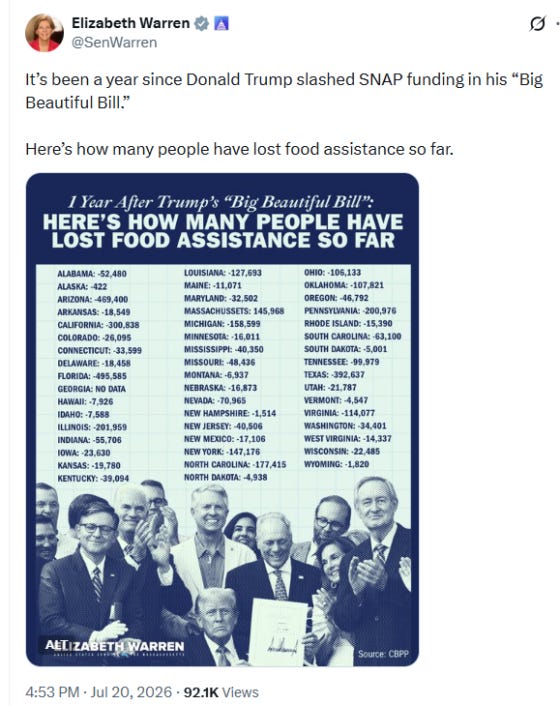
Malnutrition in old age is real, common and lethal, and for most of the past thirty years American medicine has ignored it. But after 2012 it became reimbursable for hospitals. Hundreds of millions of dollars have been frittered away through the healthcare system, and yet the USDA has stopped collecting information about it (we’re at the mercy of the Federal Reserve Bank of New York for what limited live information we can get). And, as this tweet from Elizabeth Warren observes, millions have lost access to their food assistance in the year since Trump’s Big Beautiful Bill.
Hello! With all that we’ve learned this week about covid, could you maybe do a post about the impact of the Gates foundation on african agriculture? Thank you if that’s possible!