

Alberto Garzón’s Ecosocialist Notebook is a fund of insight, and deep scholarship. Not for nothing was he one of the invitees at a recent Economy for Life meeting in Colombia. You’re well advised to subscribe to his newsletter both to get ahead of what will undoubtedly be another poor choice from the Swedish Riksbank in 2026, and to find out what he learned there. Meantime, here’s Alberto’s analysis of the last winners of the Sveriges Riksbank Prize in Economic Sciences in Memory of Alfred Nobel.
More than fifty years ago, the Club of Rome’s report Limits to Growth, directed by Donella Meadows, provoked a furious reaction among conventional economists. The 1972 document predicted that “the planet will reach the limits to its growth within the next hundred years,” meaning that, over the course of the 21st century, the depletion of certain natural resources would inevitably lead to a decline in both population and industrial capacity. In short, economic growth would collapse, and society as we know it would fade away.
Two years earlier, American economist Paul Samuelson had received the Nobel Prize in Economics. When the report was published, he used his renewed fame to attack it. Samuelson dismissed Meadows’s work as an exercise in hysteria, while his student William Nordhaus called it “pure fantasy.” Nordhaus admitted that economists were having an “allergic and violent reaction” to the report’s pessimistic theses — but, in his view, a justified one.
Fifty years later, little has changed. In academic economics, it is still rare to find analyses that take seriously humanity’s ecological dependence. And when the issue is addressed, it is usually through cost-benefit analysis that ignores the fundamental fact that the economy is a subsystem of the Earth System — not the other way around. The fact that Nordhaus was awarded the Nobel Prize in 2018 “for integrating climate change into long-run macroeconomic analysis” is a perfect example of this blindness. His models, more controversial than helpful, have justified decades of weak and superficial action by assuming that future economic growth will compensate for present environmental damage.
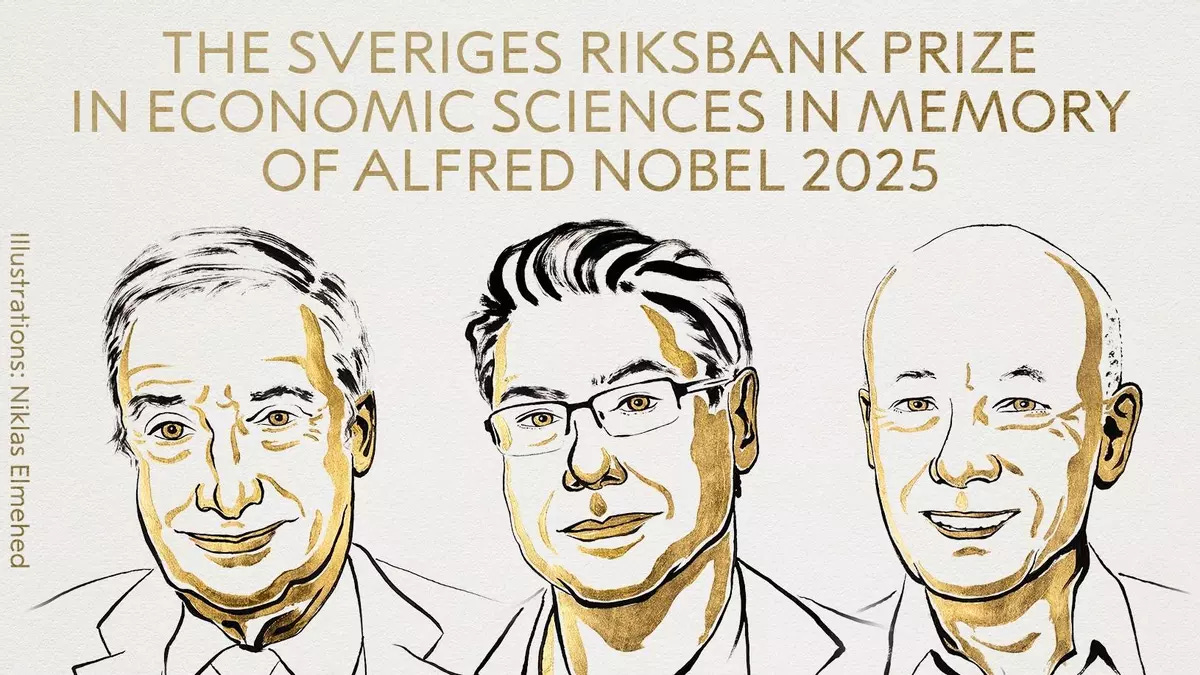
The most recent Nobel in Economics, awarded just days ago to Joel Mokyr, Philippe Aghion, and Peter Howitt, reproduces the same shortsightedness. The three were honoured for “explaining innovation-driven economic growth,” yet their worldview leaves intact the premise that the economy stands above nature. And that has consequences.
Mokyr: The Industrial Revolution Without Coal or Colonies
Mokyr’s case is particularly striking because he is an economic historian who has sought to explain the origins of the Industrial Revolution — widely regarded as the beginning of the Anthropocene. His interpretation focuses on the role of what we now call the “knowledge economy”: the accumulation of theoretical and practical know-how later applied, directly or indirectly, to production. For Mokyr, it was the power of ideas — embodied in particularly intelligent and creative men — that determined the course of the Industrial Revolution in England.
This view of economic history fits well with models of the “new growth theory,” particularly the notion of human capital, which refers to the knowledge and skills each worker possesses. Most mainstream economists today emphasise this aspect, promoting education and professional training as the surest path to economic development. Both approaches share a blatant individualism: they assume that success or failure depends on personal attributes, downplaying the role of productive structures and other critical factors — beyond workers’ control — in shaping national development.
What is most striking — and perhaps most troubling — about Mokyr’s analysis, however, is the complete absence of geography and environmental factors. He has explicitly claimed that Britain’s abundant coal reserves played no essential role in the Industrial Revolution, even minimising the importance of the steam engine. In his view, it was human creativity that truly drove the process — so even without coal, the British would have found other energy sources to power their new technology. This interpretation reveals an openly hostile attitude toward ecological thought, which Mokyr associates with a kind of religious fundamentalism that, in his view, defends a conservative stance in which humanity manages but does not dominate nature. In Mokyr’s work, the Promethean dream remains alive and well.
Mokyr’s work offers insights, but it is far from a complete understanding of the Industrial Revolution. Many economic historians have provided far more realistic and comprehensive accounts of how modern societies emerged. In La guerra por la energía (The War for Energy, forthcoming January 2026), I explore this issue in depth, but three names suffice here: Kenneth Pomeranz, Edward A. Wrigley, and Jason Moore. Together, their work demonstrates that the Industrial Revolution was only possible through the combination of cheap energy from fossil fuels and the colonial networks woven by imperialism — including the exploitation of natural resources and the most fertile, low-cost lands of the New World (seized from Indigenous peoples), as well as slave labour (Indigenous, indentured, or African). Given how uncomfortable such a story is for the Western world, it is unlikely that any of these historians will ever win the Nobel Prize in Economics. Though strictly speaking, only the last of them identifies as both an ecologist and a Marxist.
Aghion and Howitt: Innovation as a Universal Balm
The case of Aghion and Howitt is both different and similar. Different, because they are not historians but economists focused on the variables that drive growth, and thus they look more toward the future than the past. Yet similar, because their conception of the economy once again places it above nature — not as a set of biophysical limits, but as a practically inexhaustible source of resources for human expansion.
Many economists — including some progressives — have celebrated the Nobel Prize to Aghion and Howitt. Partly because their work revives the old intuitions of Joseph Schumpeter, who understood economic development not as a linear process but as a cyclical dynamic driven by innovation and human creativity. Within growth theory — a highly formalised and mathematically complex field — this represents a meaningful addition. And, as usual, it is not just theory: the policy implications differ markedly from those of earlier, more free-market, neoliberal models. Yet despite their apparent novelty, Aghion and Howitt’s contributions remain anchored in the dominant neoclassical framework, and it is therefore unsurprising that their treatment of ecology is so deeply limited.
In fact, in Chapter 16 of their book The Economics of Growth, Aghion and Howitt present a model that, they argue, integrates environmental concerns. This is worth examining closely, as it distils the entire logic of mainstream economics. They start by introducing the assumption that natural resources are scarce into the traditional growth model. Since production depends on those resources, it follows intuitively that growth must eventually stop. To avoid that result, they shift to a new Schumpeterian model in which innovation, driven by “human capital,” enables infinite growth. The conclusion is that innovation is the key to overcoming environmental problems.
Aghion and Howitt focus on resources, which they correctly recognise as finite and non-renewable, but they omit the other side of the equation: the planet’s capacity to absorb the waste produced by economic activity, including the CO₂ driving climate change. William Nordhaus, as mentioned earlier, addressed this issue through his climate-economy models, which evaluate the impact of global warming and determine optimal policies for emissions reduction. Yet in both Aghion and Howitt’s work and Nordhaus’s — and indeed across most of mainstream economics — a core conviction persists: the belief that technological innovation will suffice to solve ecological problems.
The Old Faith in “Weak Sustainability”
This way of framing the ecological question has roots in the era of the Club of Rome’s report. Two mainstream economists — Robert Solow and Joseph Stiglitz, both Nobel laureates — responded to environmentalist arguments by modelling nature as a form of “natural capital.” Their central premise was that this “natural capital” could be substituted by other types of capital — machines, knowledge, infrastructure, and so on. Consequently, even if natural resources were scarce and finite, their depletion would not pose an insurmountable obstacle to economic growth. The conclusion was comforting: as long as the economy kept expanding — fueled by innovation — resource scarcity and environmental damage would ultimately prove irrelevant.
This controversy sparked a significant debate in the 1970s with the first ecological economists, notably Herman Daly and Nicholas Georgescu-Roegen. Most economists have since ignored that debate, and few students today are even aware of it, yet it gave rise to two crucial notions: weak sustainability and strong sustainability. The former corresponds to the neoclassical approach, which assumes the substitutability of natural capital; the latter corresponds to the ecological economics approach, which holds that natural capital is not substitutable and that certain ecological damages are irreversible and cannot be compensated in money.
Outside the narrow world of economists, most people with a modicum of common sense would side with the ecological economists. No matter what the neoclassical mathematical model allows, natural resource scarcity cannot be replaced by machines — physics and biology do not permit it. Likewise, ecosystem damage — biodiversity loss, soil and air pollution, desertification, or any other critical Earth-system indicator — can be catastrophic and irreversible. Yet Nordhaus’s models — rewarded with the Nobel, no less — assume that economic growth will make future generations wealthier and thus better able to bear the costs of climate change. From that premise follows a dangerous conclusion: that there is no need to act too decisively today to reduce emissions.
In short, the latest Nobel laureates do not represent progress but rather the consolidation of a way of thinking about the economy–nature relationship that is, quite literally, civilizationally suicidal. Put bluntly: a civilisation that believes it can replace water with artificial intelligence is doomed. As we navigate an unprecedented ecological crisis, tens of thousands of economics students graduate each year around the world, trained in a worldview that is as elegant in its equations as it is useless for confronting the challenges of the present. It is little wonder, then, that — since these are the economists who directly or indirectly shape government policy — half a century after The Limits to Growth, the critical indicators of the Earth System, beginning with greenhouse gas emissions, have only continued to worsen.
Want more? Sign up to Alberto’s newsletter here.
This is an excellent article. But nobody seems to think that we need to limit the population. It is important to understand the upper bound for human growth. We are one species amongst the millions. If we talk of Ecology, we need to limit human population.