

Sonia Shah is the author of a shelf of politically savvy books that do the patient forensic work of political ecology. The Fever, my favourite, spends half a million years on malaria to make one point: it persists not for want of a cure but because of poverty and politics. The Next Great Migration, her most celebrated, runs the same move on different ground. The movement of people and species is not the catastrophe we’re sold but the oldest response there is to a changing world.
The piece below, reposted with Sonia’s permission, is an argument about imperial epidemiology brought up to the minute. Ebola is getting bigger and more frequent, and one underreported reason is the device on which you’re reading this: the gold, tantalum, and cobalt in our phones and semiconductors are dug by hand from the Congo basin rainforest, and every track cut into the trees is another roll of the dice on a spillover. I’m grateful she let me put it here. Subscribe to her Substack, Cross Pollinations, for more.
Is our demand for smartphones and semiconductors making Ebola worse?
How cutting down trees to dig for gold and other critical minerals is fueling more and bigger outbreaks of Ebola
Jun 08, 2026
I started looking into the connection between deforestation and Ebola outbreaks many years ago, but it was only in the last couple weeks that I learned how much global demand for critical minerals—gold, tantalum, cobalt and others—is playing a role in the ecology of the disease. Turns out, since the first outbreak in 1976, Ebola outbreaks have been getting bigger and more frequent—and global demand for smartphones and semiconductors are one important and underreported reason why.
The lush Congo basin rainforest is the second largest tropical rainforest in the world and also one of the world’s biggest untapped sources of minerals such as cobalt, tantalum, and gold which the tech industry needs to build everything from smartphones to semiconductors. The US, the EU and others consider them “critical minerals” for the economy and national security. Demand is soaring and expected to triple in coming years. Just last year, thanks to Trump’s tariffs, the price of gold doubled.
The result is fattening the bottom lines of tech companies, showering consumers with tech gadgets—and transforming the ecology of Ebola.
By now most of us know that Ebola viruses live in the bodies of animals such as fruit bats and others. And that they spill over into our bodies when we come into intimate contact with their blood, saliva, or excreta, for example by eating a piece of fruit with bat saliva on it or by hunting and slaughtering a bat—or some other Ebola-laden animal—for food.
But here’s the key thing. Not every spillover will start an outbreak. Some spillovers—perhaps most!—will die out without causing any further infections or just a few that then peter out. Getting a chain of transmission going is a probability game. The more spillovers there are, the more likely one will spark.
In the quest to fatten the bottom lines of tech companies and shower consumers with digital gadgets, that’s precisely what’s happening right now.
More on that, below.
How Ebola is linked to the smartphone in your pocket: the back story
As I wrote in the Guardian story that came out last week, nearly 400,000 people in eastern DRC eke out a living by digging for minerals such as gold and tantalum that are required to build smartphones and semiconductors. It’s called “artisanal” mining, which really means informal and unregulated mining, because it’s done without the involvement of major mining companies, who are reluctant to open mines in the area because of the long-standing and ongoing conflict and political instability.
So far, Chinese mining companies have dominated the critical minerals sector in DRC, but the Trump regime is hoping to change that. In March 2025, a lobbyist enticed Secretary of State Marco Rubio to make a deal—access to DRC minerals in exchange for military support. The result led Trump to brag that he “actually stopped the war with Congo and Rwanda,” and that “‘they said to me, ‘please, please, we would love you to come and take our minerals. Which we’ll do.” (Side note: must he always be so weird and rapey?)
A handful of months later, Rubio hosted the inaugural “Critical Minerals Ministerial” in Washington DC, where he entertained delegations from 50 countries hoping to muscle in to the critical minerals sector and counter China’s dominance. The summit facilitated deals to sell copper and cobalt mines in the Democratic Republic of Congo, one of the world’s biggest untapped sources of critical minerals, to two US companies: Virtus Minerals and Orion Critical Minerals Consortium.
While dollar signs spin in the eyes of mining execs and political leaders, in the mineral-rich Congo basin, informal miners dig up the gold-specked rocks and pass it along into the global supply chain through intermediaries and traders. The higher the price, the deeper they go.
You can see their tracks from space.
Below is a satellite image of the area around Mongbwalu, the mining town that is the epicenter of the current outbreak of Bundibugyo Ebola. The red and orange areas are older deforested areas, with Mongbwalu in the lower right corner. The light blue indicates areas newly deforested in 2025, a year after record deforestation across the Congo basin rainforest. You can see what happened, as the price of gold doubled thanks to Trump’s tariffs, pretty clearly. People started penetrating the pristine forests around Mongbwalu, along the gold-rich riverways to the north and west.
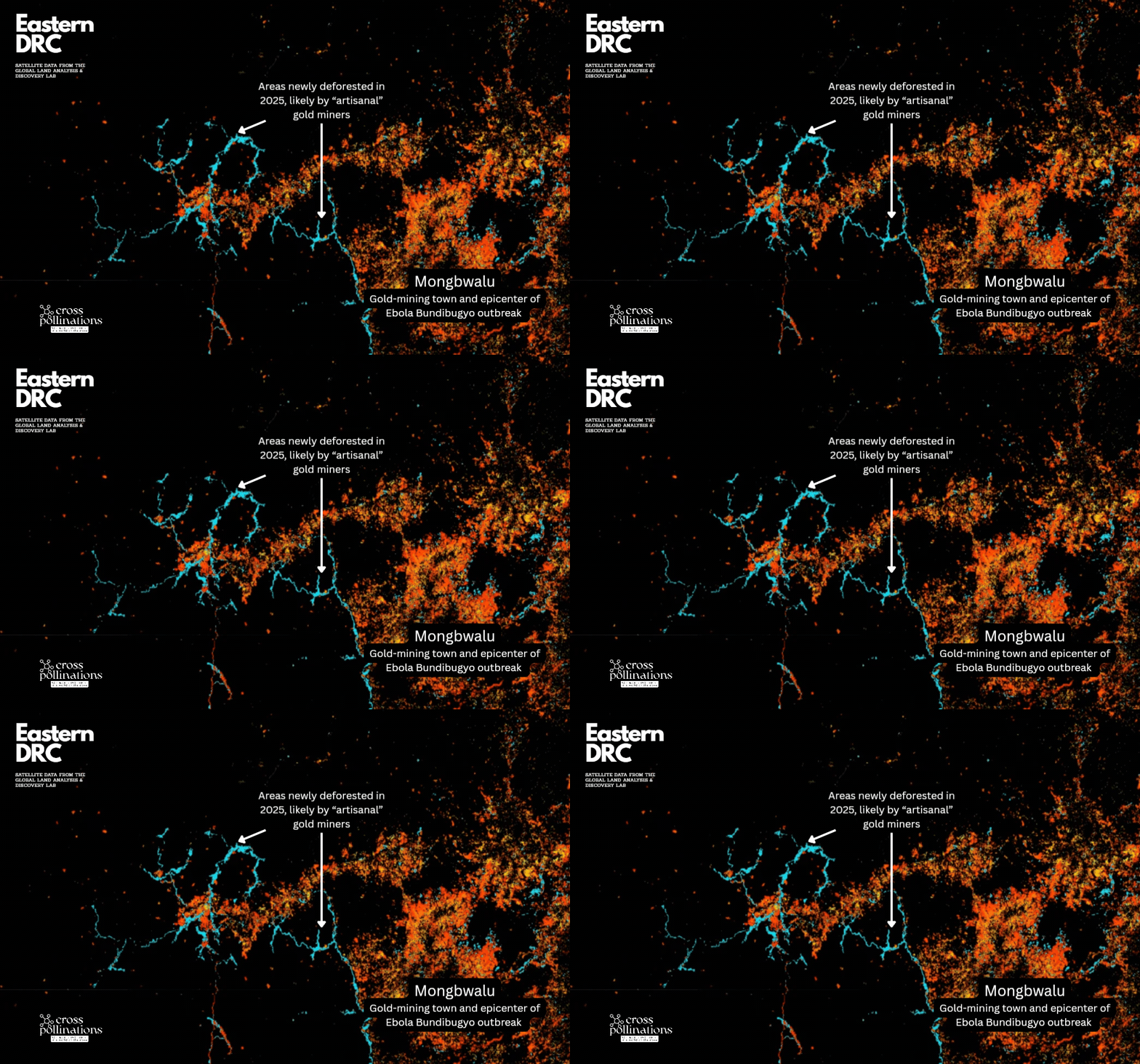
I checked out this satellite imagery while on a video interview with Matthew Hansen, co-founder of the University of Maryland’s Global Land Analysis & Discovery Lab, which has been mapping global deforestation using NASA’s LandSat data since 2012. Hansen has spent time in the DRC, but he hadn’t looked at the area around Mongbwalu before we spoke. “All I know,” he told me, is that DRC is “typically second or third annually in terms of deforestation, and mostly it’s done by hand.”
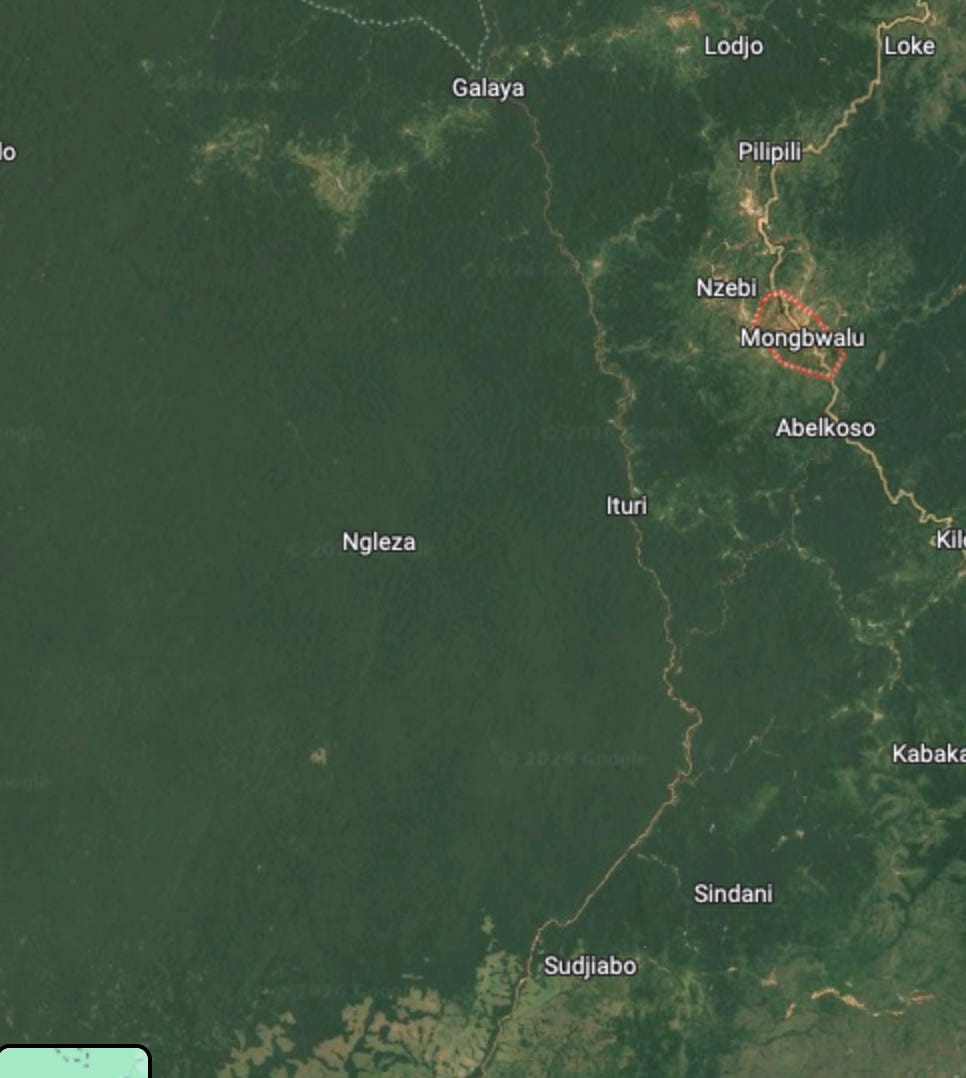
He was incredulous when he zoomed in on Mongbwalu. “Wow, it is a ton of mining around here,” he said. “Holy shit.” The pattern struck him. It isn’t the expanding circles of growing farms, but ragged lines of deforestation along riverways, snaking deep into the core of the forest, with scattered clearings for small settlements. The footprint of mining was “impressive,” he said, “stellar,” even, though “in a bad way.” It wasn’t the scale of the deforestation that struck him, so much as what this particular kind of mining-related damage does to the forest. “Mines generally in terms of footprint are really small. But the problem is they are opening up the forest in a way that other land use doesn’t. You go out in the middle of the forest.”By the way: none of this would be visible without data like Hansen’s. This is what the area around Mongbwalu looks like on Google Maps: green and untouched.
Why are people plunging deep into the forest, far away from markets where they can buy food other than Ebola-laden bushmeat and access healthcare and sanitary facilities? It’s the slow-motion catastrophe of climate change, which is making subsistence farming more difficult, unresolved and violent conflict, and the glittering high price of gold and other critical minerals that feed the global tech industry.
So yes, we need more treatments for Bundibugyo, and vaccines, and support for contact tracing and the rest of it. But there’s no number of emergency rooms that will prevent outbreaks of novel diseases like this before they start to spread, as veterinary epidemiologist Chris Walzer of the Wildlife Conservation Society said when we spoke. Outbreaks of new zoonotic pathogens like Bundibugyo Ebola is the price we pay for invading wildlife habitat.
That price—in lives lost to outbreaks, flights diverted, people evacuated, new treatment units constructed, and more—will be paid by the people of DRC and other countries in the region and the international community.
The benefits, on the other hand, flow into the private coffers of tech companies.

Subscribe to Sonia Shah’s Cross Pollinations for more!
Thank you for sharing this, Raj, and for the kind words!