

If you’re not yet signed up, The Checkout is well worth your time..
“The annual olive harvest in Palestine is more than an agricultural event; it’s a cultural cornerstone. Rooted in millennia of tradition, this harvest is crucial for Palestinians’ economic survival and cultural identity.
“The story of olive cultivation in Palestine is as old as the land itself. Archaeological evidence suggests that olives were first cultivated in this region over 6,000 years ago. - From Olive Odyssey brand page.

UN Experts Call To Protect Palestinian Olive Harvest.
Reprinted With Permission.
UN experts are calling for protections of Palestinian farmers in the occupied West Bank during their annual harvest. Farmers face renewed threats to their livelihoods, cultural rights, food security and food sovereignty as the annual olive harvest gets underway, UN experts* said today, urging Israel to guarantee their protection and safe access to their land.
“Palestinian farmers must be protected and able to access their land safely. Yet, year after year, the violence, destruction and restrictions intensify,” the experts said.
“The olive harvest should be a time when farmers can enjoy, in safety and dignity, the food and livelihoods their nature and land provide, not another season of fear, loss, violence and destruction.”
The olive harvest is a significant time of the year in Palestinian society, and is vital to Palestinian agricultural economy and cultural heritage. Tens of thousands of Palestinian families depend on the olive harvest as their primary source of income.
During the 2025 olive harvest, 178 Israeli settler attacks linked to the harvest were documented across the occupied West Bank, affecting 88 Palestinian towns and villages, the highest number of locations recorded since 2020. More than 6,000 trees and saplings were vandalized, nearly double the number in 2024 and the highest in six years.
The experts were alarmed by orders issued by Israeli military authorities in September 2026 for the removal of vegetation from approximately 84 acres of Palestinian agricultural land in the northern and central occupied West Bank, including areas planted with olive trees in Jenin, Qabatiya and Beit Rima.
The orders include provisions for the uprooting of olive trees and impose extremely short periods for landowners to remove vegetation and file objections.
“The olive harvest is an essential source of food, income and livelihood for thousands of Palestinian families, and is deeply rooted in Palestinian cultural and agricultural heritage,” the experts said. “Olive trees take years to mature and can sustain families for generations. Their destruction deprives families of far more than a single harvest: it undermines local food systems, cultural practices and ways of life, as well as the right to food and the food sovereignty of Palestinian communities.”
The experts repeated concerns about continued violence, intimidation and access restrictions imposed by Israeli forces on farmers, and about reports of olive groves being uprooted in several areas, including by Israeli military bulldozers near Ramallah shortly before the harvest.
They warned that the situation could worsen as Israeli authorities increasingly revoke or fail to issue the ‘prior coordination’ permits required for farmers to access their land in certain areas. This year, the Israeli military modified its policy, preventing Palestinians from obtaining permits or harvesting olives on land classified by Israel as ‘State land’, including plots containing olive trees that Palestinian farmers have traditionally harvested for generations.
Food security in the occupied West Bank has long been under severe strain, driven by intensifying settler attacks that have displaced mainly Bedouin and herding communities, and by Israel’s continued withholding of Palestinian clearance revenues, which has sharply eroded household incomes.
The experts urged Israel to ensure that its forces protect Palestinian farmers from settler attacks, refrain from interference with their access to land and to comply with its obligations under international law.
“Israel is under an international legal obligation to end its occupation of Palestinian land, immediately cease new settlement activities, evacuate settlers from the occupied Palestinian territory and provide full reparation for the damage caused by its violations, including by returning land and allowing displaced Palestinians to return to their homes,” the experts said.
“The international community, especially States with power and influence, must exercise maximum pressure to protect Palestinian civilians, halt and reverse the rapidly expanding policies and practices of annexation and ensure accountability for decades of violations of Palestinian rights under international law,” they said.
Signed,
Sofía Monsalve Suárez, the Special Rapporteur on the right to food
Alexandra Xanthaki, the Special Rapporteur in the field of cultural rights
Elena Carolina Díaz Galán, the Special Rapporteur on extreme poverty and human rights
Paula Gaviria, the Special Rapporteur on the human rights of internally displaced persons
Francesca Albanese, the Special Rapporteur on the situation of human rights in the Palestinian territory occupied since 1967
Reem Alsalem, the Special Rapporteur on violence against women and girls, its causes and consequences
Shalmali Guttal, the Working Group on the rights of peasants and other people working in rural areas
Special Rapporteurs/Independent Experts/Working Groups are independent human rights experts appointed by the United Nations Human Rights Council. Together, these experts are referred to as the Special Procedures of the Human Rights Council. Special Procedures experts work on a voluntary basis; they are not UN staff and do not receive a salary for their work. While the UN Human Rights office acts as the secretariat for Special Procedures, the experts serve in their individual capacity and are independent from any government or organisation, including OHCHR and the UN. Any views or opinions presented are solely those of the author and do not necessarily represent those of the UN or OHCHR.
How To Support The Palestinian Olive Harvest:
Protect The Harvest Campaign:
A Jewish-led organization bringing Jews and Palestinians together to Protect the Harvest. This enables volunteers to work alongside Palestinian farming communities during the annual olive harvest. Based in villages in the West Bank, participants spend a week working in the olive groves, sharing meals with local families, and supporting farmers during one of the most culturally and economically significant seasons of the year.

International Solidarity Movement.
ISM is a Palestinian-led organisation. During the olive harvest, which is in September/October, ISM provides a protective presence to farmers whose harvest is frequently disrupted by settlers and soldiers.
Standing Together Movement.
Jewish and Palestinian activists standing in solidarity with the Palestinian community and helping harvest olives.
“Millions of Palestinians living under occupation in the West Bank are not citizens of any state, and they cannot vote to influence the government and military policies that touch every part of their lives. They are increasingly being terrorized and killed by settlers who are backed by the state and the army.
”Not only should every Palestinian be able to pick their own olives on their own land without fear of losing their lives, but they should be able to live free of occupation and oppression.”
Hospitality For Humanity:
A Palestinian-led coalition organizing chefs, farmers, beverage and hospitality workers across geographies, communities, and diasporas. Their membership spans “every tributary of the food system”.
“As food workers of all kinds, we know intimately that food is a source of individual and collective health, cultural cohesion, economic self-reliance, and environmental stewardship. And yet since the creation of the Israeli state, forces have torn up wheat fields and uprooted almost a million olive trees. In an area with little fresh water, Israeli industrial agriculture uses most of it. Meanwhile, in the West Bank, Israel has diverted or blocked springs and wells that once supported prosperous Palestinian farming communities, forcing them to purchase water at high prices from Israel. Palestinian farmers who have managed to remain on their land are prevented from accessing Palestinian markets. Stores in refugee camps are captive markets, forced to stock their shelves with European and Israeli processed foods and produce from Israeli farms. The Palestinian population is Israel’s third largest export market; they have been deliberately forced into dependency by the very forces occupying their land.”
Union of Agricultural Work Committees (UAWC)
The Union of Agricultural Work Committees (UAWC) is a Ramallah based Palestinian non-profit organization that was established in 1986 to improve the performance and professionalism of Palestinian farmers. The Union also aims to help Palestinian farmers market their produce and provides agricultural employment opportunities through a framework of cooperation with domestic, Arab, and international agricultural development institutions.
UAWC is a longstanding Palestinian nongovernmental developmental institution that has served farmers and rural communities in the West Bank and Gaza Strip for decades.
In December 2025, Israeli troops destroyed the UAWC local seed bank in Hebron, which took over twenty years to complete.
Palestine Heirloom Seed Library
The Palestine Heirloom Seed Library (PHSL), founded in 2014 in the West Bank village of Battir by Vivian Sansour works to preserve the legacy of Palestinian seed diversity and innovation. Palestine is one of the world’s centers of crop diversity, particularly for wheat and barley (but also chickpeas, lentils, fava beans, flax, oats, and other crops).
Palestinian Brands To Buy, Support and Stock In Stores:
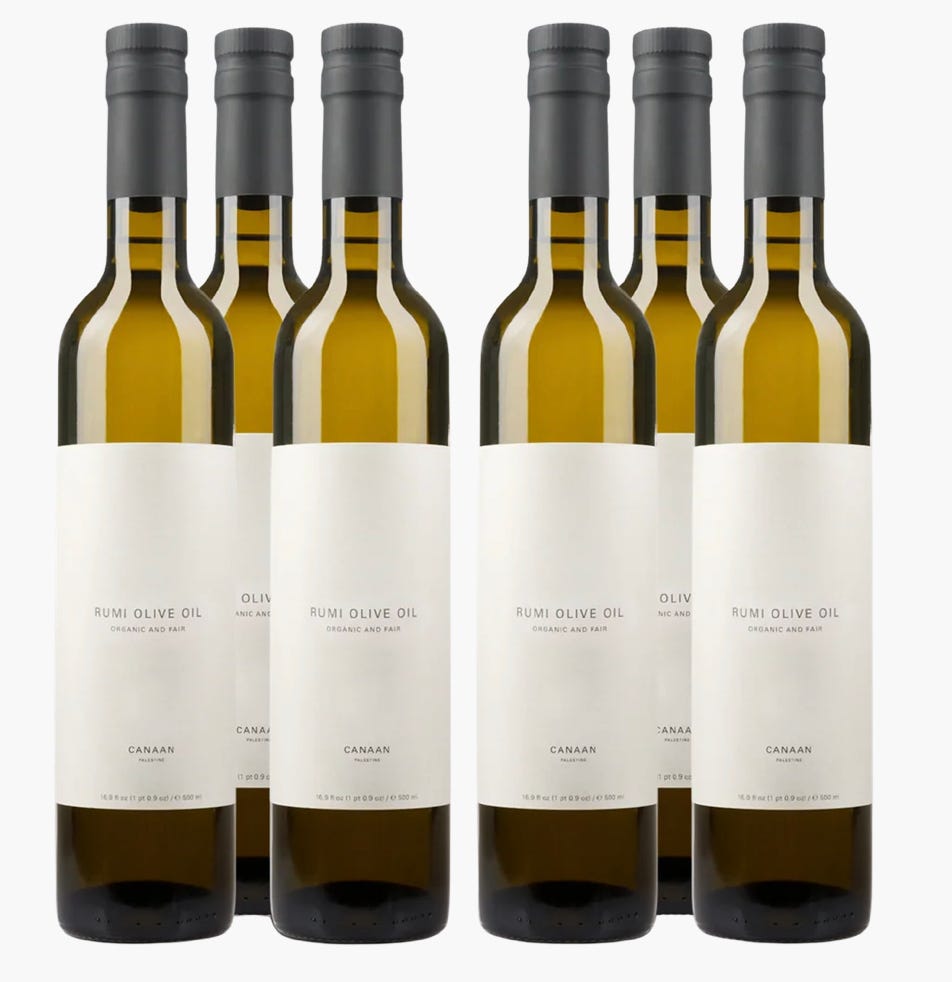
Canaan Fair Trade: A Leading Natural/Specialty Brand
“Canaan works with over 1,000 artisan family farms spanned across 43 different villages. We are engaged year-round with these communities, committed to long term partnerships with fair trade principles that ensure transparency, full direct payment, fair prices and purchase guarantee. Canaan was founded on the principles of empowering traditional farming communities. Agriculture is the most significant sector in Palestine and we seek to ensure its viability within the modern economy. We’re committed to increase the value returns of such farms, invest in their communities and make them competitive in the marketplace while carving them a space in the modern world.”
They use Fair Trade principles and Regenerative Organic practices in a value chain of small family farms across Palestine, “a living system where agriculture becomes a bridge, offering the world not just sustenance, but a model of harmony, resilience, and hope. Rooted in fair trade principles, they ensure transparency, direct payments, fair prices, empowering traditional farming communities”.
Their impact includes $1,210,000 USD Contributed to the fair trade community, 2,400+ Farmers integrated into exports value chain and 50+ Cooperatives established.
Durgham Muhameed is one of the farmers:
“Give to the land, and it will give to you… When you treat it like a human, it will treat you with dignity; it’s a reciprocal relationship built on respect.”
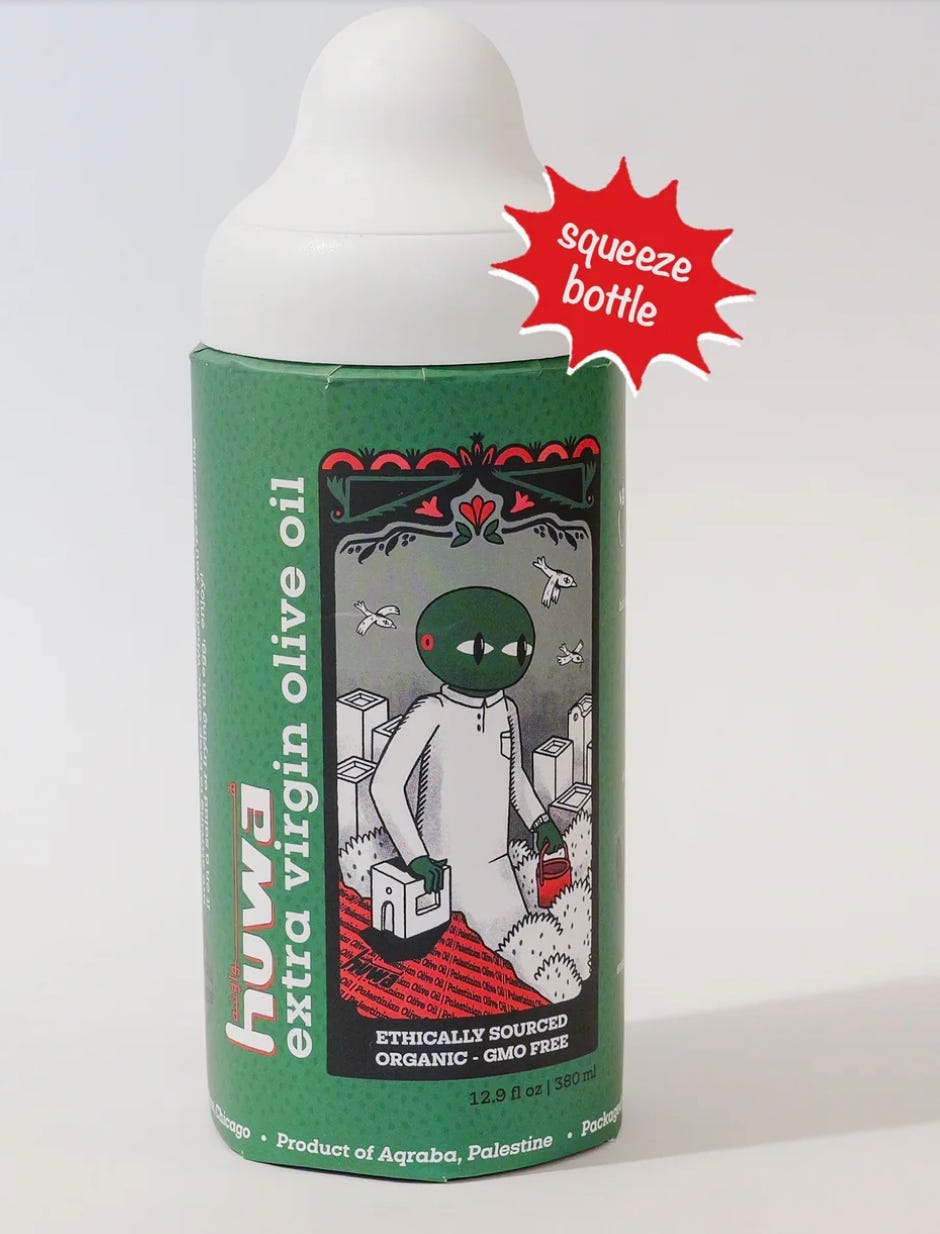
Huwa Olive Oil: Organic, Fair Trade and Hip AF
“The family that produces Huwa olive oil has been nurturing olive trees in Aqraba,Palestine for hundreds of years. Their Extra Virgin Olive Oil was handcrafted with the indigenous traditions we are striving to keep alive, including no chemical fertilizer, completely rain-fed trees, organic, cold pressed single origin that pays farmers up to 3x as much as big oil.”
Huwa has some of the best branding out there.
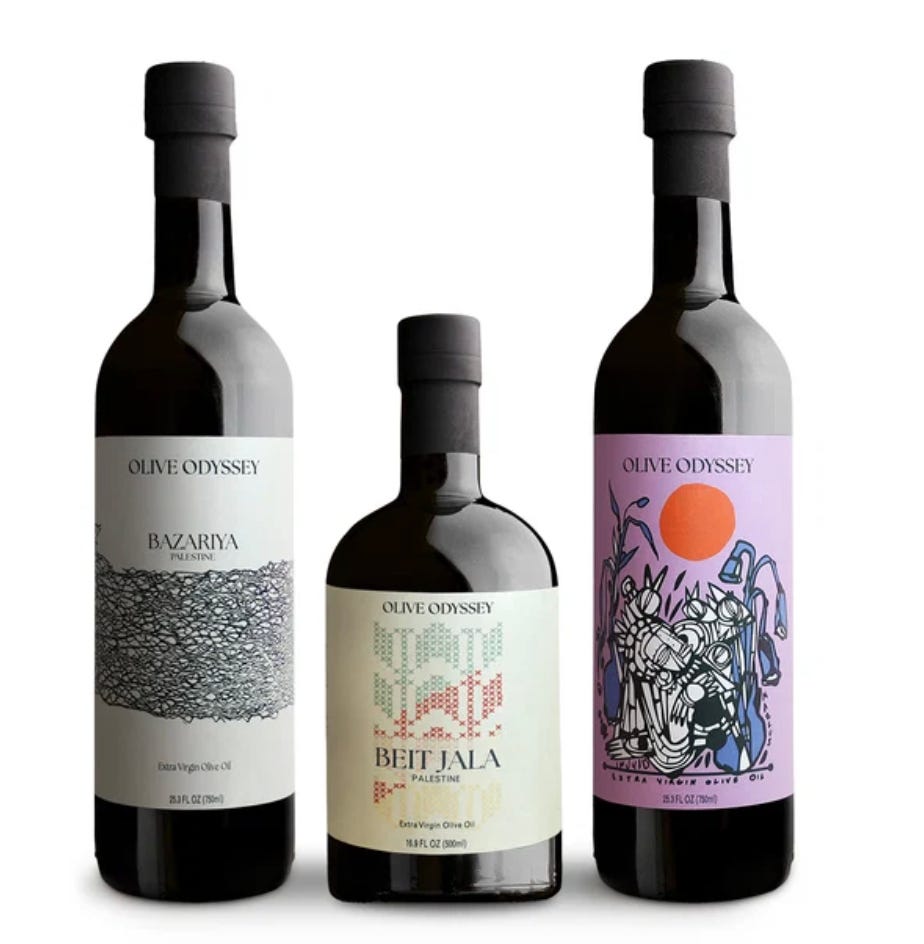
Olive Odyssey: A Deep Legacy of Farming
Their mission is to tell the story of the Palestinian people through the medium of olive oil. As a collective, they work hand in hand with Palestinian farmers who tend to their olive trees with unwavering dedication. Organic cultivation is their cornerstone, and their farmers abstain from artificial interventions, cultivating olive trees in harmony with the rhythms of the land.
“Palestine’s landscape is defined by its olive groves. With over 9 million trees covering the West Bank alone, olives are not just a crop, but a crucial part of Palestinian identity. These ancient trees paint the hills in silvery-green hues, their gnarled trunks telling stories of generations past.”
Olive Odyssey Farmer and Producer Profiles:
Shireen Najjar is one of the few female olive oil producers in Palestine, and a voice of both heritage and innovation. Together with her husband, who works as a quality assurance manager in the industry, she oversees the entire journey from tree to bottle.
Mustafa Turabi is known across Palestine as one of the country’s master engineers of olive oil production. Over the years, he has helped build and calibrate more than fifty production centers — all while running his own family press in Sarra, near Nablus.
Basheer Al-Sous tends groves that have been in his family for more than four generations. His knowledge blends traditional hand-picking and modern steel-drum pressing—an approach that honors the past while perfecting the present.
PalBox
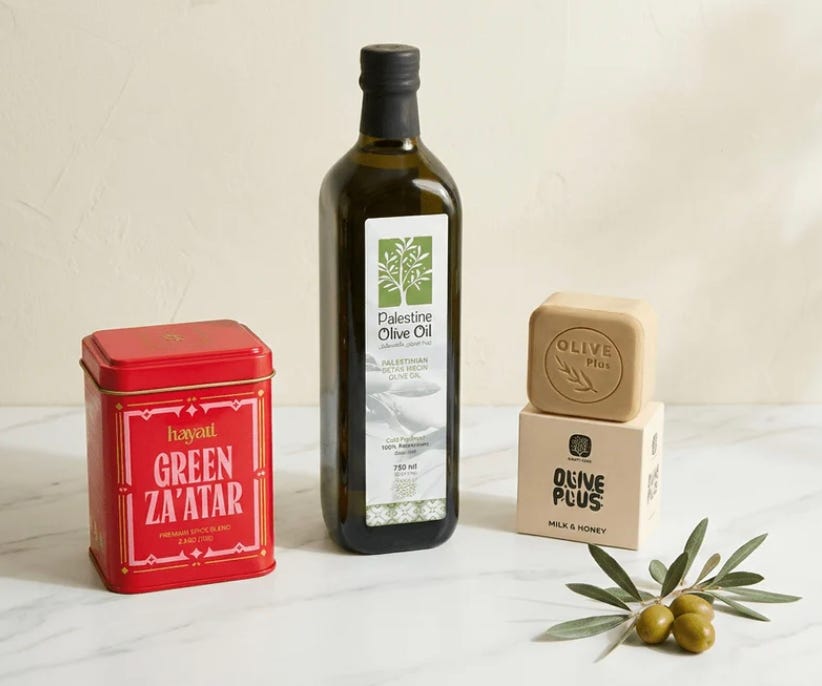
Palbox is a Palestinian-American family business delivering authentic food, handmade crafts, and cultural artwork from Palestinian farmers and artisans directly to your door.
Further resources from The Checkout Podcast:
Interview with Nasser Abufarha of Canaan Fair Trade
Interview with Jewish Solidarity Activist Ora Wise
Interview with Palestinian/Syrian Chef Reem Assil of Hospitality for Humanity
Further Learnings:
Naza Movie: Updated Link.
Sami Tamini cookbooks (Palestinian)
Online Course led by Professor Zachary Foster (American Jewish scholar)
Omar El Akkad, One Day, Everyone Will Have Always Been Against This: National Book Award (Palestinian journalist)
Ta-Nehisi Coates, The Message (American journalist)
Mahmoud Khalil, No Land to Stand On (Palestinian/American scholar)
Rashid Khalidi, The Hundred Years War on Palestine (Palestinian/American scholar)
Ilan Pappe, The Ethnic Cleansing of Palestine (Israeli scholar)
Norman Finkelstein, Gaza: An Inquest Into Its Martyrdom (American Jewish scholar)
Gideon Levy, The Punishment of Gaza (Israeli journalist)
Amira Hass, Shifting Sands (Israeli journalist)
Avi Schlaim, Genocide in Gaza (Iraqi Jewish Scholar)
Standing Together Movement (Israeli Palestinian solidarity organization)
Official BDS Movement Page
Breaking The Silence: Israeli NGO of Military Veterans
B’Tselem Israeli Human Rights Campaign
Omer Bartov Interview (Israeli scholar)
SIGN UP FOR THE CHECKOUT, Errol Schweizer’s excellent roundup of the (multi) trillion dollar grocery industry.
❤️✊
This is GREAT! Thanks for so much information - I'm keeping it on hand.
I'm sure everyone knows that Brad Lander, Congressional Candidate for New York's 10th district, was detained today by Israeli forces while volunteering for the olive harvest in Palestine, along with other volunteers, rabbis among them. They were released several hours later. Arrested by Israelis in Palestine??? I am so sick of these people - they wanted Israel, they got Israel, they should stay in Israel.