

If you’ve not yet signed up to receive *Offshoot, you’re missing out!
The Price of Passage
A conversation with Raj Patel
May 20, 2026
Industrial agriculture is deeply tied to fossil fuels. Natural gas is used to make fertilizer, oil powers mechanized farming, and the food system itself depends on enormous energy-intensive supply chains to transport, refrigerate, process, and distribute food across the world. The fragility of the globalized industrial food system lies not only in how interconnected it is, but in its dependence on endless extraction, cheap energy, and uninterrupted trade flows. A blockade or escalation in one node can rapidly cascade into food shortages, rising prices, stalled harvests, and deepening hunger thousands of miles away.
What we are witnessing now, with the US-led war on Iran resulting in the disruption of trade through the Strait of Hormuz, is another chapter in this long history of violence. Nearly a fifth of the world’s oil and gas shipments move through this narrow corridor, and the escalation has already toppled energy and food systems worldwide.
While no one is spared of the impact of this war, these shocks do not move evenly through the world. And because these crises ripple across supply chains, speculation, inflation, and everyday life in ways that are often difficult to fully see while we are living through them, it can be hard to grasp the scale of what is unfolding. Understanding what this could mean over the next few months, and even years, requires tracing the deeper connections between war, energy, food, debt, and survival. What will continued escalation mean for food supply and prices; which communities will bear the heaviest burden; and how do we build resilience within an increasingly fragile global food system?
To help us make sense of this moment, AGC staff member Rohan Antony spoke with food systems scholar and activist Raj Patel, whose work has long traced the links between empire, capitalism, agriculture, and hunger. We hope this conversation leaves you with as much clarity and insight as it did for us.
We read your article on the closure of the Strait of Hormuz and the ongoing energy crisis. We wanted to start with just a little bit of a background on industrial agriculture and its dependence on synthetic fertilizers and on fossil fuels. How is it that food access came to be so tightly coupled with volatile energy markets in the first place? And what generally happens to food production globally when energy supply chains are disrupted?
Raj: Well, we have to understand that modern industrial capitalist agriculture has always been hitched to the problem of fertilizer and fuel. Most people know about the Haber–Bosch process, the way synthetic nitrogen fertilizer is manufactured. What’s often missed is that the same chemistry underwrites both fertilizer and explosives. When the British blockade cut off German access to Chilean nitrates during the First World War, Haber–Bosch scaled up to keep German munitions factories running. After the Second World War, those same nitrogen-fixing plants were repurposed to industrial fertilizer, just as the United States was prosecuting the Cold War through the Green Revolution. It’s called the Green Revolution because, as the USAID administrator William Gaud put it in 1968, it was meant to forestall a “Red Revolution.”
So chemical fertilizer has been baked into agriculture for over a century, and it runs on fossil fuels. Haber–Bosch makes ammonia under enormous heat and pressure, and then urea—the main agricultural fertilizer—is cooked from that ammonia using natural gas. Producing synthetic fertilizer requires vast quantities of natural gas. All of it is now hostage to the flow of gas through the Strait of Hormuz. Even the modest commodity price increases we’re seeing are already reaching kitchens—in India, Egypt, and across the Gulf—through the diesel that moves food and the cooking gas that prepares it.
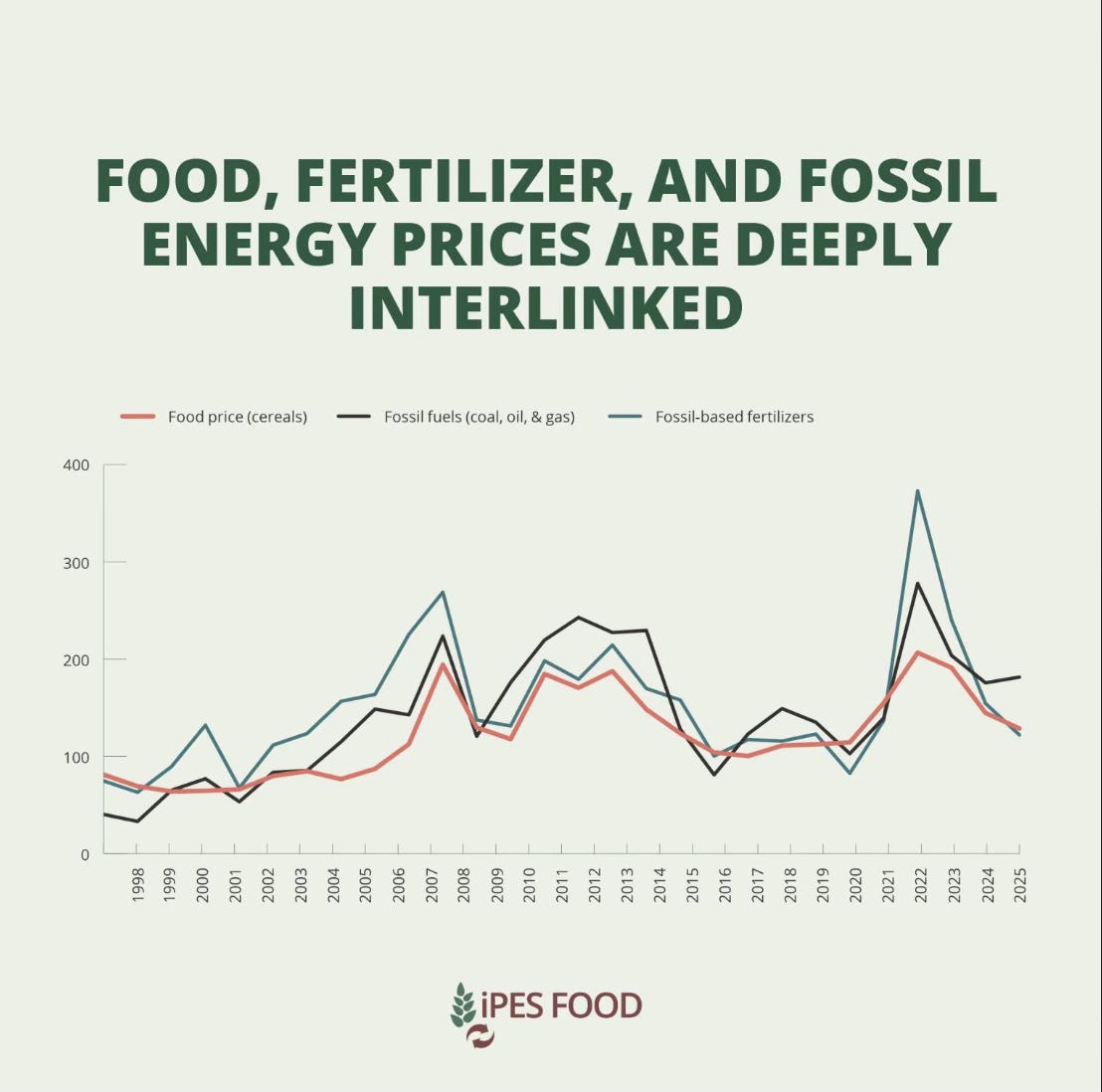
If you live in India, for instance, you’ll notice that roadside dabbas are finding it increasingly difficult to stay afloat. The cost of the natural gas they use for cooking has risen, and so has the price of diesel used to transport food. That is already beginning to spark food price inflation, certainly for cooked food, and also for food that’s been delivered through these supply chains that are hostage to fossil fuels.
And I imagine you’re seeing that in India, right?
Yes, in India, we’ve been facing a major LPG crisis since the closure of the strait. There are long queues at distribution centres, with thousands of people waiting to access cooking gas, and refill prices in many places have nearly doubled due to shortages. Black market rates are several times higher.
The petrol and diesel prices were relatively stable, but that’s largely because of elections. The government had been cutting taxes to hold prices down, but now that the results are out, these costs are catching up.
Raj: That’s the other thing. In countries without significant domestic natural gas reserves, the only real short-term option is to increase subsidies. India’s fertilizer subsidy is already in the billions of dollars - roughly $12.7 billion on urea alone this year - and that’s money that could be going to a lot of other things. The commitment to keep fertilizer prices low will hold past the elections, because farmers are both a core constituency and the people producing the food everyone in India absolutely needs. But for countries without the borrowing capacity to absorb several billion dollars of subsidy, things will have to be cut back. That’s a huge problem.
At the same time, there are companies making a killing. Yara, the Norwegian fertilizer giant, posted record profits during the Ukraine price spike and is up sharply again. Almost every fertilizer major has seen its stock climb since February - some more sharply than others.
And, I guess this crisis is widely being discussed as an energy crisis. But it’s equally also a food crisis that, maybe, is already happening, and also stands to get a lot worse in the coming months.
Raj: I love that you recognise the fact that things are awful right now. And you’re right: 30% of globally traded fertilizer passes through the Strait of Hormuz, and the concentration is even sharper for specific products. Roughly 49% of seaborne urea, 30% of ammonia, and 44% of the world’s sulphur trade move through the Strait. Sulphur is the feedstock you need to turn phosphate rock into usable fertilizer, so when one chokepoint seals, you’re disrupting nitrogen and phosphate fertilizer simultaneously.
Different countries are exposed differently. Even the US, which produces most of the fertilizer it uses, is feeling the price shocks because we’re connected to world markets — particularly for farmers who didn’t lock in their fertilizer on time. If it’s this bad here, you can bet it’s worse almost everywhere else.
We saw your post on the global fertilizer shortage and the map of import vulnerability, and we were wondering if you could expand a bit on your analysis. Which countries are the most vulnerable, and what this disruption looks like in terms of long-term food security in these regions?
What the map shows is that for 11 of 12 months in the year, there’s at least one zone of the world in its peak fertilizer procurement window — a month when application is critical. Right now, in the next eight weeks or so, that’s South Asia: Sri Lanka, Bangladesh, and India in particular. India claims it has enough fertilizer to get through the imminent Kharif planting season, but it’s already spent $12.7 billion on urea subsidies this year, and that number will climb when Rabi planting begins. Bangladesh and Sri Lanka are far more exposed.
Then there are other places — Egypt and Ethiopia in particular — where it’s not clear they have the capacity to provide for themselves on the world market. Egypt was a major fertilizer producer until its gas supply from Israel was cut in mid-2025 during the earlier round of fighting, and again after February. The world market price has since gone through the roof.
Longer term, sub-Saharan Africa imports about 90% of its fertilizer. With USAID — which had long been pushing this unsustainable model — now being dismantled, those farmers are even more exposed. None of this is to say we need more fertilizer. What we need is a transition plan away from fertilizer-dependent industrial agriculture and into agroecology. But in the short term, absent those plans, this is a disaster.
The gravest problem may be in Brazil, which is about 85% import-dependent, and whose July-to-September planting window is the most fertilizer-sensitive of the year. A weak Brazilian soy crop has knock-on effects across a range of other commodities. So that’s the production side.
The consumption side is just as serious. If you’re spending more on fuel and cooking gas, you have less to spend on food. Two crises at once. In the minority world we’re already seeing shrinking entitlements and a generalised war on the poor. In the Global South, that neoliberal impetus has been at work for decades; this will be the lagging indicator of dispossession as fuel prices stay high. Money will have to come from somewhere, and that means hunger.
In moments of crisis like this, we see hunger levels rising, and at the same time, agribusiness lobbies, commodity traders, and others often report record profits. What does that tell us about how the system is structured, and who it ultimately serves?
Raj: Here’s one way to think about it. Everyone agrees chokepoints are bad — that’s maybe the one lesson people can agree on from this crisis. But oligopoly is a chokepoint.
Take this idea that what we need is more fertilizer production. Who stands to profit? The handful of fertilizer companies already manufacturing it. We’re not suddenly going to have free markets or new entrants. The proposal just gives the existing oligopoly more shop windows and more factories to produce the same thing.
When a few companies control a vast share of the market, that’s exactly what a chokepoint looks like. It used to be ABCD, now it’s effectively ABCCD: Archer Daniels Midland, Bunge, Cargill, COFCO (the Chinese state trader), and Louis Dreyfus. Their combined 2022 profits roughly tripled relative to the 2016–2020 average; Cargill alone posted $177 billion in revenue in FY2023. Yara, the Norwegian fertilizer giant I mentioned, posted record profits during the Ukraine spike. The chokepoints are becoming more concentrated, not less. Bunge has just closed its $8.2 billion merger with Viterra — a deal the European Commission waved through in Phase 1, without the deeper investigation it warranted.
These are structural chokepoints in the global economy, created and enabled by governments operating in the interests of the capitalist class. Those are the chokepoints we should be focused on. Deconcentration is the answer — not building more of the factories that profit the same corporations who benefited from the crisis in the first place.
To close, I want to step back for a moment. Over the course of your career, you’ve witnessed multiple food crises, and what we’re seeing now doesn’t feel entirely new. It’s another disruption, another supply chain shock, another moment of strain in a deeply fragile food system.
We’ve seen these patterns. We saw it during the pandemic, during the Russia–Ukraine war, the shut down of USAID. Every time there’s a disruption like this, millions of people are pushed into hunger and poverty. It feels like history repeating itself again and again. If this crisis is yet another warning, what is it asking us to fundamentally rethink about food, power, and globalisation?
Raj: You’re right. This is the fourth food price spike in 15 years: 2007–08, 2010–11, the Ukraine crisis, and now this. But I think things are changing. In the minority world, more and more people are thinking about the affordability crisis as a way of re-articulating demands on the state.
The state itself has been so hollowed out — through the death throes of neoliberalism, the rise of the far right, this more toxic insulation of the state from democracy. Whatever happens after Trump or Orbán or the various other tyrants of the world, the state will need to be rebuilt in some form.
The neoliberal branch of the Democratic Party and its analogues in the Global South will push for a minimal reconstruction. But there are also forces saying: if we’re going to meet this affordability crisis and avoid yet another food price spike, the move is into public grocery, public food supply, public food chains. This is genuinely ambivalent, because France is saying what we need is a French food sovereignty law that deploys the military all along the supply chain so the French always have access to their bananas, their coffee, their chocolate.
There’s another way of thinking about what it might mean to render supply chains public — the vision behind Mamdani’s public grocery announcements in New York, and from some of the plans coming out of the New Democratic Party in Canada. I’m more optimistic about those kinds of state reconstruction in the wake of this far-right burst, which has eroded some arms of the state — though, of course, not the military arm.
That’s something to think about, maybe for a future conversation. If there’s a warrant to rebuild certain kinds of public infrastructure, and it comes through meeting the challenge of affordability and if enough working people force a shift in the discourse of political parties, then what does it look like? What does it mean to have public supply chains? That’s where I’m watching movements move into, and where I think real political work now lies.
To learn more about how the war, energy shocks, fertiliser disruptions, climate breakdown, debt, and corporate concentration are reshaping global food systems, and what alternatives could build greater resilience through local production, agroecology, regional cooperation, and food sovereignty, read this latest report by IPES Food

AGC was honoured to support the Earthkeepers Vs AI Empires convening from 2nd to 4th May, in Lusaka, Zambia, bringing together peasant and indigenous groups, advocacy, campaigning and research organisations, as well as digital rights movements from all over the world. The gathering held space to collectively examine how the rapid expansion of AI infrastructure is accelerating extractivism, deepening colonial patterns of resource extraction, and reshaping struggles over land, labour, and energy. It was a beautiful space where we shared poetry, art, strategy, and visions for the future, grounding ourselves in collective imagination and care. We return energised by our shared comradery in resistance, and the reminder that the struggles for land, climate, technology, and justice are deeply intertwined. Read this beautiful context paper summary by our dear comrade Esther Mwema and illustrated by the incredible Chaila Putta.

This position paper by La Via Campasina on Food Sovereignty in the Face of War, Imperialism, and the Hunger of Peoples Around the World, that argues that today’s food crises cannot be separated from war, imperialism, and corporate control over land, energy, and agriculture. The paper frames our current food crises as not simply as an agricultural question, but as a political struggle against empire, militarism, and corporate concentration. It calls for true food sovereignty: rebuilding local and regional food systems rooted in agroecology, agrarian reform, peasant farming, Indigenous land rights, and democratic control over food production.
This article by GRAIN that argues that Big Tech’s growing influence over agriculture is not just about innovation or efficiency, but about expanding corporate control over food systems through data, AI, and digital trade agreements. The piece warns that companies like Microsoft, Amazon, Google, and Meta are increasingly converging with agribusiness giants to capture vast amounts of agricultural data, with very little public oversight. It calls to build democratic, community-controlled alternatives to corporate digitalisation, highlighting how peasant organisations, Indigenous movements, delivery worker unions, and right-to-repair campaigns are already developing more local, cooperative, and agroecological approaches to technology and food systems.