

1. Trump: Good luck with your home. You’ll get one soon.
In the 2026 State of the Union Address, Trump offered this:
Another pillar of the American dream that has been under attack has been home ownership. With us tonight is Rachel Wiggins, a mom of two from Houston. She placed bids on 20 homes and lost all of those bids to gigantic investment firms that bypassed inspection, paid all cash and turned all those houses into rentals, stealing away her American dream. She was devastated. Stories like this are why last month I signed an executive order to ban large Wall Street investment firms are buying up in the thousands single family homes.
And now I’m asking Congress to make that ban permanent, because all this for, people, really, that’s what we want. We want homes for people, not for corporations. Corporations are doing just fine. Rachel thank you very much. Good luck with your home. You’ll get one soon.
That ‘corporations are doing just fine’ because they’ve enclosed so much wealth and land is not something the Commander-in-Chief is likely to mention. The fight for a place to call home, and ways to keep those homes out of the hands of the powerful, isn’t just a US worry. There are serious conversations about land reform happening this week at ICARRD+20 in Cartagena. Below, a quick intro to ICARRD, and a couple of pieces about land reform and law that have recently come my way.
2. ICARRD+20 for beginners
In 2006, the FAO convened the International Conference on Agrarian Reform and Rural Development (ICARRD) in Porto Alegre, Brazil — a landmark gathering that brought together governments, civil society, and social movements to reassert land reform and rural development as central to any serious agenda for food security and poverty reduction. The Porto Alegre Declaration that emerged from ICARRD was a hard-won document, affirming principles of food sovereignty, recognizing the rights of peasants and Indigenous peoples to land and territory, and committing states to genuine redistributive agrarian reform. It was, in many ways, a counter to the market-led land reform orthodoxy that had dominated development thinking since the 1980s — an insistence that land is not merely an asset to be efficiently allocated, but a foundation for livelihoods, culture, and democratic life.
Two decades on, the world ICARRD+20 convenes into looks dramatically worse on almost every front. Land grabbing has accelerated across the Global South, with financialised agriculture and carbon offset schemes adding new vectors of dispossession to old ones. Climate breakdown is rewriting the conditions of possibility for smallholder farming across entire regions. And the corporate consolidation of food systems — seeds, inputs, processing, retail — has deepened to a degree that would have seemed alarming even in 2006. ICARRD+20 is a reckoning with how comprehensively the commitments of Porto Alegre have been betrayed, and a test of whether the international community has the political will to chart a genuinely different course.
3. Common law vs civil law
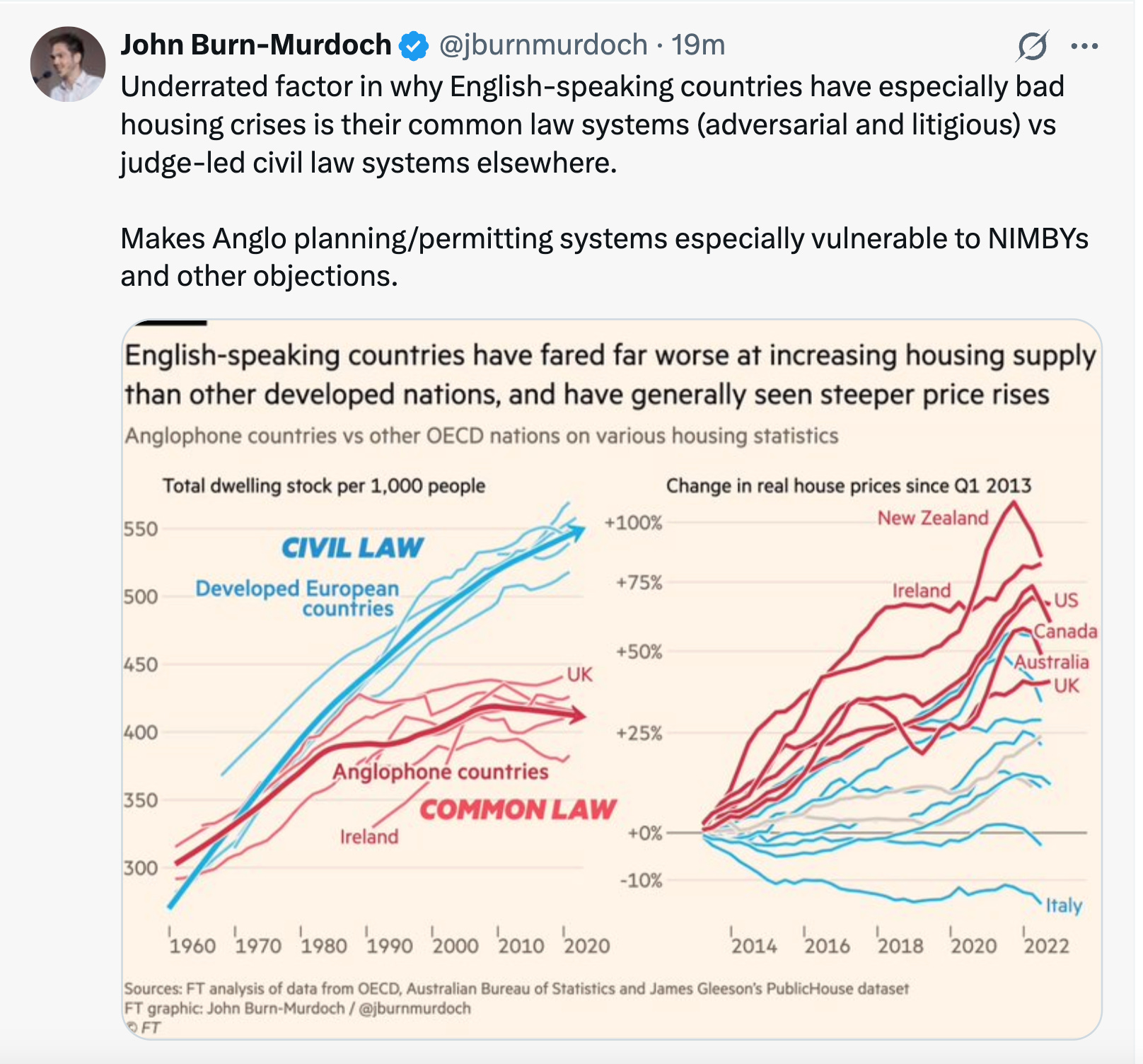

This reminded me of the politics of civil land law, discussed by George Mészáros:
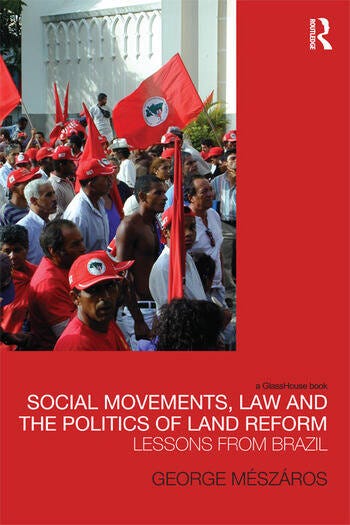
The gist of his argument, available here, is that while civil law and the Napoleonic code might make it easier to make a public use argument for social movements occupying land….
4. …to get land reform, movements need to do land reform
In general, the groups that understand that forgiveness is easier to find than permission have been the corporate land grabbers—capital grabs back. But people’s movements aren’t sitting outside courthouses with folded palms. Here’s a recent discussion from the People’s Coalition on Food Sovereignty:
5. Community land trusts from the FT
If butting up against the state’s armed forces isn’t quite where you’re at, yet, there are gentler experiments to try, as Sarah Langford writes in the FT:
Fordhall stakes a claim as England’s first community-owned farm; it was established in 2006, just 24 hours before the tenants were due to be evicted. Siblings Ben and Charlotte Hollins had returned from university to their childhood home to find the organic farm — the tenancy of which had been held by the family for four generations — broke, with buildings in disrepair and their father left with few choices. Necessity being the mother of invention, they decided to offer £50 “community shares” to anyone who wanted to buy them. Good press coverage and committed door-knocking raised their £800,000 target in six months. Twenty years later, Charlotte Hollins runs the Fordhall Community Land Initiative, a charitable Community Benefit Society (CBS), while her brother rents the farm and buildings under a conditional 100-year tenancy from the more than 8,000 shareholders.
This radical way of co-owning a farm in a country where less than 1 per cent of the population owns half the land seems to be catching on. Community ownership has grown by 59 per cent over the past decade, according to a 2025 report published by the Plunkett Foundation, a charity supporting rural areas to own and run their own businesses….
…while many choose the trust route, it seems community ownership through a CBS is becoming a promising legal model empowering communities to raise both funds and a sense of community investment. While it may seem odd to ask people to invest in shares legally barred from delivering maximum profit, investing in the desirability of an area can be a financially savvy move.Proof that a rising tide lifts all boats, even at a small scale, can be found on the Pembrokeshire coast. The CBS regenerative seaweed and shellfish farm Car-y-Mor has generated a reported £300,000 in turnover since 2019, created 20 year-round jobs and increased local crop yields by 24 per cent through a seaweed-based bio stimulant trial. The initiative also restores marine and soil biodiversity. Shares in its community ownership can be bought for £1.