

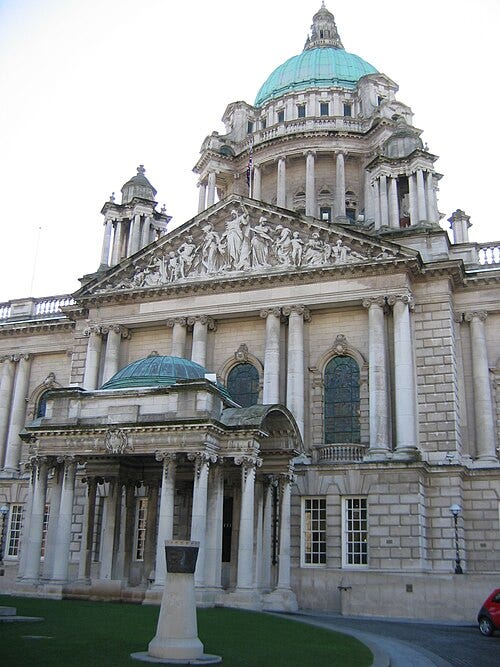
Belfast City Hall/ Itub CC BY 3.0, Wikimedia

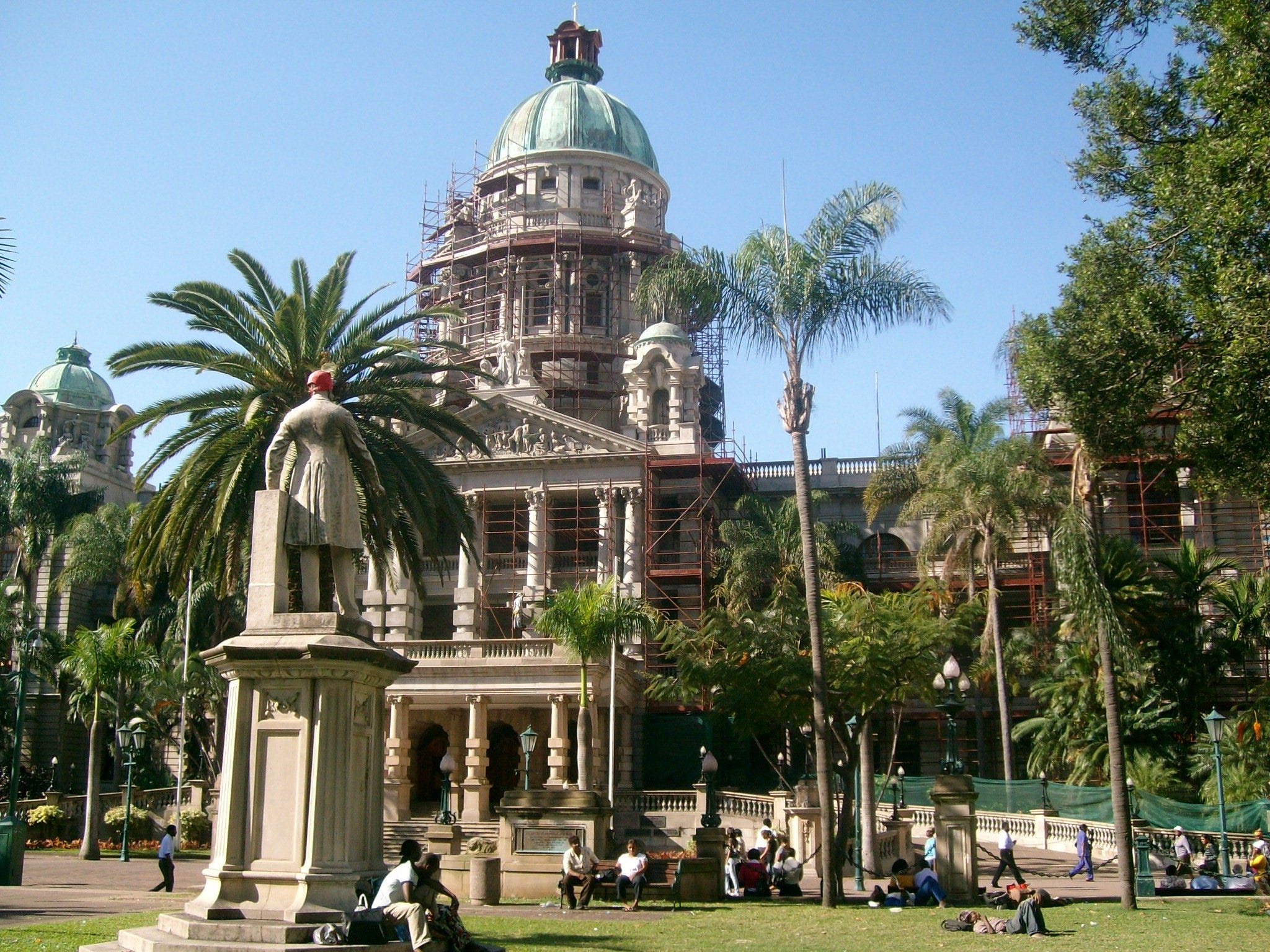
Durban City Hall A3albOwn work/ CC BY 3.0 Wikimedia

The two buildings above are almost exactly the same. The same Edwardian Baroque, the same dome, the same allegorical statues of commerce and industry along the façade. Durban’s pediment says “unity, patriotism, and Great Britain.” In 1903 Durban’s architect, Stanley Hudson, set about copying Belfast’s new city hall. In 1910, the year the Union of South Africa was founded, he unveiled the result, a more or less stone for stone replica. The empire had a house style for civic confidence and a limited imagination. Hence Belfast-on-the-Indian-Ocean (though, if we’re being faithful to the cliché, it’s Belfast-on-the-uMgeni).
The resemblance has outlasted the stonework. This month masked men in Belfast marched to migrants’ doors and burned families out. In Durban, as many as ten thousand people driven from their homes are penned in a single field while the state gets on with deporting them.
There is an older echo. In 1921 Belfast’s hall became the provisional seat of the parliament of a newly partitioned Northern Ireland. The building through which Durban could see like a state was itself a monument to drawing borders around who belonged and who did not.
None of the present violence is improvised. Writing about Belfast this week, Richard Seymour calls it distributed violence: never quite ordered from above, never quite spontaneous, its work of incitement and arson smeared across a loose network of agitators and after-the-fact apologists. It’s part of a reactionary international. In Belfast that includes Elon Musk, whose posts researchers judged instrumental to the riots. In Durban it is March and March, an astroturfed outfit with a well-funded media operation and the backing of the uMkhonto weSizwe Party.
The official account, in both countries, is that this is about numbers. Too many migrants, too few jobs, public services worn thin. It is a convenient story and a false one. Migrants are about 4% of South Africa’s population. They did not produce its 44% unemployment, its captured state, its political assassinations or its hunger, any more than refugees dug the potholes in County Antrim.
As Progressive International observes, scapegoating does one thing dependably: it turns public anger away from the people who caused the misery, and public attention away from anyone with a plan to end it. Seymour’s question for Britain is the question for South Africa. Why is ethnic purification always the answer offered to social ruin, and why do the people at the very bottom so often refuse to be complicit in it?
In 2025 a coalition of grassroots organisations, represented by the Socio-Economic Rights Institute, won a judgment against Operation Dudula in the Gauteng High Court. The court barred the group from demanding people’s documents, harassing foreign nationals and blockading schools and clinics, and restated the otherwise obvious point that only the state, and not a man in a borrowed uniform, may ask you who you are. The organisations doing this work pay for it.
Abahlali baseMjondolo, the country’s largest movement of the poor, has been on the front line throughout, and its members have been threatened with assassination and with necklacing. Yet still they march and organise.
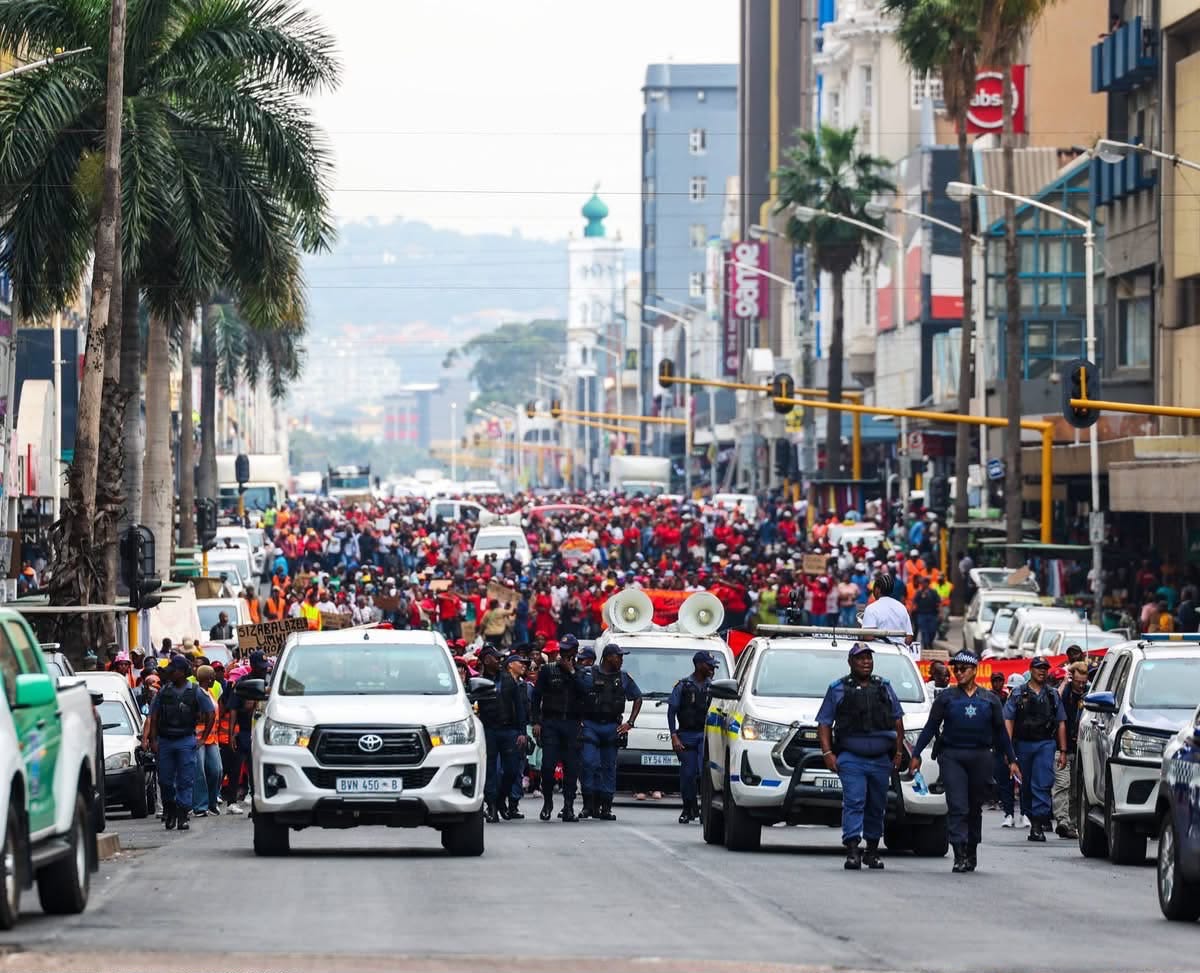
Its founder, S’bu Zikode, has spent two decades being told he is about to be killed. He has spoken out plainly against the pogrom regardless, and has been threatened with death for it. None of this is new to him.
The demand the Progressive International is making of Pretoria is not complicated. Act against the people organising the violence. Enforce the court orders that already exist. House and support those who have lost everything. And drop the double act of condemning the mob while ventriloquising its grievances. A government that recites the marchers’ talking points about migrants and jobs, and that has arrested more than forty thousand migrants this year, is not fighting the fire. It is fanning it.
The South African state is sensitive to how it looks abroad. That is the one piece of good news, and very nearly the only reason a sentence like this one is worth writing. What is happening in Durban is being filed, by officials and by much of the press, under migration. It is not a migration crisis. It is a crisis of organised cruelty, conducted by people with names and addresses and party affiliations, and tolerated by a government that could stop it and has chosen not to.
Updated to add Progressive International’s statement (and fix some grammar):
Right now, South Africa is witnessing the accelerated escalation of a coordinated campaign of xenophobic terror by March and March, an ethnically inflected Durban-based anti-migrant organisation closely associated with the uMkhonto weSizwe Party (MKP).
Small groups of armed men are moving through impoverished and working-class neighbourhoods, forcing families from their homes and shuttering or seizing their businesses. Everyone the mob deems ‘foreign’ is at risk — documented or not — and South Africans of minority ethnicities have also been targeted.
March and March rose to prominence earlier this year when it sought to bar the children of migrants from entering school. Since then it has also blockaded clinics, and hospitals, demanding that people produce identity documents; organised intimidatory marches; and engaged in repeated street thuggery.
In this latest effort to channel the fury of an immiserated society toward its most vulnerable, March and March announced 30 June as a “deadline” for all undocumented migrants to leave the country, escalating intimidation on the ground with a vast social media operation in which death threats have become routine. Xenophobic intimidation and violence has now been decentralised and often operates through locally organised thuggery.
There have already been murders, and thousands of people have been driven from their homes at the 30 June deadline nears. Ten thousand displaced people are now sheltering in a park in Durban in abject conditions. The governments of Nigeria, Ghana, Malawi, and Mozambique are urgently repatriating their citizens.
The right in South Africa has a long and lethal history of inciting xenophobia — the worst of these waves came in 2008, when 62 people were killed, 21 of them South Africans, many from minority ethnicities, and more than 150,000 displaced. Many now fear that if urgent action is not taken there could be a pogrom of even greater scale.
The cultivation of xenophobic politics feeds on an acute social crisis. Unemployment is among the highest in the world at 44 per cent, and a catastrophic 70 per cent among 15-to-25-year-olds. Hunger and violence are endemic; pervasive corruption, collapsing public institutions and services, and regular assassinations of grassroots activists have hollowed out faith in democracy itself.
On 17 June the country’s four largest trade union federations — COSATU, FEDUSA, SAFTU and NACTU — declared: “Migrants must not be made scapegoats for failures they did not create. Removing foreign nationals from workplaces, communities or public spaces will not reopen factories, repair municipalities, strengthen public healthcare or create sustainable jobs. The frustrations of local communities must be addressed by fixing the economy, creating decent work and rebuilding the state.”
The federations warned, too, that the surge in anti-migrant mobilisation is increasingly coordinated and politically orchestrated — designed to fracture the working class and to shield the architects of poverty, unemployment, and collapsing public services from accountability.
Progressive forces are fighting back. Abahlali baseMjondolo, the South African Federation of Trade Unions (SAFTU), the Socio-Economic Rights Institute (SERI), and others face intense pressure and routine threats of violence as the atmosphere grows ever more febrile in the days before 30 June.
Progressive forces around the world must stand with all those who are living in fear in South Africa, including migrants, South Africans of minority ethnicities — and all the movements refusing to let the working class be turned against itself. Their fight is ours.
As disturbing as this is, it's like a spreading wildfire, going from continent to continent, country to country. But what exactly did people expect??? If people are displaced by unjust wars, genocide, greed, corruption, unchecked climate change, who can blame them for striking out and seeking safer ground? I certainly would, wouldn't you? And would you expect to have the door slammed in your face? The xenophobic reactions are such a discouraging show of our basest instincts - what has become of us? If people are lost, and have lost everything they call home, shouldn't we be making room for them and offering them succor? That's certainly what I would hope for if I was lost and scared and had only the clothes on my back (and maybe a child or two, or an elderly relative depending on me).